Highlights

Feb 22, 2008
Genetically Engineered Materials Science and Engineering Center (2005)

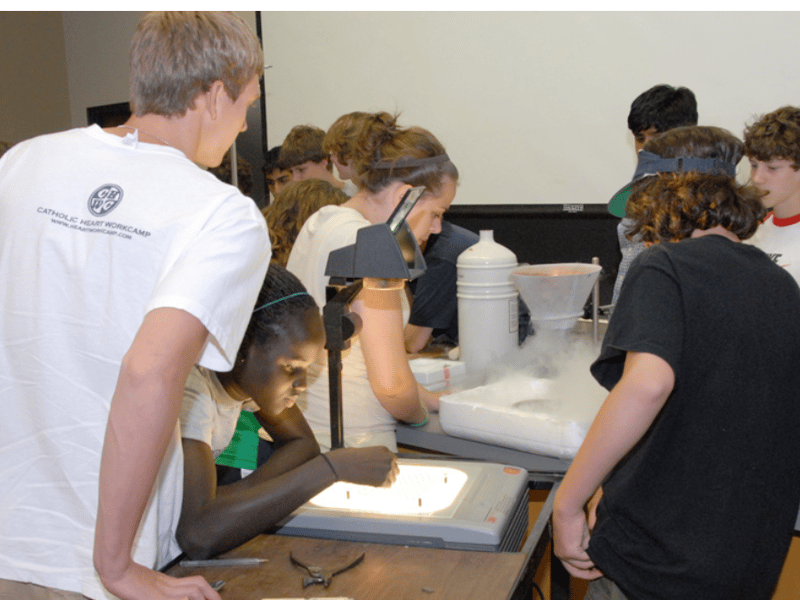
Multi-faceted Education and Partnerships at GEMSEC

With a particular focus on engaging and including Native Americans in its entire range of programs, GEMSEC is weaving a fabric of education offerings to seamlessly support and complement its research thrusts.
Feb 22, 2008
Princeton Center for Complex Materials (2014)

Self-Assembly of Soft Materials: A Multiscale Computational Approach

Seed and IRG 2: Maria Sammalkorpi, Mikko Haataja, and Athanassios Panagiotopoulos

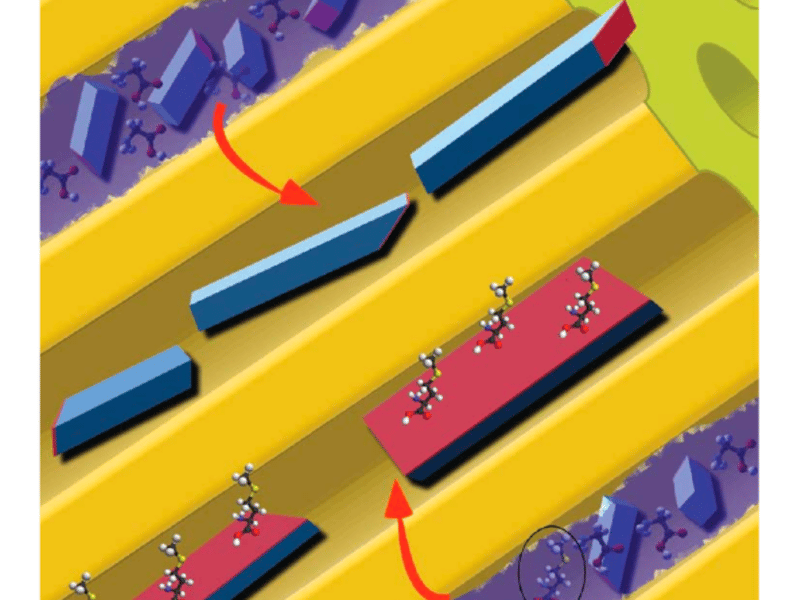
Surfactant adsorption at solid-liquid interfaces is important in many industrial processes, including corrosion inhibition, dispersion stabilization, and lubrication. Furthermore, surfactant adsorption may provide novel and exciting means to guide soft materials to self-assemble into a myriad of tailored shapes. Recently, PCCM researchers have made a breakthrough in elucidating the physical mechanisms behind surfactant self-assembly on a graphite surface [1].
Feb 22, 2008
Princeton Center for Complex Materials (2014)

Direct-Transfer Patterning on Three- Dimensional Surfaces

Xin Xu and Steve Forrest

While many approaches have been developed over the years to transfer patterns onto flat surfaces, faithfully transferring patterns onto curves substrates remains a major obstacle to the development of large-area electronics. Recently, PCCM researchers have successfully patterned domed polyester substrates with metal stripes (gold, silver, etc.). They employed a soft, pre-patterned elastomeric stamp coated with a thin layer of metal by electron-beam evaporation, bent into a complementary hemisphere.
Feb 22, 2008
Princeton Center for Complex Materials (2014)

Doping Affects Electronic Transport Through Molecular Junctions

Antoine Kahn and David Cahen (Weizmann Inst.)

Electronic transport through a junction formed between silicon (Si), a monolayer of alkyl chains (C14H29) self-assembled on Si, and a metal (M) is dominated by thermionic emission above the semiconductor barrier and tunneling through the insulating molecular layer [1].
Feb 22, 2008
Princeton Center for Complex Materials (2014)

Breaking the Mold to Produce Submicron Polymeric Gratings with Large Areas

L. F. Pease III, P. Deshpande, S. Y. Chou, and W. B. Russel

PCCM researchers have discovered a new method for making gratings: by prying apart two rigid plates that sandwich a thin, glassy polymeric film. The process fractures the film into complementary sets of ridges on each plate, with the ridges on one corresponding to the valleys on the other. The technique produces patterns with periodic spacing from 120 nm to 200 Â’µm, and the period simply scales as four times the film thickness, regardless of the molecular weight or chemical composition of the glassy polymer.
Feb 18, 2008
Princeton Center for Complex Materials (2014)

Si Nanowire Grids Polarize Down to 193 nm

Young-Rae Hong, Koji Asakawa (Toshiba), Doug Adamson, Paul Chaikin (NYU), and Rick Register

The continual decrease in microelectronic device feature size, captured in the famous "Moore's Law", has come in part from a decrease in the wavelength of light used in the photolithographic steps used to pattern these features. Today, the most advanced production photolithography uses 193 nm ultraviolet (UV) light from an ArF excimer laser. At such short wavelengths, control of the polarization of the light becomes critical for achieving minimum feature size.
Feb 18, 2008
Princeton Center for Complex Materials (2014)

An Electronic Density-Wave Turns into a Superconductor

Dong Qian, David Hsieh, Lewis Wray, Emilia Morosan, Robert Cava, and Zahid Hasan

At low temperatures, the electrons in most layered transition-metal chalcogenides undergo a phase transition into an interesting, highly-ordered state called the charge-density-wave (CDW), in which the electron density spontaneously acquires a weak, periodic spatial modulation. In a small subset of materials, the CDW state is destroyed and replaced by the superconducting state.
Jan 20, 2008
MIT Center for Materials Science and Engineering (2014)

A story of two spin off companies

Fundamental MRSEC research often leads to new technologies that in turn create innovative start-up companies. QD Vision and Luminus Devices are two exciting examples of this process. In both cases, MRSEC-supported research at MIT helped to develop the basic platform for these new technologies.
Nov 28, 2007
CPIMA — Center on Polymer Interfaces and Macromolecular Assemblies (2002)

Closing the Loop on Recycling: Can We Stop the oil-to-Landfill Treadmill?

James L. Hedrick, Robert W. Waymouth

Poly(ethylene terephthalate) (PET), a widely used engineering thermoplastic for carpet, clothing (fibers), tire cords, soda bottles and other containers, film, automotive, electronics, displays etc., will contribute several billion pounds of waste to landfills this year alone! According to the American Plastics Council, PET packaging was originally used for soft drinks, but packing applications today include other beverages such as water, juice, beer, in addition to other foods such as peanut butter and ketchup and a variety of other household products.
Nov 13, 2007
Materials Research Science and Engineering Center at UCSB

Chocolate Finally Understood: UC Santa Barbara and Nestle Uncover the Physics of Self-Aggregating Foods

Scientists from UCSB's Materials Research Laboratory (MRL) and the Nestle Research Center (NRC), Lausanne, Switzerland have resolved a long-standing problem in the self-assembly behavior of lipid molecules in water.