Highlights

May 22, 2015
UPENN Materials Research Science and Engineering Centers

Fractal Mechanical Structures

David Srolovitz & Shu Yang (Seed 5)

How can we wrap a 3d object with a sheet of paper without folds? Wrapping implies the ability to stretch as much as bend.  Using concepts from fractal geometry, we have designed and realized a new class of materials with unprecedented control of stretchability and bendability to conformally wrap any shape or expand to nearly any predetermined shapes.   Fractal cut sheets for controlled expansion
May 22, 2015
UPENN Materials Research Science and Engineering Centers

Research Experience for Undergraduates (REU): Celebration of the 600th REU Student at the Penn-MRSEC

Andrew R. McGhie & Mark W. Licurse

In 2015 we will celebrate the arrival of our 600th REU student in our NSF-supported REU program. This program started in 1989 with a small grant that supported 5 minority students. Over the following 26 years, we have averaged 23 students/yr by supplementing our MRSEC–supported students with an additional DMR REU Site grant that supported 10 students per year and some individual faculty contributions. Overall, 61% of our students were from under-represented groups (39% minority and 43% women) in STEM departments.
May 22, 2015
UPENN Materials Research Science and Engineering Centers

IRG-4 Plasmonic Enhancement of Upconversion in Nanorod/Nanophosphor Heterodimers

N. Engheta, C. B. Murray, C. R. Kagan (IRG4)

A central goal of IRG-4 is to use collective interactions between dissimilar nanocrystals to enhance the performance of their assemblies. Here we demonstrate plasmonic enhancement of optical upconversion luminescence within nanorod-nanophosphor heterodimers (Fig 1a-c). Using experiment and theory we are able to develop design rules for optimizing heterodimer geometry. The templated assembly process (Fig 1d-e) can be used for many other nanocrystal building blocks and for larger assemblies.
May 22, 2015
UPENN Materials Research Science and Engineering Centers

Understanding Plastic Deformation in Glasses from Single-Soft-Spot Dynamics

Andrea J. Liu (IRG 3), Robert A. Riggleman (Seed 3)

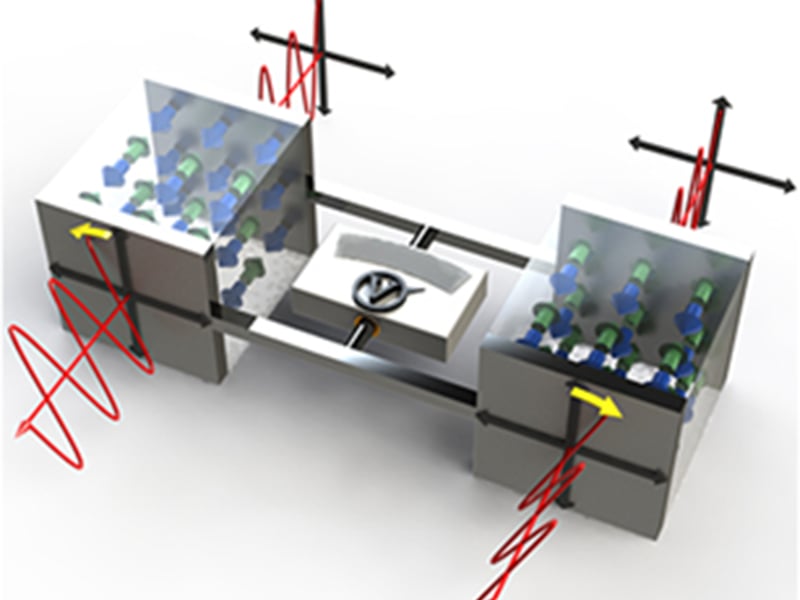
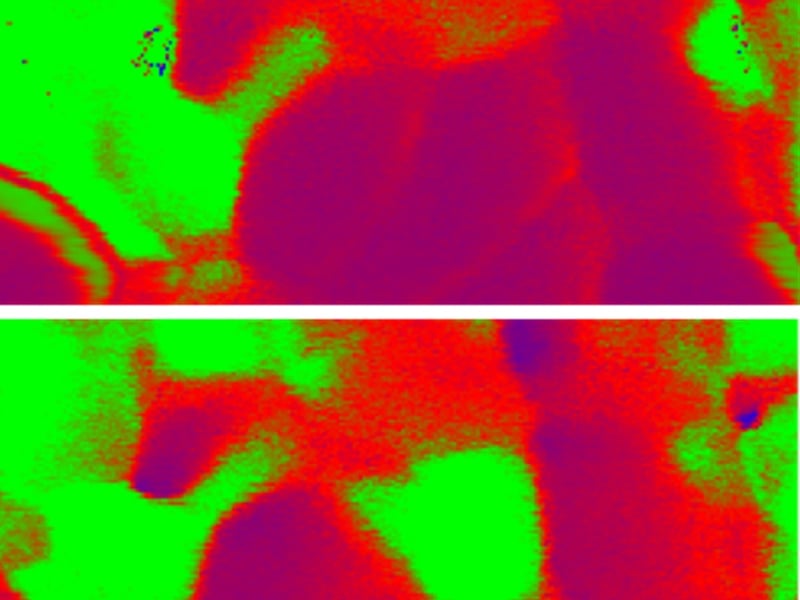
In crystalline materials, topologial defects such as dislocations mark flow defects, or “soft spots,” corresponding to local regions that are likely to rearrange due to thermal fluctuations or an applied load.  In disordered packings, it is extremely difficult to identify the corresponding soft spots. We previously discovered that sound waves are strongly scattered by flow defects, enabling us to identify soft spots acoustically.
May 22, 2015
UPENN Materials Research Science and Engineering Centers

Synthesis, self-assembly and response of glycodendrimers

Virgil Percec, Paul A. Heiney and Mike Klein (IRG2)

Dendrimers are branched molecules of precise chemistry, and Janus-dendrimers are dendrimers that have two distinct faces, with unique chemistry corresponding to each face. Here, we made a library of carbohydrate containing glycodendrimers (GD) that self assemble into vesicles – a structure that mimics biological materials such as viruses. We show the vesicles have the ability to agglutinate lectin proteins at vesicle walls, owing to the chemistry and concentration of the carbohydrate.  Synthesis of these materials is the first step in the assembly of a synthetic virus.
May 22, 2015
UPENN Materials Research Science and Engineering Centers (2017)

Surface Alignment and Handedness of Chromonic Liquid Crystals

Peter Collings, Tom Lubensky and Arjun Yodh (IRG-1) & Alan T. Johnson (Seed)

Chromonic liquid crystals (CLCs) are different from typical LCs used in displays, in part because they “live” in water and thus hold untapped potential for coupling LC phenomenology with biological media. Furthermore, CLCs twist very easily compared to bend and splay deformation, and the consequences of this giant elastic anisotropy are not well understood. Recently, Collings, Lubensky, Yodh & Johnson developed a new alignment layer for CLCs based on parylene (Fig. 1); it enabled homeotropic surface anchoring (i.e., perpendicular anchoring) [1].  
May 15, 2015
UNL Materials Research Science and Engineering Center (2014)

Graphene-Enhanced Ferroelectric Tunnel Junctions

Haidong Lu, Alexey Lipatov, Evgeny Tsymbal, Alexander Sinitskii, Alexei Gruverman (Nebraska MRSEC) and Sangwoo Ryu, Chang-Beom Eom (University of Wisconsin-Madison)

Ferroelectric tunnel junctions exploit an ultrathin ferroelectric layer, 100,000 times thinner than a sheet of paper, so that electrons can "tunnel" through it. This layer resides between two metal electrodes that can reverse the direction of its polarization by applying electric voltage to it. A junction polarity determines its resistance to tunneling current, with one direction allowing current to flow and the other strongly reducing it, known as “on” and “off” states.
May 15, 2015
UNL Materials Research Science and Engineering Center (2014)

Nebraska MSREC WoPhyS14 Conference

Axel Enders (Nebraska MRSEC)

The University of Nebraska- Lincoln (UNL), under Nebraska MRSEC’s leadership, held its sixth Conference for Undergraduate Women in Physical Sciences, WoPhyS, on November 6-8, 2014.