Highlights

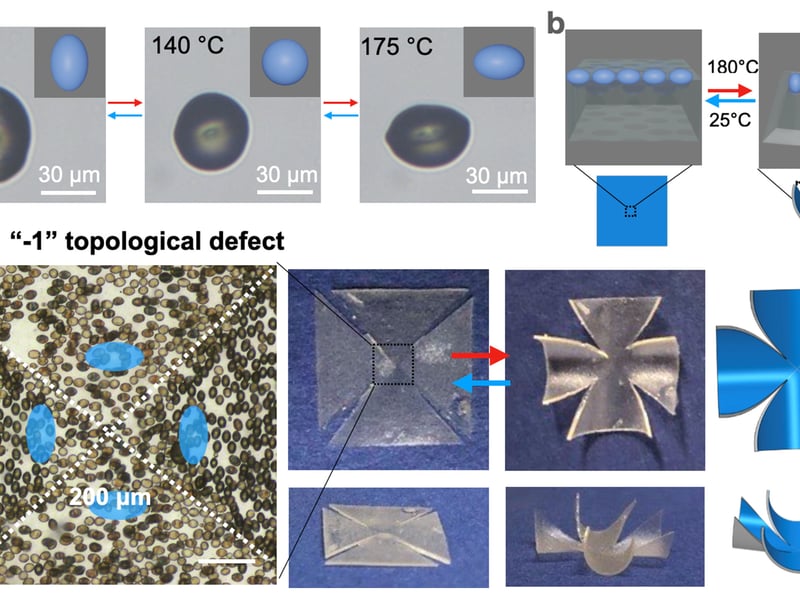
Top: Examples of printed structures with complex geometries. Bottom: Internal structures before (left) and after (right) heating, showing the thermal activation of microporosity.
Left: Schematic of swell shark and egg casing. Right: Inset shows hierarchical nanostructures that deform under stress.
May 16, 2022
Materials Research Science and Engineering Center at UCSB

Nanolatticed Architecture Mitigates Damage in Shark Egg Cases

R. Goh, S.P.O. Danielsen, E. Schaible, R.M. McMeeking, J.H. Waite (UC Santa Barbara)

Structure-mechanics analysis of shark egg cases has revealed that dynamic reorganization of the nanolatticed architecture provides strength and resilience without compromising permeability.
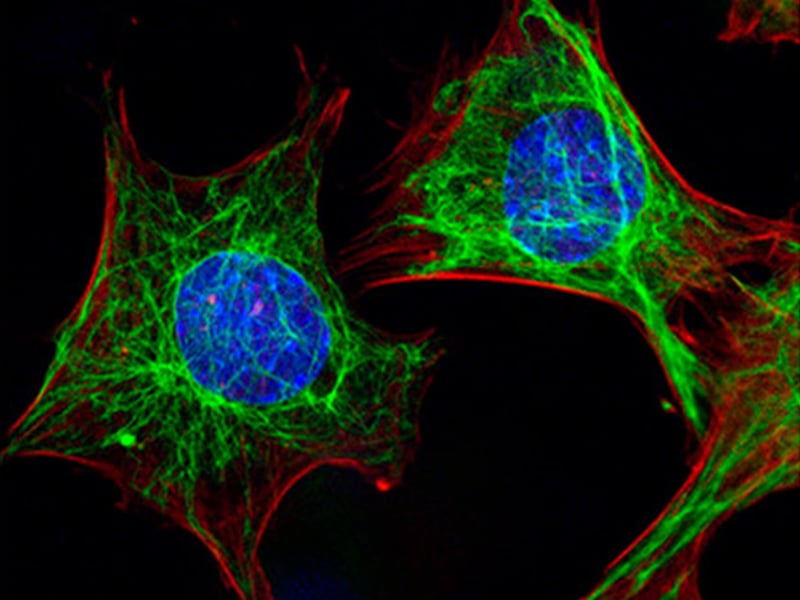
3D-printing aligned collagen reveals that this scaffold does not direct mammary gland branching.
These zwitterionic electrolytes promote ion transport through a pathway of vacancies. This transport mechanism enables performance that exceeds the literature (squares) when analyzed in the selectivity-conductivity design space.
May 16, 2022
Materials Research Science and Engineering Center at UCSB

Zwitterionic Electrolytes Enable Decoupling of Ionic Transport from Segmental Relaxation

Ionic transport in polymers typically undergoes a standard liquidlike transport mechanism whereby diffusion of ions is permitted only by relaxation of the local fluid elements, this mechanism results in limitations in designing conductive and cation-selective electrolytes. In this work we demonstrate that superionic transport (untethered to polymer dynamics) is possible in semicrystalline poly(zwitterionic liquids).
Additively manufactured Alnico magnets and 3D microstructure generated using TriBeam tomography.
May 16, 2022
Materials Research Science and Engineering Center at UCSB

Microstructural evolution in additively manufactured magnetic materials

Rottmann, Polonsky, Francis, Emigh, Krispin, Rieger, Echlin, Levi, Pollock (UC Santa Barbara)

Samples of Alnico magnets were printed by selective laser melting, and their microstructure was investigated in 3D at the mm3-scale using the femtosecond-laser enabled TriBeam microscope.
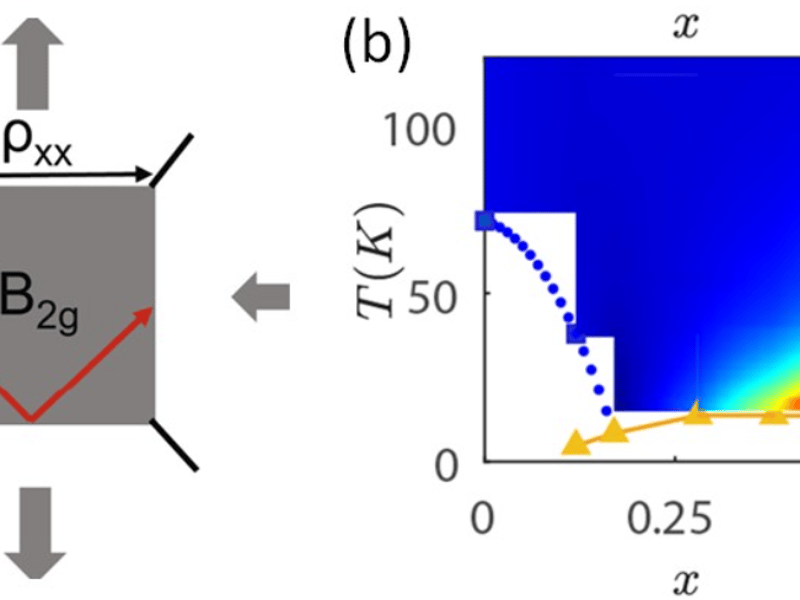
Multiscale computational design approach to identify magnetic alloys with prescribed properties.
May 16, 2022
Materials Research Science and Engineering Center at UCSB

Tuning magnetic antiskyrmion stability in tetragonal inverse Heusler alloys

Kitchaev, Van der Ven (UC Santa Barbara)

A computational approach was implemented to design Mn2XY tetragonal inverse Heusler alloys that host magnetic antiskyrmions whose stability are sensitive to elastic strain.
Enhancing lithium-ion transport in solid-state polymer electrolytes using electron-deficient imidazole ligands. Our study indicates that steric and electronic ligand properties are critical for enhancing lithium-ion diffusion and transport.
May 16, 2022
Materials Research Science and Engineering Center at UCSB

Electron-Deficient Imidazoles in Solid-State Polymer Electrolytes

Andrei Nikolaev, Peter M. Richardson, Shuyi Xie, Luana Llanes, Seamus D. Jones, Hengbin Wang, Rachel A. Segalman, Raphaële J. Clément, and Javier Read de Alaniz  (UC Santa Barbara)

Solid-state polymer electrolytes offer a safer alternative to traditional lithium-ion batteries based on organic electrolytes. However, current benchmark polymer electrolytes lack ion transport selectivity (t+ = 0.2) which limits their commercial use. We demonstrate the enhancement of lithium-ion transport (t+ = 0.48) of PMS-based polymers by taking advantage of the steric and electronic properties of imidazole ligands.
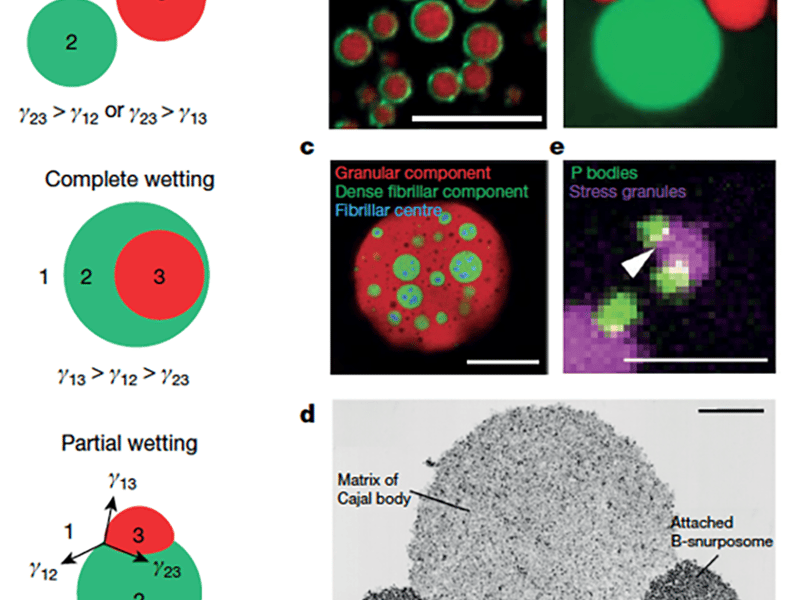
Multiphase droplet of flexible single-stranded DNA (green) and rigid double-stranded DNA (red), demonstrating the key role of mechanical properties in phase behavior. Right: Water-in-oil emulsion droplets containing DNA coacervate droplets; we have invented a method to quantify the phase diagram from such images.
May 16, 2022
Materials Research Science and Engineering Center at UCSB

Selecting for Phase-Separating Nucleic Acid Coacervates

Complex coacervation is a process in which oppositely charged macro-molecules in solution condense into dense liquids. While primarily driven by charge effects or, with DNA, basepairing, other macromolecular traits are likely to have strong effects. This Seed project leverages modern tools of DNA sequence control and biochemistry to study the fundamental physical principles underlying coacervation,
The BioPacific MIP SAXS/WAXS beamline. The six-meter long platform instrument is custom designed and constructed by a research and development team that has been supporting the MRL X-ray Diffraction facility.  Many design elements were inspired by the original SAXS/WAXS instrument built by the same team in the MRL X-ray Facility.
The BioPacific MIP SAXS/WAXS beamline. The six-meter long platform instrument is custom designed and constructed by a research and development team that has been supporting the MRL X-ray Diffraction facility. Many design elements were inspired by the original SAXS/WAXS instrument built by the same team in the MRL X-ray Facility.
May 16, 2022
Materials Research Science and Engineering Center at UCSB

Development of a high brilliance laboratory SAXS/WAXS beamline

In collaboration with the newly established NSF BioPacific MIP, the MRL X-ray facility team spearheaded the development of an SAXS-WAXS (small and wide angle x-ray scattering) laboratory beamline with unparalleled beam brightness for high throughput characterization of biopolymers and nanostructures.