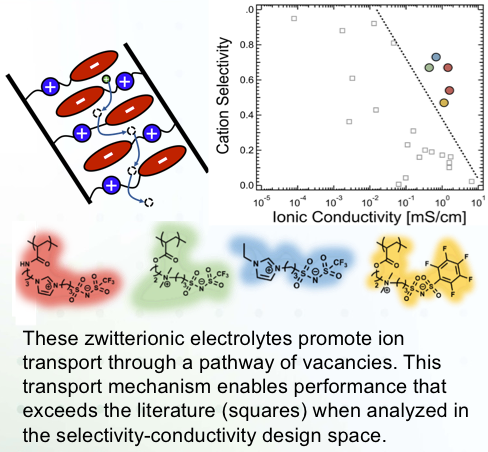
Intellectual merit: Ionic transport in polymers typically undergoes a standard liquidlike transport mechanism whereby diffusion of ions is permitted only by relaxation of the local fluid elements, this mechanism results in limitations in designing conductive and cation-selective electrolytes. In this work we demonstrate that superionic transport (untethered to polymer dynamics) is possible in semicrystalline poly(zwitterionic liquids). These materials have higher combined selectivity and conductivity than existing polyelectrolytes. This work is now part of a broader collaboration with Mitsubishi Chemical for development as a potential battery material.
Broader Impacts: Solid electrolytes are advantageous for applications in batteries due to an ability to mitigate instabilities in battery cells. These innovative polymer electrolytes are advantageous over classic systems as they simultaneously possess favorable mechanical, conductivity, and selectivity properties.
 Download
Materials Research Science and Engineering Center at UCSB
The U.S. National Science Foundation Materials Research Science and Engineering Center at UC Santa Barbara develops and sustains a productive, collaborative, and engaged community that drives a portfolio of transformative materials research and empowers a diverse workforce.