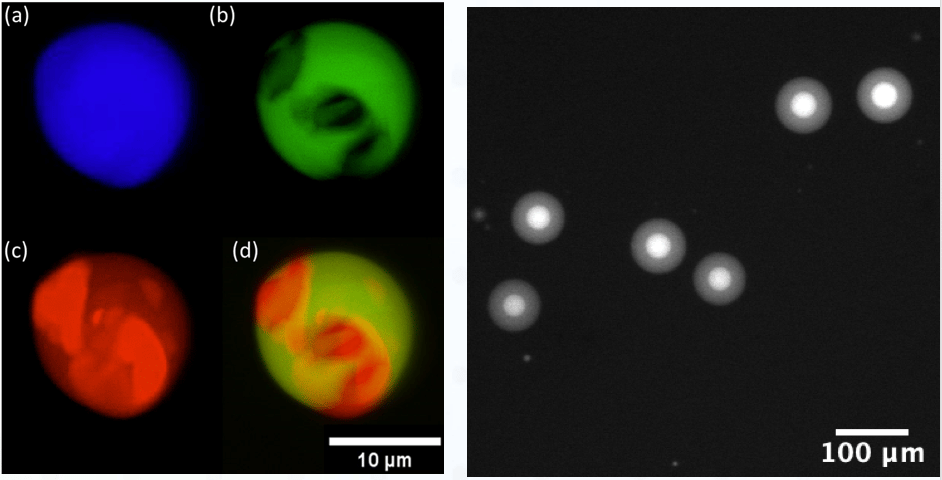
Intellectual merit: Complex coacervation is a process in which oppositely charged macro-molecules in solution condense into dense liquids. While primarily driven by charge effects or, with DNA, basepairing, other macromolecular traits are likely to have strong effects. This Seed project leverages modern tools of DNA sequence control and biochemistry to study the fundamental physical principles underlying coacervation, with a specific focus on the role of polymer charge density and flexibility.
Broader Impacts: Understanding coacervation will impact technological applications, e.g. in food and pharmaceutical science. Further impacts occur in biology, where biomolecular coacervates form a substrate for key processes within living cells, and in origins-of-life research, where coacervates are plausible candidates for early gene-protecting ‘protocells’.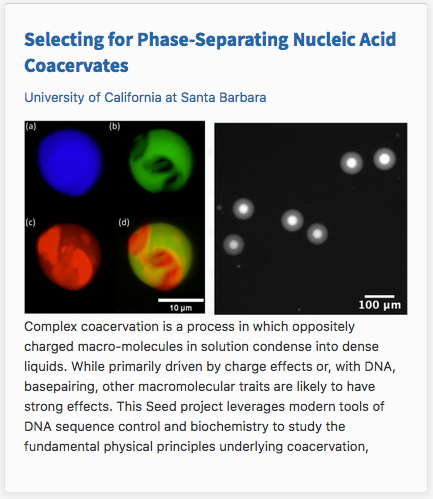

Materials Research Science and Engineering Center at UCSB
The U.S. National Science Foundation Materials Research Science and Engineering Center at UC Santa Barbara develops and sustains a productive, collaborative, and engaged community that drives a portfolio of transformative materials research and empowers a diverse workforce.