Highlights

Figure 1 | a, Magnetic hysteresis loop of an Fe3GeTe2 monolayer at 15 K. Inset: atomic lattice of monolayer Fe3GeTe2. b, MFM image of a 300 nm flake at 0.03 T, showing labyrinthine domain structures. c, Compiled thickness-temperature phase diagram.
May 16, 2018
University of Washington

Two-Dimensional Itinerant Ising Ferromagnetism

David Cobden and Xiaosong Xu Molecular Engineering Materials Center (MEM-C), University of Washington, Seattle

Ferromagnetism in monolayer van der Waals materials (vdW) has recently drawn tremendous attention since they were first discovered last year. Most of the materials found, however, are semiconductors and extremely air sensitive, so a vdW material that is metallic and stable under ambient conditions is highly desirable.
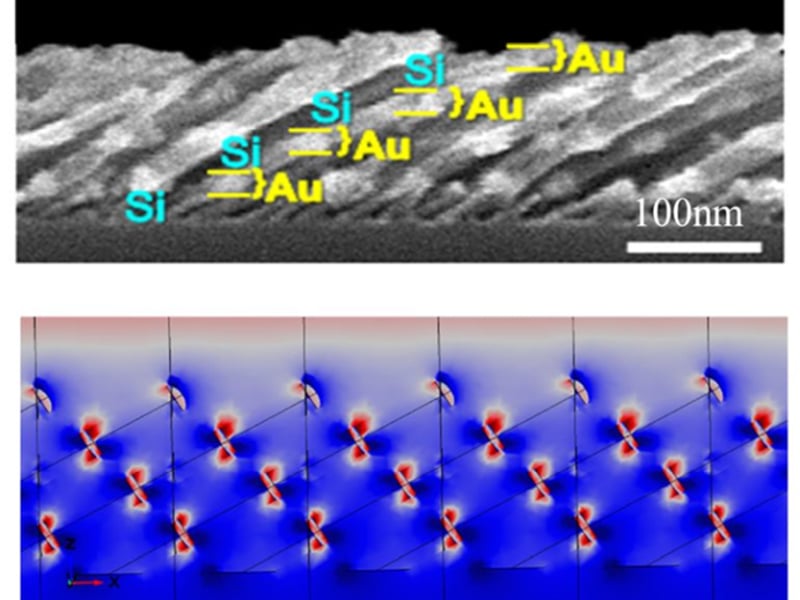
Silicon vacancy color center in nanodiamonds for high pressure temperature sensing and quantum cryptography.
May 16, 2018
University of Washington

Silicon vacancy color center in nanodiamonds for high pressure temperature sensing and quantum cryptography.

Xiaosong Li and Peter Pauzauskie Molecular Engineering Materials Center (MEM-C), University of Washington, Seattle

The presence of isolated defects in the lattice of large band-gap semiconductors can introduce colored centers, by altering their electronic properties giving rise to transitions within the visible region.  Diamond has a rigid and dense lattice preventing defect diffusion and phase transitions under high pressure and temperature settings.
Arts+Sciences Collaboratory Residence Program
May 16, 2018
University of Texas at Austin

Arts+Sciences Collaboratory Residence Program

University of Texas at Austin

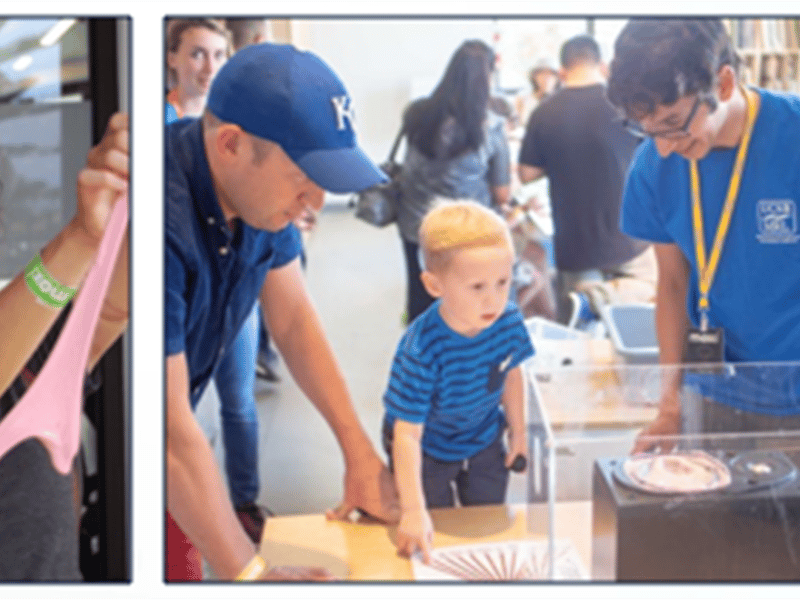
The CDCM Arts+Sciences Collaboratory Residence Program is educating MRSEC students, post-docs and faculty about the ways in which contemporary artists are using and developing advanced technologies.
Scheme 1. (a) Electron equivalents generated from S. oneidensis MR-1 reduce a metal catalyst from an inactive state (MOX) to an active state (MRED) to enable ATRP, (b) molecular weight and polydispersity of poly(OEOMA500) as a function of monomer conversion, (c) rescue of normal polymerization activity via knockout complementation with a plasmid encoding MtrC.
May 16, 2018
University of Texas at Austin

Shewanella oneidensis as a Living Electrode for Controlled Radical Polymerization

N. A. Lynd, B. K. Keitz:  University of Texas at Austin

Researchers at the University of Texas - Austin find that manipulating biological electron transport pathways may be a general strategy for allowing bacteria to produce or communicate with synthetic materials.
Routing Valley Excitons with a Metasurface
May 16, 2018
University of Texas at Austin

Routing Valley Excitons with a Metasurface

X. Li, A. Alu, C. K. Shih:  University of Texas at Austin

Researchers at the University of Texas - Austin have discovered a new method to separate valley index using a designed metasurface. Excitons that carry different valley index are routed toward different directions in real space and momentum space, and photons emitted go to different directions according to their helicity.
This CEM-nucleated team was awarded a major DARPA grant in February 2018 to work on skyrmion materials.
May 7, 2018
Ohio State University

Proto-IRG: Spin Textures in Chiral Magnetic Materials

A. Ahmed, J. Rowland, B. Esser, S. Dunsiger, D. McComb, M. Randeria, R. Kawakami, Phys. Rev. Materials, 2, 041401 (2018).

Experimental evidence in MBE-grown FeGe thin films for “chiral bobbers”, topological spin texture that exist near an interface. Theoretical modeling  predicts stable chiral bobbers in materials with both bulk and interfacial DMI. Lorentz TEM imaging of skyrmions in FeGe thinned crystals Topological Hall effect measurements of skyrmions in FeGe thin films and novel oxide heterostructures of SrIrO3/SrRuO3. Development of microwave absorption spectroscopy to probe skyrmion materials.
Physics of Emergent Materials Workshop (POEM)
May 7, 2018
Ohio State University

Physics of Emergent Materials Workshop (POEM)

R. Page and  J. Katoch, Ohio State University

The CEM Internal Advisory Council, a grassroots committee of students and postdoctoral researchers, created POEM to inform the Center’s direction and improve the educational and research experiences of CEM students. 
Nanoparticles For Delivery of DNA Therapeutics
May 7, 2018
University of Colorado at Boulder

Nanoparticles For Delivery of DNA Therapeutics

A. Harguindey1, D.W. Domaille1, B.D. Fairbanks1, J. Wagner1, C.N. Bowman1,2, J.N. Cha1,2   1 Chemical and Biological Engineering - University of Colorado, Boulder, CO 80309, USA. 2 Materials Science and Engineering Program - University of Colorado, Boulder, CO 80309, USA.

Many advanced drugs acting in cells are made of DNA fragments.  Since DNA is biologically active and destroyed if not recognized, a major challenge for this kind of medicine is getting the DNA into selected target cells.  SMRC researchers have found that soap-like molecules that form nanometer-size spherical particles in water and that have a DNA-like component as part of their molecular structure can act as effective carriers of therapeutic DNA for cancer treatment.
A Double Helix of Bent Molecular Dimers
A Double Helix of Nucleic Acid Monomers