Highlights
May 24, 2018
University of Minnesota - Twin Cities
Glass-like Thermal Conductivity in Epitaxial Oxygen-Vacancy-Ordered Oxide Films
Xiaojia Wang, Chris Leighton University of Minnesota
Precise control over defects in materials is often a highly effective means to control properties and function. In oxide materials, which are the focus of enormous current attention for many existing and proposed applications, defects known as oxygen vacancies often play the key role. These vacancies, simply missing oxygen atoms in the structure, can have a significant impact on properties.
May 22, 2018
University of Wisconsin - Madison
IRG1: Increased Stability of CuZrAl Metallic Glasses Prepared by Physical Vapor Deposition
George B. Bokas and Izabela Szlufarska, University of Wisconsin-Madison MRSEC
One of the main drawbacks of metallic glasses is their low thermodynamic stability, which limits their formability and service life. Recently, experiments by members of the Wisconsin MRSEC showed that organic glasses with high thermodynamic stability can be synthesized via physical vapor deposition (PVD) onto a substrate at a controlled temperature. Now, this team of researchers has used molecular dynamics simulations to predict that the same PVD methods can enhance the stability of metallic glasses.
May 22, 2018
University of Wisconsin - Madison
Wisconsin MRSEC Researchers and Teachers Collaborate to Create Digital Educational Games
Anne Lynn Gillian-Daniel, University of Wisconsin-Madison MRSEC
The Wisconsin MRSEC has developed research-inspired educational digital games that are each being played over 1900 times/week. Atom Touch teaches students about atom behavior, bonding, and forces. Crystal Cave lets students explore how molecules form repeating patterns to grow into large crystals. During development, local K-12 teachers provided input on how to make the games more engaging for student learning.
May 18, 2018
New York University
World Science Festival: Crystals, Colloids and Fun!
NYU-MRSEC investigators along with research scientist from the BioBus/BioBase organization mentored nine high school students as part of a two month peer-mentorship program. The idea, to train high school students in optics, CAD/3D printing and basic of microscopy including applications in materials science (crystals and colloids).
May 18, 2018
New York University
Phases of Matter – Adult Coloring Book
MRSEC investigators team-up to create an adult coloring book. The coloring book, “Phases of Matter,” designed to help the general pubic understand physics and phase behavior.
May 18, 2018
New York University
Freezing on a Sphere
Andrew D. Hollingsworth & Paul M. Chaikin, New York University
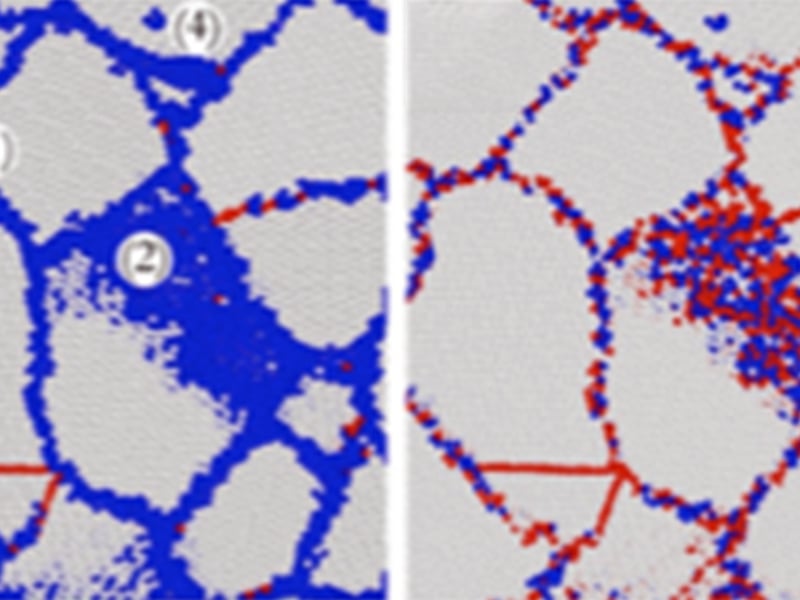
A crystal is defined by the regular and periodic ordering of the atoms, molecules, or particles that compose them. If bent or strained, this order and regularity is disturbed, and defects appear that relieve some of the applied stress.
May 17, 2018
University of California, Santa Barbara
Simple Coacervation of a Mussel-inspired Peptide Improves Wet Adhesion
Upon spontaneous deposition on surfaces underwater and moderate compression, single-component coacervates of adhesive peptide mimics (mfp-3S-pep) display orders of magnitude improvement compared with un-coacervated native (mfp-3S) or synthetic peptides. The increase in the work of adhesion is due to the peptide’s intrinsic cohesive properties upon coacervation correlated with dehydration, tight peptide packing and restricted peptide mobility.
May 17, 2018
University of California, Santa Barbara
UCSB MRSEC Maker Activities
In response to the needs of teachers, the UCSB MRSEC has placed a new focus on the development of maker activities for K-12 students. These encourage the integration of maker activities into the school curriculum as well as within out-of-school environments (Maker Faires), supporting the adoption of Next Generation Science Standards (NGSS).
May 16, 2018
University of Illinois Urbana-Champaign
Atomically-precise graphene etch masks for 3D integrated systems from 2D material heterostructures
A. van der Zande, P. Huang, N. Mason, E. Ertekin University of Illinois Urbana-Champaign
Atomically-precise fabrication methods are critical for the development of next-generation technologies which rely on nanomaterials. New methods are particularly needed in van der Waals (vdW) heterostructures where it is necessary to individually address each molecular layer to form devices with nanometer thicknesses. The Illinois MRSEC has demonstrated a highly selective etching technique using graphene as a monolayer etch stop within vdW heterostructures. This technique is a versatile and simple nanofabrication process that bridges the challenging technological divide between atomic-precision and wafer scale uniformity.
May 16, 2018
University of Illinois Urbana-Champaign
Surface state anisotropic magnetoresistance in proximity magnetized topological insulators
N. Mason, M. J. Gilbert, A. Hoffmann, University of Illinois Urbana-Champaign
Information stored in magnetic materials is often read-out by measuring changes in magnetoresistance. Large magnetoresistance effects are thus important for establishing well-defined memory states within materials that store information. The Illinois MRSEC discovered a new and large magnetoresistance effect generated when a topological insulator (TI) is placed on top of an ordinary magnetic insulator. The surface of the TI becomes magnetic and exhibits a so-called surface-state anisotropic magnetoresistance. This effect is two-orders of magnitude larger than previous effects induced in similar materials.
Showing 401 to 410 of 1400