Highlights

Simulation of film structure (a) confirmed by electron diffraction (b). Real space experimental image (c) of film structure and simulated TEM image (d).
Oct 26, 2018
University of Pennsylvania

Large-area synthesis of monolayer 1T'-WTe2 flakes

Andrew Rappe, Charlie Johnson, Rob Carpick, & Jay Kikkawa, Super Seed, University of Pennsylvania

Large-area growth of monolayer films of transition metal dichalcogenides is important in the rapidly advancing research field of topological materials, because scientists believe tungsten ditelluride has so-called “topological” electronic states. To this end, the Penn MRSEC SuperSeed team (Rappe, Johnson) and IRG faculty (Carpick, IRG-3; Kikkawa, IRG-4) collaborated to develop a growth process methodology for synthesis of reliable and reproducible large-area many-monolayer 1T'-WTe2 flakes.
Fabrication of hybrid nanorods. Low- (lower left) and high- (lower right) resolution SEM images, of hybrid nanorod arrays before release. Upper right, SEM image of released hybrid nanorods. Red arrows highlight nanorods sitting on the substrate on their sides.
Oct 26, 2018
University of Pennsylvania

High-strength magnetically switchable plasmonic nanorods

M. Zhang, D.J. Magagnosc, I. Liberal, Y. Yu, H. Yun, H. Yang, Y. Wu, J. Guo, W. Chen, Y.J. Shin, A. Stein, J.M. Kikkawa, N. Engheta, D.S. Gianola, C.B. Murray, C.R. Kagan, Nature Nanotechnology 12, 2017

Next-generation 'smart' nanoparticle systems should be precisely engineered in size, shape and composition to introduce multiple functionalities, unattainable from a single material. Bottom-up chemical methods are prized for the synthesis of crystalline nanoparticles, i.e., nanocrystals with size-and shape-dependent physical properties, but they are less successful in achieving multifunctionality. Top-down lithographic methods can produce multifunctional nanoparticles with precise size and shape control, yet this approach becomes increasingly difficult at sizes of order 10 nm.
Schematic of glass films formed by physical vapor deposition. Image source: Felice Macera
Oct 26, 2018
University of Pennsylvania

Birefringent Stable Glasses with Predominantly Isotropic Molecular Orientation

Zahra Fakhraai and Jay Kikkawa, IRG3, University of Pennsylvania

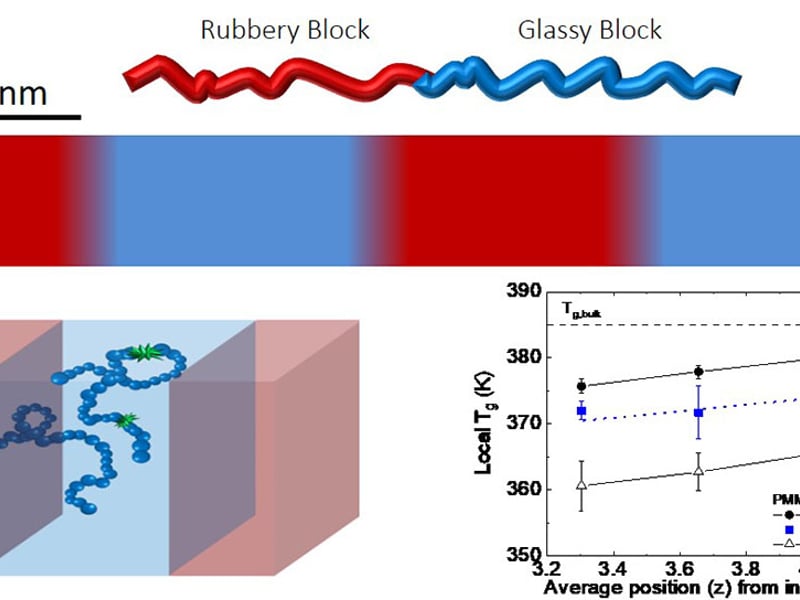
Stable glasses produced by physical vapor deposition are important to understand. They exhibit optical birefringence, which traditionally implies that the constituent molecules are aligned.
Janus dendrimersomes as models for cell fusion and fission.
Oct 26, 2018
University of Pennsylvania

Janus dendrimersomes as models for cell fusion and fission.

Virgil Percec, Michael Klein, Dan Hammer, and Tobias Baumgart, IRG2, University of Pennsylvania & Temple University

Vesicle fusion and fission processes often occur in biological systems, usually with the aid of specialized proteins. Percec, Klein, Hammer, and Baumgart carried out comprehensive fusion/fission experiments based on three membrane ingredients: hydrogenated (RH), fluorinated (RF), and hybrid-hydrogenated/fluorinated (RHF) Janus dendrimers (Figure – Top Left).
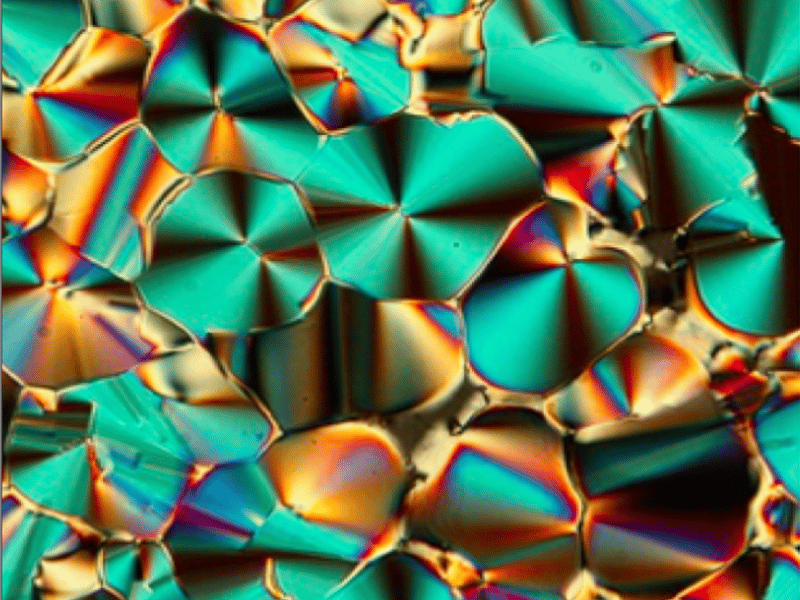
Focal conic domains (FCDs) form on inner surfaces of spherical shells filled with cholesteric LC. Image source: Lisa Tran
Oct 26, 2018
University of Pennsylvania

Shells of Cholesteric Liquid Crystals

Daeyeon Lee, Kathleen Stebe, and Randall Kamien, IRG1, University of Pennsylvania

Liquid crystals, fluids with aligned phases of rod-like constituent molecules, are used in everything from computer and television displays to mood rings. “Handedness” or chirality, is ubiquitous in complex biological systems and can be controlled and quantified in synthetic materials such as cholesteric liquid crystals.
Fig. 1 (top) shows yield stress vs modulus for disordered solids (IRG 1 data) and crystalline solids (balloons). Remarkably, the yield stress is tightly distributed around 3% for systems spanning over 13 decades in modulus.
Fig. 1 (bottom) shows the size of rearrangements vs particle size for 6 systems (3 experimental, 3 computational) spanning nearly 7 orders of magnitude of particle size.  Inset shows that the size (exponential length scale) of rearrangements is universally about one particle diameter at low strains.
Fig. 1 (top) shows yield stress vs modulus for disordered solids (IRG 1 data) and crystalline solids (balloons). Remarkably, the yield stress is tightly distributed around 3% for systems spanning over 13 decades in modulus. Fig. 1 (bottom) shows the size of rearrangements vs particle size for 6 systems (3 experimental, 3 computational) spanning nearly 7 orders of magnitude of particle size. Inset shows that the size (exponential length scale) of rearrangements is universally about one particle diameter at low strains.
Sophia Siefert  working with students from Girard College and Pennsylvania School for the Deaf as they explore different types of materials. Image source: © Felice Macera
Sophia Siefert working with students from Girard College and Pennsylvania School for the Deaf as they explore different types of materials. Image source: © Felice Macera
Predictive model of the static structure and the evolution of the system.
Jun 8, 2018
University of Chicago

Tunable nechanics and dynamics in biopolymer-based nematic materials

David Kovar and Gregory Voth groups

At the University of Chicago MRSEC, we have shown that building blocks of the biopolymers, actin and microtubule, form lyotropic liquid crystals with controllable structure and mechanics.
Rabi-swap pulse sequence. The qubit and resonator interact for a time τ , and the qubit state is then measured.
MRSEC representatives and conference attendees interact at the International Materials Research Congress in Cancun, Mexico.
Jun 5, 2018
Northwestern University

NSF-MRSEC Booth at the International Materials Research Congress

Following a successful inaugural year in 2016, a NSF-MRSEC booth was again featured at the XXVI International Materials Research Congress (IMRC) in Cancun, Mexico on August 19-25, 2017 to increase awareness, promote international collaboration, and broaden participation from traditionally underrepresented groups in the National Science Foundation Materials Research Science and Engineering Center (NSF-MRSEC) program. Dr. William Kung (Northwestern University), Ms. Michelle McCombs (Ohio State University), and Ms.