UC San Diego Materials Research Science and Engineering Center
The UC San Diego Materials Research Science and Engineering Center unites interdisciplinary teams of scientists and engineers to tackle complex, fundamental problems in materials science, from quantum metamaterials to a new class of electronic materials only a few atoms thick.
Center for Complex and Active Materials (2020)
The primary mission of he NSF MRSEC at UCI is to establish foundational knowledge in materials science and engineering of new classes of materials offering unique and broad functionality via an interplay among design, simulation, synthesis, and advanced characterization.
Wisconsin Materials Research Science and Engineering Center
The U.S. National Science Foundation-sponsored Wisconsin Materials Research Science and Engineering Center brings together teams of researchers from diverse disciplinary backgrounds to tackle grand challenges in the materials science of liquids and glasses and non-equilibrium magnetism.
Center for Dynamics and Control of Materials
This NSF MRSEC brings together researchers from across science and engineering to create materials with new atomic-scale structures and functionalities, and to develop approaches for actively controlling and reconfiguring materials in real time.
UChicago Materials Research Center (2020)
The UChicago MRSEC pioneers frameworks for materials discovery, focusing on trainable soft materials, activated architectured materials with dynamic transport properties, and quantum transduction for integrated circuits.
Center for Emergent Materials (2014)
The Center for Emergent Materials engages researchers from multiple disciplines to work in teams on scientific problems too complex for a single researcher to solve. The CEM, established in 2008, is located at The Ohio State University and funded by a U.S. National Science Foundation MRSEC award.
Cornell Center for Materials Research (2005)
The major theme of the NSF MRSEC research and education programs at the Cornell Center for Materials Research (CCMR) is Mastery of Materials at the Atomic and Molecular Level. The objective is to educate scientists and engineering students (largely PhD students) and postdoctoral researchers in the methods of research used to tackle cutting edge problems in materials research. At the same time CCMR manages and maintains a set of shared experimental facilities that enable this research to be carried out; these facilities are also actively used by a wide spectrum of researchers from across the campus, from other Universities, Government Laboratories and Industry. CCMR also has an expansive and effective educational outreach program that helps students and teachers from primary, secondary and local colleges to learn about materials sciences, recent advances and how to integrate this new knowledge into the classroom. Finally, CCMR's Industrial Partnerships program speeds the transition of new scientific discoveries into technologies that can promote economic growth and opportunities.
Our research is organized into teams focused on several specific topics, including: Controlling Electrons at Interfaces, "Building Blocks" for Photonic Systems, and the Study of the Dynamics of Growth of Complex Materials. CCMR also manages a "Seed Program" that supports smaller short term activities that explore high-risk/high-payoff areas and that integrates new faculty into our interdisciplinary culture. Our long term goal is to control materials systems at or near the level of atomistic precision (atom identity and geometric placement), as is possible in the synthesis of some organic molecules. Our vision is that such control will allow precision tuning of properties and is likely to uncover vast new areas of science, to facilitate the construction of a wide variety of novel devices, and to enable technologies not presently imagined. The proposed research capitalizes on unique science we recently developed, substantially extends the effort in new and ground breaking directions, and explores entirely new topics; all require new talents, new skills and new senior investigators.
UMN Materials Research Science and Engineering Center (2020)
This multifaceted NSF MRSEC enables important areas of future technology, ranging from applications of electrical control over materials to scale-invariant shape-filling amphiphile network self-assembly. The UMN MRSEC manages an extensive program in education and career development. The MRSEC is bolstered by a broad complement of over 20 companies that contribute directly to IRG research through intellectual, technological, and financial support. International research collaborations and student exchanges are pursued with leading research labs in Asia and Europe.
IRG II: Non-Equilibrium Phenomena in Mechanically Soft Systems
This IRG is pursuing new insights into the behavior of mechanically soft systems that are subjected to perturbations far from equilibrium. By combining data-rich experiments, theory, and artificial intelligence, the research will contribute greatly to U.S. National Science Foundation's 10 Big Ideas: Harnessing the Data Revolution by expanding its application to soft materials. While our focus is on soft materials, the insights gained will be broadly applicable to other classes of materials, spanning a wide range of length and time scales.
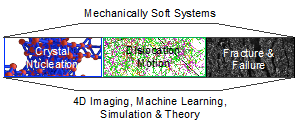
Figure 1. IRG 2 goals
To carry out the research, we bring together a multidisciplinary research team composed of faculty members from applied mathematics, biology, physics, chemistry, earth and planetary science, soft matter physics, and mechanical engineering with deep expertise in soft materials assembly (Lewis, Weitz, Whitesides), fracture mechanics (Holbrook, Rice, Suo), 4D confocal imaging and materials characterization (Spaepen, Vlassak), machine learning and computer simulation (Brenner, Colwell, Denolle, Frenkel, Kozinsky), and theory (Nelson) to focus on three goals that exploit data-driven science (Figure 1).
Understand crystal nucleation in single and multi-component hard-sphere systems and use the knowledge gained to develop new routes for creating alloys.
Investigate collective dislocation motion that underlies plastic deformation of materials.
Explore fracture phenomena in mechanically soft systems to understand their toughening, dissipation, and failure mechanisms.
IRG I: Programmable Multiscale and Multi-Material Control of Functional Matter
This IRG is aimed at fundamental advances in materials synthesis, modeling, and 3D printing that enable the creation of functional soft materials that augment human performance. New classes of soft materials that sense, actuate, and communicate are being developed for use in wearables, haptic interfaces, and artificial muscles connecting to U.S. National Science Foundation's 10 Big Ideas: Future of Work at the Human-Technology Frontier.
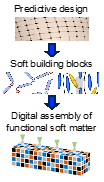
Figure 1. IRG 1 goals
To carry out the this research, we bring together a multidisciplinary research team composed of faculty members from applied mathematics, bioengineering, chemistry, materials, and mechanical engineering with deep expertise in theory and computation (Bertoldi, Kozinsky, Mahadevan, Rycroft, Suo), synthesis and assembly (Aizenberg, Clarke, Lewis, Parker, Vaia, Weitz), and characterization (Bertoldi, Clarke, Pindak, Suo, Walsh) to focus on three intertwined goals (Figure 1).
Establish predictive design rules that guide the synthesis and digital assembly of soft functional materials across multiple scales.
Synthesize soft building blocks composed of functional elastomers with controlled network architecture and stimuli-responsive moieties for creating soft functional materials.
Create functional soft matter via digital assembly that sense, communicate, and actuate in response to external stimuli for potential application at the human-technology interface.
Showing 851 to 860 of 2691