
The UChicago MRSEC establishes new conceptual frameworks to guide materials discovery and explores synergistic connections. The research activities are organized into two Interdisciplinary Research Groups (IRGs) and one SuperSeed.
The IRG on Trainable Soft Materials establishes a framework for building classes of materials whose physical response is engineered by using external manipulation to train in novel functionality. It takes inspiration from the fundamental processes that govern the structure and enormous adaptability of biological networks in order to derive new principles for pluripotent material fabrication by varying the training protocol.
The IRG on Activated Architectured Materials constructs materials with spatiotemporally programmable and self-regulating transport properties by bringing together recent advances in active materials with inorganic colloidal and thin film synthesis. This work enables dynamic control of transport properties of inorganic materials with potential applications in sensing, actuation and biodesign.
A Super-Seed on Materials for Electrical-Optical Quantum Transduction focuses on the challenge of creating integrated quantum circuits with coherent interfaces between different quantum materials spanning across many energy scales.
 Brochure
Trainable Soft Materials
This IRG explores the concept of materials training, drawing inspiration from biological adaptation to develop materials that can evolve their properties in response to external stimuli. Unlike traditional materials design, where parameters remain fixed, this research aims to create trainable materials that modify their internal structure and functions through applied mechanical stress—similar to how bones strengthen under repeated use.
The focus is on soft materials, which have highly adaptable configurations, making them ideal candidates for imprinting memory and evolving properties through structured training protocols. The research investigates how different training methodologies can lead to emergent behaviors such as impact absorption, shape morphing, and multi-functional actuation. A key goal is to develop a systematic framework for designing trainable soft materials, leveraging interdisciplinary insights from materials science, polymer chemistry, soft matter physics, and biological systems.
The group is structured into three focus areas (FAs), each targeting a specific type of soft matter network:
FA1: Macroscopic network-based materials (adapting structural links)
FA2: Dynamic polymer networks (allowing node reconfiguration)
FA3: Particle/gel-network composites (integrating both link adaptation and node reconfiguration)
By understanding trainability, learning, and memory in these systems, this research aims to establish new paradigmsfor materials processing, enabling materials that can be retrained and repurposed for different functionalities without requiring a full redesign.
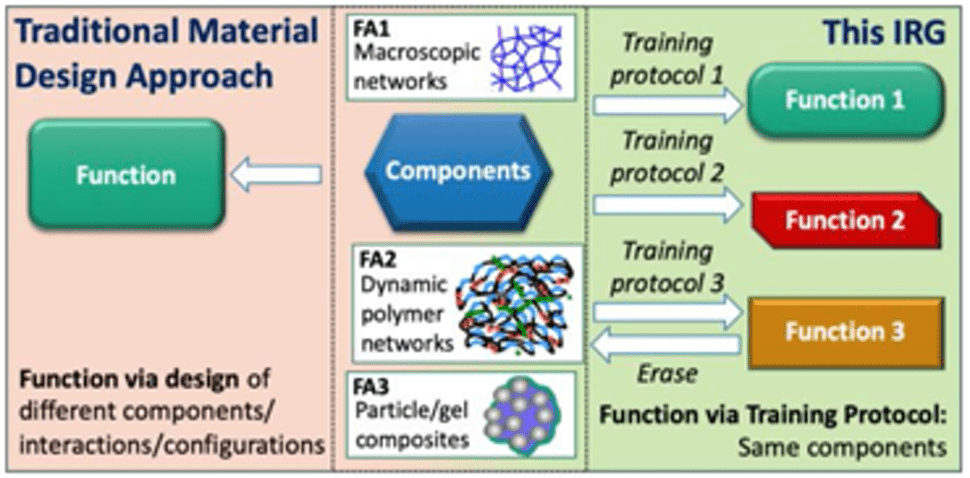
Traditional materials design vs. a materials training approach and the three focus areas (FAs) of Interdisciplinary Research Group 1.

Activated Architectured Materials
This IRG focuses on designing and building shape-morphing hybrid materials with programmable and self-regulating transport properties by integrating concepts from active matter and inorganic materials science. The goal is to develop activated architectured materials that autonomously respond to their environment, similar to biological systems, enabling applications such as artificial skin and self-printing ink-jet drops.
The research explores two key activation routes:
Route 1 – Activation modifies transport properties, such as fluid viscosity, leading to structural changes (e.g., self-shaping droplets).
Route 2 – Activation directly alters a material’s structure, which in turn affects properties like thermal transport.
The IRG is organized into three focus areas (FAs):
FA1: Develops activated fluids (metafluids) composed of self-spinning colloids and nanoparticles to enable spatiotemporal control of stresses for self-printing ink-jet drops.
FA2: Investigates activated sheets that integrate biological and inorganic materials, using biomolecular motors to manipulate shape, optical, and thermal properties.
FA3: Combines elements of FA1 and FA2 to develop composite structures, such as artificial skin, by integrating epithelial cells with soft polymer electronics for biomechanical functionality.
By harnessing the interplay between activation, material architecture, and transport properties, this research aims to establish a new paradigm in materials science, bridging the gap between synthetic and biological systems.
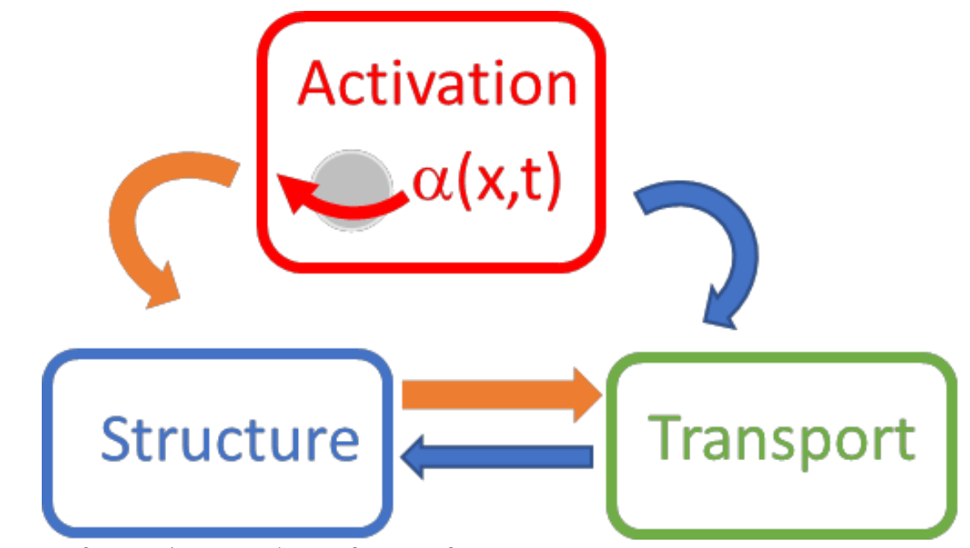
Material components (gray circles) are activated with spatial and/or time control (α(x,t)) to drive local motion and force (red arrow). This local activation controls material response through two routes, as described in the text.


Electrical-Optical Quantum Transduction
This seed project focuses on developing materials capable of coherently transferring quantum information between electrical circuits and optical photons. The research investigates materials systems that can support both microwave and optical excitations, with a particular focus on color centers—atom-like structures in wide-bandgap semiconductors that serve as interfaces between these domains. These centers exhibit spin excitations tunable to microwave frequencies and spin-dependent optical transitions, often in the telecom band.
Despite their coherence, color centers pose challenges in coupling due to their localized spin states and small sizes. Rare earth ions such as erbium require specific host materials to preserve their properties, but these materials may not be optimal for integration into metamaterials or other quantum systems.
The project explores two materials science pathways to enable coherent electrical-optical coupling. The first involves the development of novel color centers with improved coherence and optical stability compared to existing systems such as nitrogen vacancy centers in diamond. The second focuses on optimizing host materials and electrical qubit coupling to address scale mismatches between color centers and microwave photons. By leveraging theoretical operating protocols and new materials platforms, the research aims to significantly enhance magnetic, electrical, and acoustic coupling for quantum information applications.
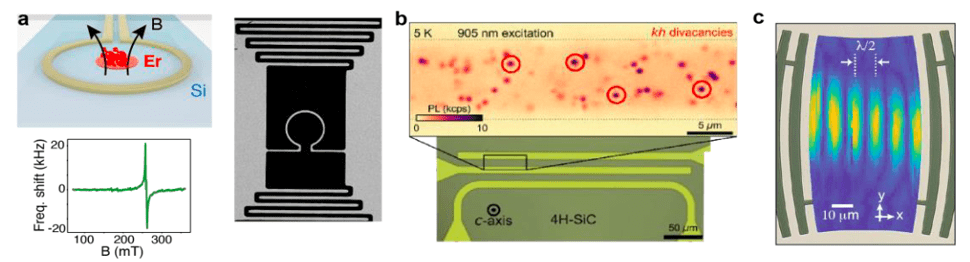
Three physical modalities of coherent coupling between spins and microwaves. (a) Magnetic coupling to spins using a low impedance superconducting circuit (schematic and device images shown) and preliminary ESR signal. (b) Photoluminescence of electrically biased divacancy spins in 4H-SiC, in between two electrodes. (c) X-ray strain measurements of surface acoustic waves in a Gaussian used to acoustically control spins.