
The Materials Research Science and Engineering Center (MRSEC) at the University of California, Irvine (UCI) builds on UCI’s strengths in multidisciplinary science and engineering research, experiential learning, world-class facilities, and commitment to diversity. The primary mission of the Center is to establish foundational knowledge in materials science and engineering of new classes of materials offering unique and broad functionality via an interplay among design, simulation, synthesis, and advanced characterization.
The Center’s interdisciplinary team members work together to create materials with complex chemical compositions — able to exhibit unprecedented physical properties, such as the ability to withstand extreme environments having applications in national defense — and dynamic, responsive soft materials — able to mimic complex biological processes serving as an interface with living systems for healthcare applications. Through seed projects, the Center engages new participants in emergent research directions. The Center attracts many junior scientists, including women, underrepresented minority groups, and persons with disabilities, from across the nation and trains future leaders at all academic and professional levels to address critical societal challenges. The Center’s integrated activities — including novel materials research, partnerships with industry and national laboratories, entrepreneurial innovation, career development, and mentorship — are enabling a transformative long-term impact on fundamental science, advanced applications, and workforce development.
Program Highlights
UCI-MRSEC investigators develop a new capability of transmission electron microscopy imaging and electron energy loss spectroscopy to probe local phonon spectra around defects and stacking faults with ultrahigh spatial resolution.
Facilities
Center for Transmission Electron Microscopy
Laboratory for Electron and X-ray Instrumentation
The Surface System Facility
Thermal, Elemental, Mechanical, Physical and Rheological Facility
Materials Characterization Center
 Brochure
Complex Concentrated Materials
IRG-1 will develop the fundamental science needed to understand, describe, and predict interfacial phenomena in metals and ceramics with multiple principal elements. These so-called complex concentrated materials have been reported to have outstanding properties such as high strength, tailored band gaps, extremely large dielectric constants, and substantially reduced thermal conductivity, making them the next paradigm shift in structural and functional materials.
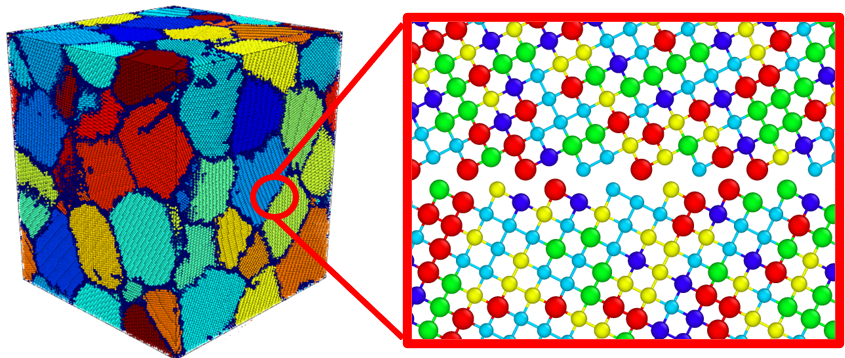
Fig. Interfacial Science of Complex Concentrated Materials
This IRG’s interdisciplinary team will be the first to develop the core principles of microstructural engineering for complex concentrated materials, including fundamental investigations of atomic-level structure and chemistry, interfacial thermodynamics, kinetics, and mechanical and functional properties. This foundational knowledge will then be used to design and synthesize materials with planned microstructures and properties.
The team provides complementary expertise in materials theory, computational materials science, processing science, advanced characterization, property measurement, and artificial intelligence to enable a complete study of interfacial behavior in complex concentrated materials. This IRG is expected to transform complex concentrated materials from laboratory curiosities into materials that alter our global economy in a variety of essential industries.


Bioinspired Active Materials
Charge-matter Interactions in Bioinspired Supramolecular Materials
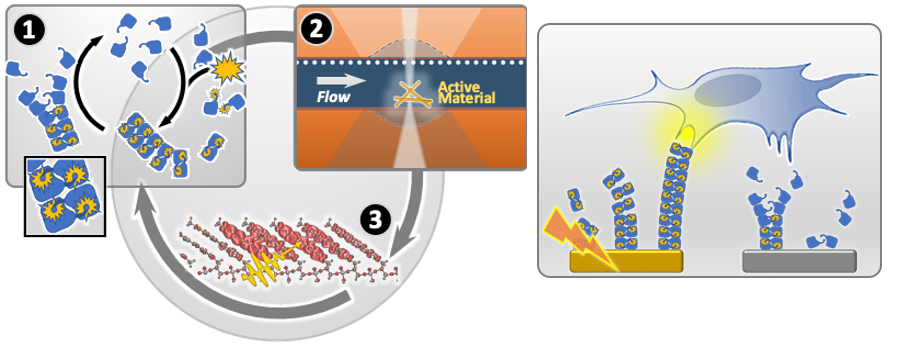
This IRG will develop active conductive supramolecular materials that self-assemble in response to electronic and other stimuli. While a variety of stimuli—including chemical, light, and mechanical triggers—have been used to control synthetic supramolecular polymerization, the interactions between charge and synthetic self-assembled systems are poorly understood. This IRG will support an integrated team effort to investigate actively assembling materials inspired by biological systems to seamlessly interface biology and synthetic electronic devices.
Research objectives will include:
design and synthesis of novel active materials fueled by electrical and other energy,
integrated computational and experimental mechanistic investigations of active self-assembly systems, and
experimental and theoretical characterization of the emergent electronic and mechanical properties of the active supramolecular systems to inform iterative materials design.
Building on this IRG’s strong and complementary expertise in materials design and synthesis, as well as experimental and computational studies, a highly interdisciplinary plan is proposed to gain fundamental understanding of charge-matter interactions in bioinspired supramolecular materials. This research will provide foundational knowledge in Synthetic Materials Biology for how to effectively interface living and nonliving matter for future technological development of artificial intelligence and bioelectronics.