What is the Atomic Structure of Sustainable Concrete? (Seed 3)
Principal Investigators
Claire E. White (Civil and Environmental Engineering)
George W. Scherer (Civil and Environmental Engineering)
* This seed is inactive.
Concrete is the second most used resource after water, and is employed throughout the world in a wide variety of industrial, infrastructure and commercial settings. Due to the extensive CO2 emissions that arise from ordinary Portland cement (OPC) production (5-8% of man-made CO2), low-CO2 concrete alternatives are fast emerging in the marketplace. A promising alternative, alkali-activated slag and/or fly ash cements (AAC), are known to reduce the CO2 burden by 80-90%, and therefore pose as promising candidates for creating a truly sustainable future. Nevertheless, in order to accelerate implementation of any new and transformative structural material in the built environment we must have a detailed understanding of its chemistry and physics, including the nature of the atomic structure.
The aim of the Seed 3 project is to develop an iterative modeling-experiment methodology that will produce experimentally valid and thermodynamically plausible atomistic representations of C-A-S-H and C-(N)-A-S-H gels, and therefore reveal the location and role of aluminum in these gels. This will be achieved by utilizing advanced X-ray scattering data combined with ab initio modeling. The outcomes of this transformative research are twofold; firstly, the generation of thermodynamically plausible structural representations of C-A-S-H and C-(N)-A-S-H gels; and secondly, the development of a modeling framework methodology that is highly relevant for elucidating the structure and thermodynamics of other important disordered materials, including glassy phases, amorphous carbonates, polymers, nanoparticles and any materials with intrinsic disorder at the atomic length scale. Hence, this research project will promote an unconventional level of interaction between modeling and experiment, and will encourage the development of innovative research approaches to accelerate implementation of new materials in society.
2016 Publications
V. O. Ozcelik and C. E. White, “Nanoscale charge-balancing mechanism in alkali-substituted calcium−silicate−hydrate gels,” Journal of Physical Chemistry Letters, 7, 5266 (2016).
Structured Materials for Strong Light-Matter Interactions
IRG Senior Participants:
Greg Fuchs (ApplPhys, co-leader), Gennady Shvets (ApplPhys, co-leader), Nicole Benedek (MatSci), Debdeep Jena (ElecE), Jeffrey Moses (ApplPhys), Farhan Rana (ElecE), Alejandro Rodriguez (ElecE, Princeton), A. Nick Vamivakas (Optics, U. Rochester), Huili Grace Xing (MatSci).
Collaborators: Michael Flatté (U. Iowa), Peter Schunemann (BAE Systems)
The goal of this newly proposed IRG is to understand, create, and harness exceptionally strong light-matter interactions for scientific discoveries and future photonic information processing technologies. To date, optical information processing has been limited by the fact that photons typically interact only very weakly with each other; this IRG will aim to generate orders-of-magnitude enhancements in light-matter interactions, and hence light-light coupling mediated by these interactions. Our strategy is to unite materials and photonics expertise to develop new “structured materials,” consisting of thin layers and thin-film heterostructures designed to provide unique optical properties (e.g., stronger nonlinearities or better efficiency as single-photon sources compared to existing materials) which are then sculpted – sometimes in non-intuitive ways – to control light-matter interactions down to the nanoscale. If successful, this research will enable new, small-footprint optical information-processing platforms capable of operating at high speeds, with extremely high efficiency, at low power, and in some cases, in advanced quantum technologies.
IRG 3: Nanoionics at the Interface: Charge, Phonon, and Spin Transport
This IRG aims to discover the coupling mechanisms between oxygen defects and the transport of phonons, spin and charge at the interfaces of metal oxides, and to control the extent of this coupling via electric field, strain, and electrochemical potential applied at interfaces. Oxygen defects play a central role in determining many electronic, chemical and phononic properties, with transformative implications for energy and information technologies including thermoelectrics, fuel cells, sensors, and memristive and magnetoelectronic devices. Within the fourth year of our project, the following key contributions were reported:
1) demonstrated a thermodynamic formulation to quantify the point defect formation energetics under high electric fields,
2) 3) 4) assessed effects of biaxial strain on the stability of different types of electronic defects, quantified the proton and oxygen defect effects on high-k oxides for magneto-ionics, demonstrated electrochemical phase control, to induce very large reversible changes in thermal conductivity (electrical heat valve) and electronic conductivity,
5) revealed oxygen vacancy-mediated magnetism and a strain-relieving morphology in perovskite oxides.
Mechanical Failure of Disordered Packings
IRG Leaders: Robert W. Carpick & Andrea J. Liu
Senior Investigators; Paulo E. Arratia, Douglas Durian, Dan Gianola, Jerry P. Gollub, Daeyeon Lee, Ju Li and Arjun G. Yodh
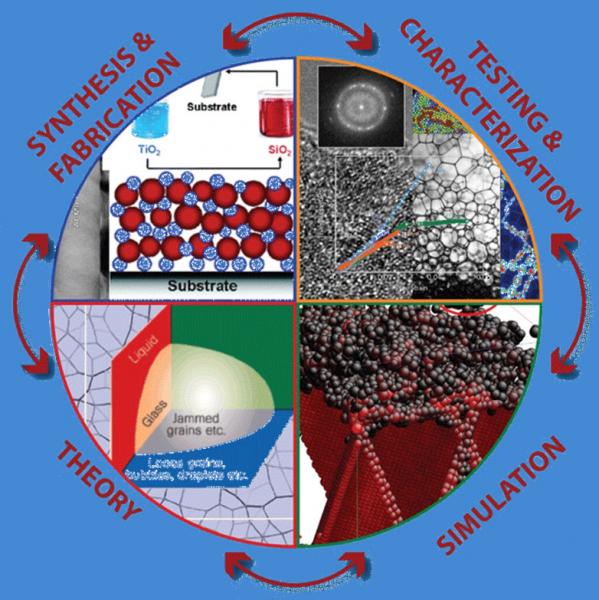
IRG-3 studies disordered packings of atoms, nanoparticles, colloids and grains with a goal to to understand how localized rearrangements organize under extreme load to form shear bands, and thereby to develop ways of predicting whether systems are about to fail, and to make new, tough materials by designing their vibrational properties. In condensed matter systems, disordered packings are pervasive. Yet our fundamental understanding of the mechanical response of disordered packings lags far behind that for crystalline ones. In particular, the mechanisms controlling mechanical instabilities that lead to failure are not understood. This scientific gap impedes applications of materials such as bulk metallic glasses, amorphous thin films, and nanoparticle assemblies. To gain new insights into the failure process, the onset of mechanical instabilities and failure will be studied in disordered systems across a range of constituent particle sizes, from packings of atoms to packings of macroscopic grains. This comparative approach brings together researchers from fields that are currently disparate. IRG-3 leverages this collective expertise to study shear band formation and the onset of mechanical failure at each scale: (1) atoms in carbon-based films and metallic glasses; (2) nanoparticles in layer-by-layer (LbL) assemblies; (3) colloidal glasses; and (4) granular media. The atomic and nanoparticle systems are chosen because their mechanical properties are important in applications. The colloidal and granular systems are chosen both for their materials importance and as model systems that are straightforward to visualize and that offer fine control over particle interaction and particle shape and size distributions. The IRG's long range goal will be to use this knowledge to develop and test new design rules for fabricating novel materials with otherwise unattainable mechanical stability.
Multicomponent Assemblies for Collective Function
IRG4 seeks to understand and control the organization of particle mixtures to generate photonic and electronic architectures in which non-additive functions are imparted by the collective properties of the array. Co-assemblies will incorporate multiple, distinct particle populations that vary in composition and consequently in their response to various directed self-assembly approaches (Figure, top/middle). Learning how to achieve desired assembly outcomes despite these differences, and to find ways to take advantage of them for increased control, will set the stage for a new era of nanomaterial-enabled device applications well beyond those proposed here. Three general classes of multicomponent assemblies will be investigated, incorporating new types of functional particles and spanning a wide range of organizational ordering schemes (Figure, bottom): (1) well-ordered arrays with single-particle positioning relative to underlying electrical contacts for fundamental studies of bioinspired synchronization in electronic oscillator networks; (2) arrays with intermediate order that will collectively define the spatial refractive index profile to manipulate light in new ways; (3) disordered assemblies of scattering particles to advance understanding of ‘random’ photonics, with a focus on lasing and nonlinear wave mixing.
Topological Phases of Matter and Their Excitations (IRG 1)
 IRG-1 brings together a diverse team of solid-state chemists, condensed matter physicists, and electrical engineers to create materials systems with topological electronic phases and to probe and understand their novel properties using a variety of experimental and theoretical techniques. It proposes a broad program that includes the study of topological quantum states in novel insulators, semiconductors, metals, superconductors and magnetic materials.
This IRG builds on our previous successes in the study of topological phases in Bi-based semiconductors to further develop the new class of topological crystalline insulators and metals with strongly spin-split electronic states to explore helical bulk electronic systems. To realize topological superconducting phases, we harness atomic scale engineering and self-assembly to realize new nanoscale systems that are expected to harbor topological excitations that are Majorana fermions. Looking beyond Majorana fermions, we use our state-of-the art molecular beam epitaxy (MBE) growth of extremely high mobility two-dimensional electron systems and combine these systems together in bilayers and with superconductors to search for Majorana-like excitations (parafermions) that are predicted to be excitations of an interacting topological state. Magnetic systems provide a unique setting to explore topological phases and their excitations in condensed matter systems and will be another focus of our program; one particularly interesting system we plan to examine is made up of chains of coupled magnetic moments in which there are emergent low energy fermionic excitations. Frustrated and Kagome lattices of spins provide their own opportunities to create spin systems that have interesting low energy topological excitations.
Co-Leaders
R. J. Cava, co-leader (Chemistry)
N. P. Ong, co-leader (Physics)
Senior Investigators
B. A. Bernevig (Physics)
F. D. M. Haldane (Physics)
L. Pfeiffer (Elec. Engin.)
M. Shayegan (Elec. Engin.)
Donna D. N. Sheng (Cal. State Northridge)
Leslie Schoop (Chemistry)
A. Yazdani (Physics)
Collaborators
T. Valla (Brookhaven Nat. Lab.)
G. Gu (Brookhaven Nat. Lab.)
V. Bayot (Catholic Univ. Louvain, Belgium)
M. Lilly (Sandia National Labs)
Qi-kun Xue (Tsinghua, Beijing)
Yayu Wang (Tsinghua, Beijing)
Shaping Plasmonic Nanomaterials by Chemical Synthesis
Metal nanoparticles (e.g., Au, Ag, Cu, Al) are essential components in the toolbox of plasmonic nanostructures. Bottom-up chemical synthesis offers the potential for scaling up the materials production, as well as tailoring optical properties by fine tuning size, shape and surface beyond the conventional photolithography limit. We aim to develop rational synthesis strategies for producing nanoparticles with desired morphologies (nanowires, nanocubes, nano square cuboids), and for building up a knowledge base of shape-properties relationships. Such nanoparticles can be used as the building blocks in many areas such as plasmonic circuits, surface enhanced Raman scattering (SERS), bioimaging and even cancer therapy.
Micromechanics
This IRG investigates mechanical properties in soft matter and interfaces that are both a scientific challenge and an important technological problem. Understanding the mechanical behavior of materials requires insight into phenomena at different length scales. This IRG has established the importance of mechanics in describing soft materials and interfaces with more traditional hard materials.
SuperSeed
Magnetically and Optically Driven Topological Semimetals
 In the past decade, there has been remarkable progress in our understanding of topological states of matter. A quantum state is topological if its ground state wave function bears a distinctive character that can be specified by a topological invariant—a discrete quantity that remains unchanged upon adiabatic deformations of the system. Since the 1980s, quantum Hall systems have been recognized to be topological, but it was long believed that such topological states are rather exceptional in nature and only exist in quantum liquids under extreme conditions (requiring high magnetic fields and low temperatures). However, after the discovery of topological insulators (TIs), it has come to be widely recognized that topological states of matter can actually be widespread. In this sense, TIs have established a new paradigm about topological materials and opened up an interdisciplinary field at the crossroad between physics,quantum chemistry and material science.
The goal of this research is to discover two new types of TSMs in magnetic and photo-driven systems respectively, and explore their novel properties. First, magnetic TSMs consist of itinerant electrons that form the Dirac/Weyl point in k-space and localized moment that generates magnetism. The exchange coupling between the two is expected to catalyze a plethora of novel correlated phenomena, including an anomalous Hall effect induced by Berry curvature, an axion electromagnetic response, tunable Weyl point creation/annihilation, and metal-insulator transitions. Despite intensive searches, magnetic TSMs have not been experimentally found. The PIs will combine theoretical and experimental efforts to search for magnetic TSMs in correlated electron systems.
Second, the PIs propose a new topological phase of matter in photon-electron hybrid states, which they term the Floquet topological semimetal. Recent experiments lead by the PI Gedik has demonstrated that Bloch states in solids can be “dressed” by intense laser light, forming “Floquet-Bloch states” that are completely coherent and behave like real bands. When these states form topologically robust band crossings in energy-momentum space, the photo-excited system is expected to become a Floquet topological semimetal. The PI Fu will theoretically determine the photon polarization and frequency required for this new phase, while Checkelsky will provide the necessary materials platform and Gedik use well-established time resolved photoemission techniques to uncover these Floquet TSMs.
I. Magnetic Topological Semimetals
An important class of TSMs, known as Weyl semimetals, is proposed to materialize in magnetic topological insulators, where time-reversal symmetry is spontaneously broken. Fu’s group will use first-principles calculations to identify such magnetically driven TSMs in candidate materials and predict their emergent phenomena. Checkelsky’s group will synthesize samples and characterize their transport and magnetic properties, which will then be studied by Gedik’s group using angle-resolved photoemission spectroscopy (ARPES) to directly observe the Dirac/Weyl point in the bulk and the topological surface states with Fermi arc. Gedik’s group will further perform optical and magneto-optical measurements to thoroughly characterize the electronic structure. In addition to its scientific value, the discovery of TSMs may enable new spintronic device application, where electrical properties can be efficiently tuned by magnetization.
II. Floquet Topological Semimetals
Besides the static optical and photoemission measurements probing the equilibrium, Gedik will also study the dynamics of the material in response to photoexcitation by light. Gedik has recently showed that by shining light with energy below the bulk band gap of a topological insulator, hybrid photon-electron states can be created. These states are called Floquet-Bloch states, which are the Bloch states “dressed” by the intense laser light. Surface electrons coherently can emit and absorb multiple laser photons giving rise to replicas of the original dispersion separated by integer multiples of photon energy. These new states are completely coherent and behave like real bands for practical purposes. When these bands cross they can hybridize and open up band gaps along certain directions. Considering the fact that material properties are largely determined by electronic dispersion, this ability to manipulate the electronic band structure with light is a novel way to engineer novel quantum phases of matter. There have been a number of proposals for inducing phase transitions using Floquet methods, such as inducing a Floquet topological insulator from a trivial insulator.
Showing 1081 to 1090 of 2691