Seed 2: Room Temperature Spin-orbit Torque Switching Induced by a Topological Insulator
Research Summary: Recent studies on magneto-transport properties of topological insulators
(TIs) have attracted great attention due to the rich spin-orbit physics and promising applications
in spintronic devices. Particularly, the strongly spin-momentum coupled electronic states have
been extensively pursued to realize efficient spin-orbit torque (SOT) switching (Figure 1(a)).
However, so far current-induced magnetic switching with TIs has only been observed at
cryogenic temperatures. The goal of this seed project is to understand whether the topologically
protected electronic states in TIs could benefit spintronic applications at room temperature.
In this seed project, full SOT switching has been demonstrated in a TI/ferromagnet
heterostructure with perpendicular magnetic anisotropy (PMA) at room temperature (Figure
1(b)) [1]. Ferrimagnetic cobalt-terbium (CoTb) alloy with bulk PMA was used to overcome the
effects of the interfacial lattice mismatch, permitting direct growth on the classical TI material
Bi2Se3. The low switching current density (~ 3 × 10⁶ A/cm2) provides definitive proof of the high
SOT efficiency from the TI. The SOT efficiency was measured by the current-induced shift of
the Hall resistance-versus-magnetic field hysteresis loops (Figure 1(c)), which is consistent with
the model of the current-induced Néel-type domain wall motion. Accordingly, the effective spin
Hall angle of the TI was determined to be several times larger than in commonly used heavy
metals (Figure 1(c)). Moreover, power consumption for switching a ferromagnetic layer with
either a TI or a heavy metal was calculated, indicating that magnetization switching with TIs
presents much higher energy efficiency than with conventional heavy metals. These results
demonstrate the robustness of TIs as an SOT switching material and provide an avenue
towards applicable TI-based spintronic devices.
Rearrangements & Softness in Disordered Solids
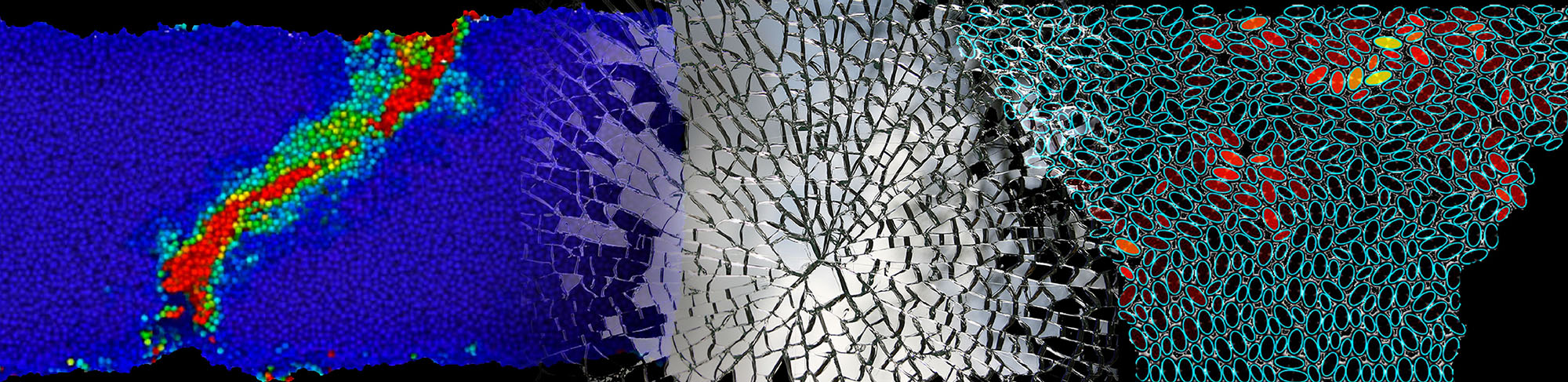
Rearrangements & Softness in Disordered Solids aims to develop fundamental understanding of the organization and proliferation of localized particle-scale rearrangements in disordered solids deformed just beyond the onset of yield, and thereby identify strategies for controlling nonlinear mechanical response and enhancing toughness. The materials studied by the team span a wide range of length scales from amorphous carbon and atomic/molecular glasses, to nanoparticles and colloids, to macroscopic bubbles and grains. When pushed beyond yield, some materials crack or shatter due to rearrangements that collect along planes, whereas others flow smoothly because rearrangement events remain separated. New theoretical concepts, some based on machine learning, will be developed to understand this dramatic difference, and these theories will be tested by atomistic simulations and experiments on systems for which it is possible to measure microstructure versus time during a large imposed deformation. Ultimately, these factors will be optimized to widen the window between yield and failure and hence to improve toughness.
Designing Materials Using Directed Evolution
The goal of this Seed is to develop new materials with unique properties through directed evolution. Through genetic mutation, protein expression, and high throughput materials screening, this Seed is harnessing the power of biological evolution for materials design. Our Seed is developing high throughput protein expression and purification techniques to synthesize sufficient quantities of material for characterization of mechanical and interfacial properties. Parallel efforts are exploring high-throughput screening methods to identify successful mutants within a large genetic library. Our work is developing new materials and understanding how existing biomaterials may have been developed through eons of evolution.
Center for Emergent Materials (2008)
The Materials Research Science and Engineering Center (MRSEC) at the Ohio State University (OSU), titled Center for Emergent Materials (CEM), performs integrated research on emergent materials and phenomena in magnetoelectronics. The aim of the Center research activities is to advance understanding of the emergent materials and phenomena and to develop highly sophisticated experimental and theoretical tools required to study them, which will lay down the scientific foundation for building future oxide-based electronic devices that can perform multiple functions, and energy-efficient, fast computers that have integrated memory and logic. The Center has two interdisciplinary research groups (IRGs). IRG 1, Towards Spin-Preserving, Heterogeneous Spin Networks, will develop a new understanding of electron-spin injection and transport in low-dimensional, spin-preserving materials such as silicon and carbon. This understanding provides a new materials basis for creating novel high-density spin networks for next-generation computing. IRG 2, Double Perovskite Interfaces and Heterostructures, designs and controls multifunctional properties of innovative double perovskite heterostructures through the understanding of structure, defects, and magnetotransport properties at interfaces. This new knowledge of magnetism in metallic oxides enables important advances in the emerging field of oxide-based electronics. The IRGs are complemented by a Seed Funding program, which provides the necessary flexibility and vitality to CEM in responding swiftly and effectively to the rapidly-changing materials research landscape. Integrated with the research activities, CEM enhances classroom education, creates research internship opportunities, widens the Science-Technology-Engineering-Math (STEM) "pipeline," and enhances diversity in STEM. Activities include an innovative education research program aimed at cognition of materials science concepts, K-12 outreach and visitation programs, undergraduate research programs, and graduate-education enhancement programs. The multidisciplinary OSU materials community is already home to major world-class shared experimental facilities, which are brought to bear on CEM research and education. The Center collaborates with the electronics, storage, and instrumentation industries; national laboratories and institutes; other U.S. universities; and international universities and laboratories in China, India, Germany, and United Kingdom.
Synergistic Linear and Nonlinear Phenomena in Multifunctional Oxide Ceramic Systems
IRG #1 seeks to advance fundamental knowledge leading to the development of energy-efficient and novel multifunctional devices for electronic, optoelectronic, storage, sensor and information technologies. The methodologies employed by the group include exploring and exploiting the unique attributes of oxide materials, resulting in two or more functionalities; and developing a thin film platform to integrate multifunctional oxides. The group focuses on oxides which simultaneously exhibit a combination of electrical conductivity, optical transparency, linear and non-linear response to external electrical, magnetic and stress fields. They are also working to validate and optimize coupled phenomena (for example optical transparency with electrical conductivity; ferroelectricity with ferromagnetism). The development of a thin film and heterostructure integration strategy is underway; and first-principles theory and simulation are being coupled with device modeling and characterization
UPENN Materials Research Science and Engineering Centers (2000)
The Materials Research Science and Engineering Center (MRSEC) at the University of Pennsylvania supports a broadly based interdisciplinary research program on complex nanostructures and materials. The research is carried out in four Interdisciplinary Research Groups (IRG) with appropriate seed projects. The IRG on Functional Biomolecular Materials focuses on developing engineering principles for de novo protein design directed towards creation of novel molecular constructs that carry out natural or novel functions with the ultimate goal of producing selectively functionalized modular materials and devices. A second IRG focuses on Carbon Nanotube-Derived Materials and involves the synthesis, assembly and theory of higher-order structures created from single-walled nanotubes. The IRG on Microscale Soft Materials harnesses theoretical and experimental expertise to design and control the self-assembly of new classes of microstructured colloidal systems with tailored optical, mechanical, rheological and storage properties. An IRG of Multifunctional Complex Oxides designs, synthesizes, characterizes and models novel materials that exhibit highly sensitive responses to external magnetic and electrical fields. The MRSEC is also developing innovative methods of instruction. It is linked to the University of Puerto Rico through a Collaborative to Integrate Research and Education. It hosts a significant program for Research Experiences for Undergraduates and it has initiated a program to provide Research Experiences for Teachers. The Center maintains a large set of shared experimental facilities that provide state of the art instrumentation for the entire University, and act as a focal point for graduate education and for knowledge transfer to industry. Participants in the Center include 36 senior investigators, 12 postdoctoral associates, 29 graduate students, 15 undergraduates, and 5 technicians and other support personnel. Professor Michael Klein directs the MRSEC.
University of Kentucky MRSEC: Advanced Carbon Materials Center (1998)
The Materials Research Science and Engineering Center (MRSEC) at the University of Kentucky focuses on the synthesis, characterization and applications of carbon nanotubes, carbon fibers, and nanotube and fullerene composites. The Center also provides seed funding for new opportunities in related areas. The Center supports efforts in materials education at all levels, including summer undergraduate research experiences and short courses and workshops on carbon materials. The MRSEC also supports shared experimental facilities that are accessible to center participants and to outside users, and has strong research collaborations with other universities and industrial laboratories.
Research in the University of Kentucky MRSEC is organized in an interdisciplinary research group that addresses the science and applications of advanced carbon materials. Participants in the Center currently include 10 senior investigators, 3 postdoctoral associates, 18 graduate students, and 1 administrative support staff. Professor Robert C. Haddon directs the MRSEC.
Designed Programmable Membranes
Senior Investigators: William F. DeGrado & Daniel A. Hammer IRG Leaders; Feng Gai, Mark D. Goulian, Michael L. Klein, Virgil Percec
IRG-3 draws expertise from four departments to design fully integrated functional analogues of cellular mstrongbranes. The goal is highly stable mstrongbranes with integrated functional components including, ion channels, receptors, & signal transducers. strongploying the tools of molecular nanotechnology, the IRG will support both biological & bio-inspired synthetic approaches to these problstrongs.
Polymeric Ionic Liquids
Elucidating fundamental design principles connecting molecular architecture and charge physics with material properties in polymeric ionic liquids has the potential to revolutionize diverse applications including electrochemical membranes and soft robotics. IRG-2 aims to understand how materials that incorporate delocalized ionic groups onto or within a low dielectric backbone self-assemble and how charge moves through these structures. The team will further impart functional properties such as photochromism, multivalent ion conductivity, redox activity, magnetism, and reconfigurability through design and exchange of ions.
Oxides as Semiconductors
 The grand challenge of IRG-2 is to develop oxides as semiconductors materials to replace nitride-based systems in the next generation of devices such as solid-state lighting. By exploiting the potential of new growth strategies for oxide semiconductors, controlling and understanding defects and impurities a sound experimental and theoretical understanding of oxides as semiconductors will be developed by a world-class, multidisciplinary team.
Showing 1071 to 1080 of 2691