Michigan State University Materials Research Science and Engineering Center (1998)
The Materials Research Science and Engineering Center (MRSEC) at Michigan State University focuses on sensing materials for control and diagnostics. The Center also provides seed funding for new opportunities in sensor materials. The Center supports education outreach efforts that include research experiences for undergraduates and outreach to the pre-college level through hands-on workshops for junior high school science teachers. The MRSEC also supports shared experimental facilities that are accessible to center participants and to outside users, and broad industrial outreach efforts.
Research in this MRSEC is organized into two interdisciplinary research groups. One group emphasizes optical probes of processes critical to engine diagnostics and sensing. A second group explores various transduction methods for transforming chemical and physical information into electrical signals. Participants in the Center currently include 21 senior investigators, 3 postdoctoral associates, 11 graduate students, 8 undergraduates, and one administrative support personnel. Professor Brage Golding directs the MRSEC.
UMD Materials Research Science and Engineering Center (1996)
The Materials Research Science and Engineering Center (MRSEC) at the University of Maryland supports interactive research in two interdisciplinary groups focusing on oxides, thin films, and novel surface spectroscopic probes. One of the research groups emphasizes fundamental materials issues in ferroelectric thin film heterostructures , related device problems of technological relevance, and fundamental materials physics of perovskite materials that exhibit unusually large ("colossal") magneto- resistance. The second group investigates the structure of surfaces on length scales from nanometers to microns, with the goal of developing a predictive understanding of surface morphology. The work may ultimately find practical application in micro-electronics, thin film growth, lubrication, catalysis, and other areas. A common theme for both groups is the development, optimization and utilization of novel surface sensitive tools to measure structural, magnetic, and electrical properties at microscopic length scales. The MRSEC supports the development, operation and maintenance of shared experimental facilities for materials research. It provides seed funding for exploratory research and fosters research participation by undergraduates. The Center is associated with an educational outreach program designed to enlighten pre-college and undergraduate students about science and the role of the center's research program in the modern world. The MRSEC also supports enhanced collaboration with industry, shared experimental facilities that also support research not directly funded by the MRSEC, and seed funding for exploratory research. The Center currently supports about 15 senior investigators, 7 postdoctoral research associates, 1 technician or other professional, 12 graduate students, and 8 undergraduates. The MRSEC is directed by Professor Ellen D. Williams. %%% The Materials Research Science and Engineering Center (MRSEC) at the University of Maryland supports interactive research in two interdisciplinary groups focusing on oxides, thin films, and novel surface spectroscopic probes. One of the research groups emphasizes fundamental materials issues in ferroelectric thin film heterostructures , related device problems of technological relevance, and fundamental materials physics of perovskite materials that exhibit unusually large ("colossal") magneto- resistance. The second group investigates the structure of surfaces on length scales from nanometers to microns, with the goal of developing a predictive understanding of surface morphology. The work may ultimately find practical application in micro-electronics, thin film growth, lubrication, catalysis, and other areas. A common theme for both groups is the development, optimization and utilization of novel surface sensitive tools to measure structural, magnetic, and electrical properties at microscopic length scales. The MRSEC supports the development, operation and maintenance of shared experimental facilities for materials research. It provides seed funding for exploratory research and fosters research participation by undergraduates. The Center is associated with an educational outreach program designed to enlighten pre-college and undergraduate students about science and the role of the center's research program in the modern world. The MRSEC also supports enhanced collaboration with industry, shared experimental facilities that also support research not directly funded by the MRSEC, and seed funding for exploratory research. The Center currently supports about 15 senior investigators, 7 postdoctoral research associates, 1 technician or other professional, 12 graduate students, and 8 undergraduates. The MRSEC is directed by Professor Ellen D. Williams.
Sustainable Nanocrystal Materials
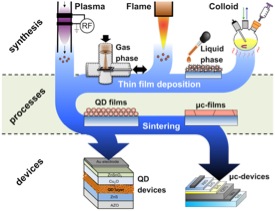
The focus of IRG-2, Sustainable Nanocrystal Materials, is the design, synthesis, processing, and thin film properties of environmentally benign nanocrystal-based electronic and optoelectronic materials. The field is currently constrained by the use of toxic (e.g., Pb, Cd) and/or scarce (e.g., In, Te) elements, with serious environmental, health, and economic concerns. IRG-2 will overcome these barriers by discovering and developing nanocrystal-based electronic thin films made from nontoxic, abundant and sustainable materials using scalable, low-temperature processes. The IRG's research will pursue three closely linked, vertically integrated thrusts: (i) nanocrystal synthesis and characterization; (ii) quantum dot films and devices; and (iii) microcrystalline films and devices. This research aims to reinvent the scope of active materials for NC-based electronics and optoelectronics, which will ultimately enable energy efficient emissive or photovoltaic devices with sustainable materials choices.
Novel nanostructures for nonlinear frequency conversion (SEED 7)
Seeds 7 is working to design nano-structured materials for wide bandwidth operation that can be used to greatly enhance nonlinear interactions, including nonlinear frequency conversion (NFC) processes: frequency mixing between two or more photons.
Principal Investigators
Alejandro Rodriguez (Electrical Engineering)
Loren Pfeiffer (Electrical Engineering)
Claire Gmachl (Electrical Engineering)
* This seed is inactive. (Seed start/end date: April 1, 2016 - October 31, 2018)
Seed 3: Bottlebrush Hydrogels as Tunable Tissue Engineering Scaffolds
Bottlebrush Hydrogels as Tunable Tissue Engineering Scaffolds
Senior Investigator: Robert Macfarlane, Assistant Professor, Department of Materials Science and Engineering
Tissue engineering (TE) is a promising method to grow artificial tissues for biological and biomedical applications, typically implemented using a porous, flexible, and biocompatible scaffold for cells so that, upon growth and proliferation, they ultimately form a continuous three-dimensional biomaterial1,2. However, living cells and tissues are complex constructs, and synthesizing scaffolds that properly interact with them remains a challenge; scaffolds need to simultaneously be (1) biocompatible, (2) mechanically matched to the native tissue, (3) porous enough to allow for nutrient flow and tissue development, and (4) capable of presenting molecular signals that promote cell growth and viability. Therefore, while hydrogels are a promising tool for medicine and biology, several key limitations in these biomedical technologies can only be addressed via advances in the field of materials science.
Here, we will develop methods to synthesize new BBP architectures, crosslink them into gels, and characterize how different design variables affect the resulting gel physical, chemical, and mechanical properties. Our lab is uniquely suited to study these materials, as we possess the requisite polymer
synthesis and characterization capabilities necessary, and have proven expertise in manipulating soft material structure at the nanoscale via controlled polymer synthetic strategies10. Additional support from other member of CMSE IRG II will aid in our characterization capabilities.
Molecular and Electronic Dynamics at Organic-Inorganic Interfaces
Harnessing the "Rules of Life" to enable bio-inspired soft materials
Principal Investigators:
Howard Stone (Mechanical & Aerospace Engineering)
Sujit Datta (Chemical and Biological Engineering)
Andrej Košmrlj (Mechanical & Aerospace Engineering)
Clifford Brangwynne (Chemical and Biological Engineering)
Bonnie Bassler (Molecular Biology)
Seed start and end dates: November 1, 2018 - October 31, 2019
An exploratory and promising research project based on a recent discovery — that polymers can regulate the structure and function of biological systems — is generating a new field of “living” soft matter. The researchers discovered that polymers can regulate the structure and function of biological materials, ranging from sub-cellular proteins to extracellular hydrogels to populations of cells, through entropic interactions. These results have generated a new field at the interface of biology, physics, and chemistry whose findings will enable the control and design of novel materials. The project goals are to define the principles underlying structural transition in intra-, extra-, and multi-cellular systems and to use this knowledge to control and design novel bio-inspired soft materials.
The research team is composed of Clifford Brangwynne (CBE), Howard Stone (MAE) and Andrej Košmrlj (MAE) who will focus on confined polymer dynamics and phase transitions. Other team members include Bonnie Bassler, (MolBio) and Sujit Datta (CBE) who will investigate structural transitions in biological and bio-inspired polymer liquids and polymer networks using experiments, theory, and simulations.
Highlights
Harnessing the Rules of Life to Enable Bio-Inspired Soft Materials (PDF)
Interface Engineering of Silicon-Oxide Core-Shell Nanorods for High-Efficiency Water Splitting Photocatalysts
Alexie M. Kolpak, Assistant Professor, Department of Mechanical Engineering
Water splitting over semiconductor photocatalysts using solar energy is a promising process for renewable hydrogen production, but an increase in conversion efficiency is required to make it economically viable. Increasing efficiency requires new materials with optimized (i) band alignment; (ii) visible light absorption; (iii) electron-hole separation; (iv) hydrogen and oxygen evolution activity; and (v) photo-corrosion resistance. We propose to use ab initio computations and classical molecular dynamics simulations to design novel core-shell catalysts to optimize these key metrics by taking advantage of interfacial effects. Our previous work showed that Si-oxide interface chemistry can induce a large electric field in an oxide thin film and a quasi-2D electron gas (Q2DEG) at the Si-oxide interface. We propose that in such a system, electrons (holes) will be driven to the Q2DEG (oxide surface), leading to a dramatic decrease in carrier recombination, and the field will also trap holes on the surface, enhancing catalytic activity and further increasing efficiency. The absorption spectrum, redox potentials, catalytic activity, transport properties, and field can be tuned by atomic-scale modifications (e.g., interfacial cation substitution), core diameter, shell thickness, and/or oxide choice. We will examine the coupling between these properties and the atomic structure, develop fundamental models of the interface chemistry, and design new high-efficiency photocatalysts. Both the physical insights and the new tools developed will be directly applicable to the design of tailored materials systems for other catalytic reactions, as well as for a wide variety of other applications in which interfaces play an important role, (e.g., photovoltaics, fuel cells, thermoelectrics).
Ultrastable Glasses: New Materials and New Insights
Glasses are ubiquitous across materials types and technological applications but their structure - property - processing relationships and underlying fundamental physics remain poorly understood. IRG 2 uses cross-fertilization of ideas and techniques for organic and inorganic glasses to design ultrastable glassy materials and use them to address these fundamental problems in glass science. These efforts include using physical vapor deposition to synthesize glassy thin films with widely varying stability, systematic coherent electron nanodiffraction to measure glass structure and dynamics, and high thermal ramp-rate calorimetry to investigate polyamorphism. Simulations and materials informatics guide the design of new glasses, and provide molecular-level insight into mechanical properties, thin film growth, and molecular motions. IRG 2 investigates both organic and inorganic glasses, including small molecules, metals, and ceramics, enabling identification of cross-cutting phenomena and mechanisms inherent to the glassy state.
Showing 1091 to 1100 of 2691