Highlights

May 16, 2022
Big Idea: Quantum Leap

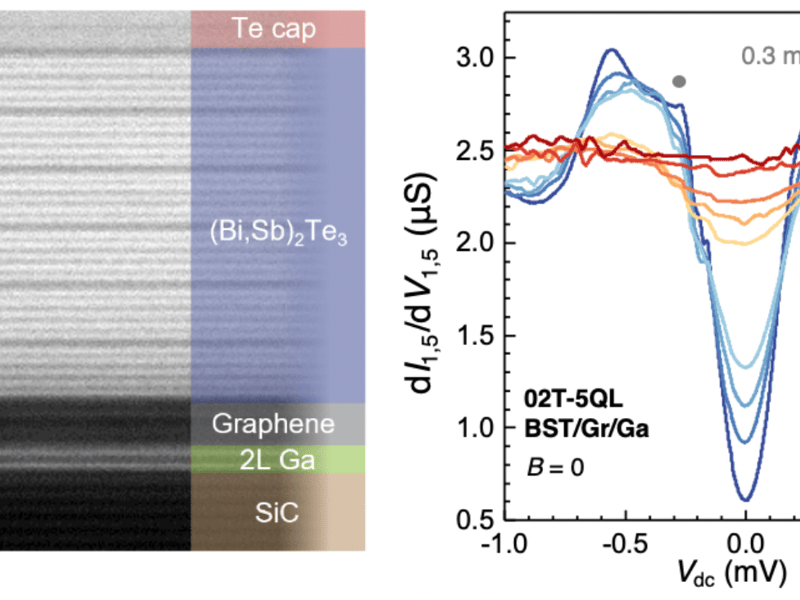
Strong coupling between a topological insulator and a III-V heterostructure at terahertz frequency

D. Q. To, M.F. Doty, S. Law, J.M.O. Zide, A. Janotti (University of Delaware) and G.W. Bryant (NIST), University of Delaware MRSEC DMR-2011824

This research focuses on theoretical prediction of strong coupling between the THz excitations in a topological insulator (TI) and a III-V quantum well, providing a potential material platform for optoelectronic device applications in the THz frequency domain.
May 16, 2022
Big Idea: Synthetic Materials Biology, Understanding the Rules of Life

Computational Design of Tetrahelical Peptide Bundle Variants Spanning a Wide Range of Charge States

R. Guo (University of Pennsylvania), N. Sinha, R. Misra, C. Kloxin, G. Jensen, D. Pochan (University of Delaware), J. Saven (University of Pennsylvania) [University of Delaware MRSEC DMR-2011824]

The resarch focus of this effort involved computationally designing a homotetrameric helical bundle to have a variety of net charges. The charged bundle variants showcase how charge state can be controlled for a common peptide structure, as well as the properties of the fibril nanomaterials constructed by the peptide building blocks.
May 14, 2022
Big Idea: Understanding the Rules of Life

Spatiotemporal control of active materials

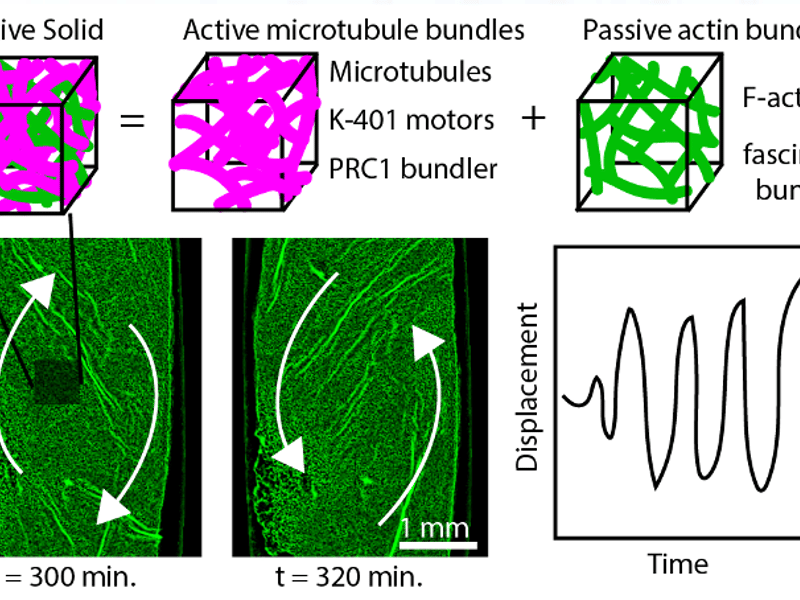
Biological cells control spatial and temporal generation of active stresses to achieve diverse sought-after functionalities ranging from motility to cell division. Motivated by these observations IRG2 goal is to control of spatiotemporal patterns of active stresses and to endow soft materials with lifelike functionalities.
May 14, 2022
Big Idea: Understanding the Rules of Life

Self-assembling DNA Origami Shells

S. Fraden, M. Hagan, W. Rogers: Brandeis University; G. Grason: U. Mass. Amherst; H. Dietz: Tech. Universität München

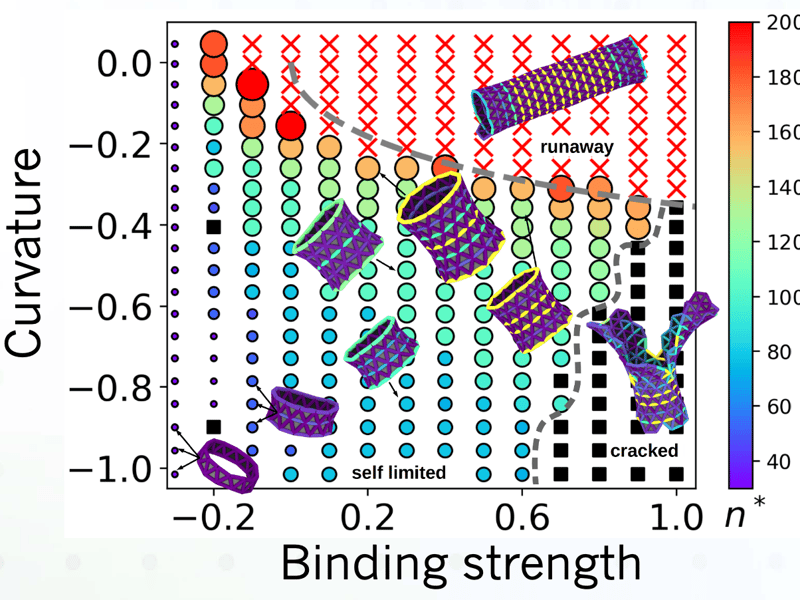
The self-assembly of biological molecules into large, but finite-size, superstructures is fundamental to life. A grand challenge for colloidal self-assembly is to produce colloidal monomers with valence-limited interactions, that have arbitrary angles and strengths, to produce structures with the precision, complexity and functionality of biological assemblies.
May 14, 2022
Big Idea: Quantum Leap

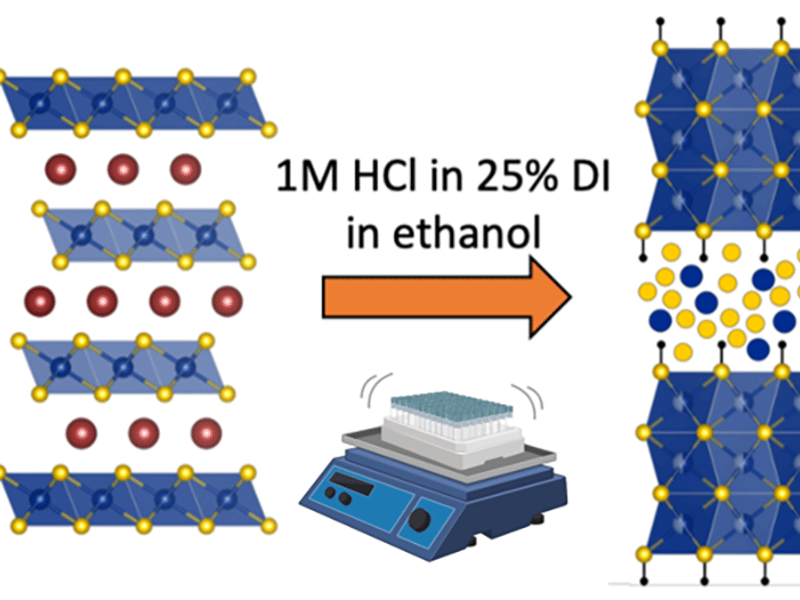
Superatom Regiochemistry Dictates the Assembly and Surface Reactivity of a Two-Dimensional Material

Colin Nuckolls, Xavier Roy, Columbia University Center for Precision-Assembled Quantum Materials

The area of two-dimensional (2D) materials research would benefit greatly from the development of synthetically tunable van der Waals (vdW) materials. While the bottom-up synthesis of 2D frameworks from nanoscale building blocks holds great promise in this quest, there are many remaining hurdles, including the design of building blocks that reliably produce 2D lattices and the growth of macroscopic crystals that can be exfoliated to produce 2D materials.
May 14, 2022
Big Idea: Quantum Leap

Crossover between strongly coupled and weakly coupled exciton superfluids

Cory Dean, Columbia University Center for Precision-Assembled Quantum Materials (PAQM)
We studied graphene double layers separated by an atomically thin insulator. Under applied magnetic field, electrons and holes couple across the barrier to form bound magneto-excitons. Using temperature-dependent Coulomb drag and counterflow current measurements, we were able to tune the magneto-exciton condensate through the entire phase diagram from weak to strong coupling.
On the left is a figure of a honeycomb type lattice of points.  On the right is a set of plots of electrical resistance of the material as a function of the magnetic field.  The curves all pass close to the origin of the axes.  Some are nearly flat, and some look like a step.
On the left is a figure of a honeycomb type lattice of points. On the right is a set of plots of electrical resistance of the material as a function of the magnetic field. The curves all pass close to the origin of the axes. Some are nearly flat, and some look like a step.
May 12, 2022
Big Idea: Growing Convergence Research

Quantum anomalous Hall effect in atomically-thin semiconductor layers

Analogous to a superconductor, the quantum anomalous Hall effect can transport electrons in a sample without dissipating any energy. The effect has been proposed as an important element for quantum circuitry, quantum computing and a standard for fundamental constants of physics. Unfortunately, it often emerges only at temperatures near absolute zero (~ 0.1 K).
Materials indicated at the top right are grown as wafers (top left). A wafer of material is grown in a cylindrical chemical reactor.  Wafers of different materials grown in the reactor are patterned into small pieces called pixels. They are then patterned into pixels and assembled into arbitrary combinations. Structures that look like a checkerboard pattern can be made. Each square in the board has a different sequence of material layers.  The absorption of light can be measured in each of the squares to learn about the material in that square.
Materials indicated at the top right are grown as wafers (top left). A wafer of material is grown in a cylindrical chemical reactor. Wafers of different materials grown in the reactor are patterned into small pieces called pixels. They are then patterned into pixels and assembled into arbitrary combinations. Structures that look like a checkerboard pattern can be made. Each square in the board has a different sequence of material layers. The absorption of light can be measured in each of the squares to learn about the material in that square.
May 12, 2022
Big Idea: Future of Work at the Human-Technology Frontier, Materials Under Extreme Conditions

Robotic Pixel Assembly of Atomically-Thin Materials

As new methods are established to synthesize atomically-thin quantum materials, it becomes necessary to develop a technique to take those materials and assemble them into complex structures.
May 12, 2022
Center for Dynamics and Control of Materials (2017)

Colorimetric Quantification of Linking in Thermoreversible Nanocrystal Gel Assemblies

D. Milliron, E. Anslyn, T. Truskett: Univ. of Texas at Austin

This highlight demonstrates the gelation assembly of colloidal nanocrystals using uniquely developed ligands that can form a metal coordination linkage. Metal ions that are paired with ligand functional groups were used to control the assembly of nanocrystals from a stable dispersion to full spanning gel networks. The metal coordination linkage was reversed using temperature as an external trigger and enabled thermally switchable nanocrystal gel networks.
May 12, 2022
Center for Dynamics and Control of Materials (2017)

CDCM Industrial Mentorship Program Prepares Students for the Workforce of Tomorrow

The Industrial Mentorship Program connects undergraduate students, graduate students and post-doctoral fellows to a mentor in industry. This program is designed to expose participants to fundamental research as it relates to societal and economic development; enable them to broaden their networks; and facilitate a successful transition into the workforce.