 Research Focus
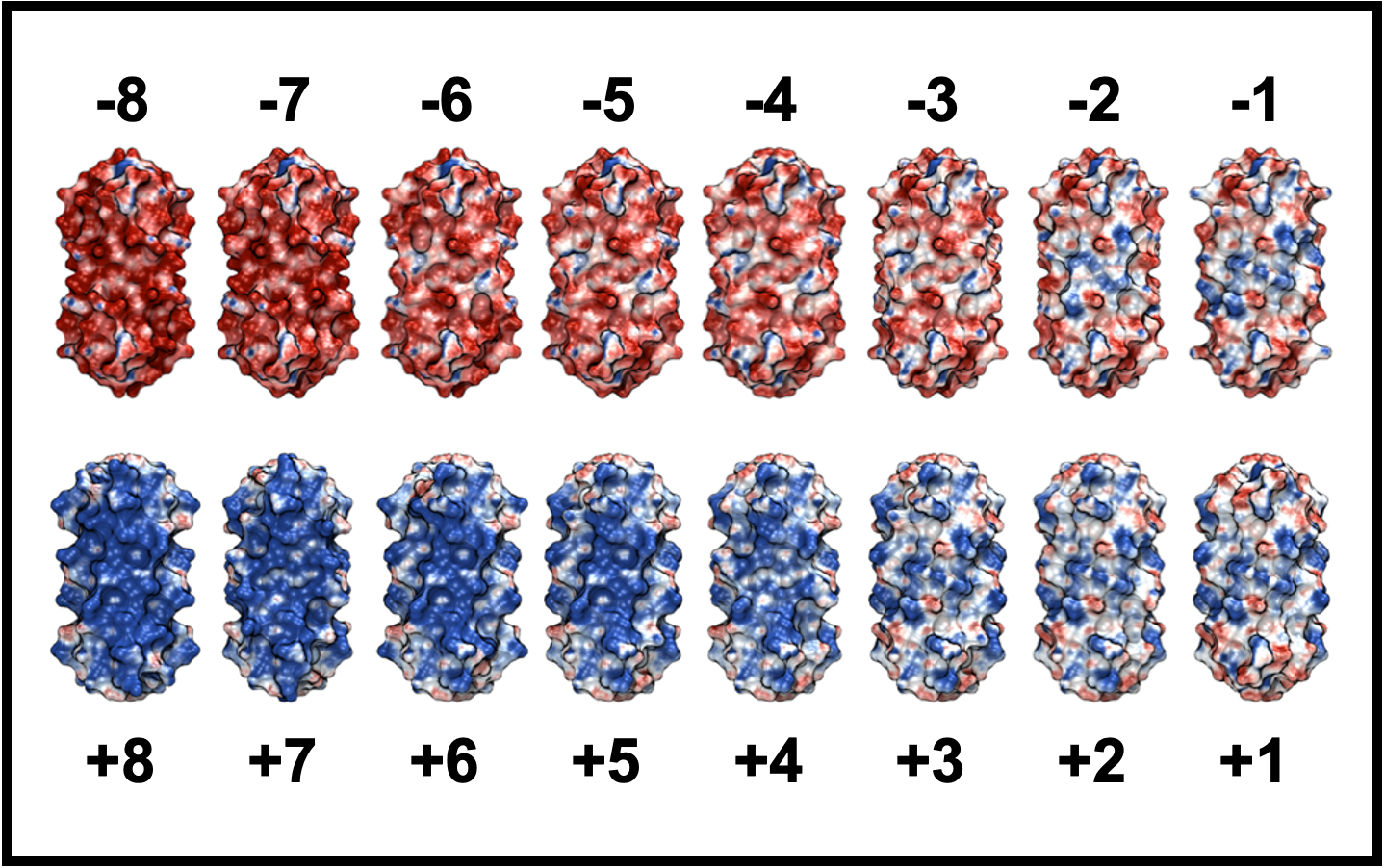
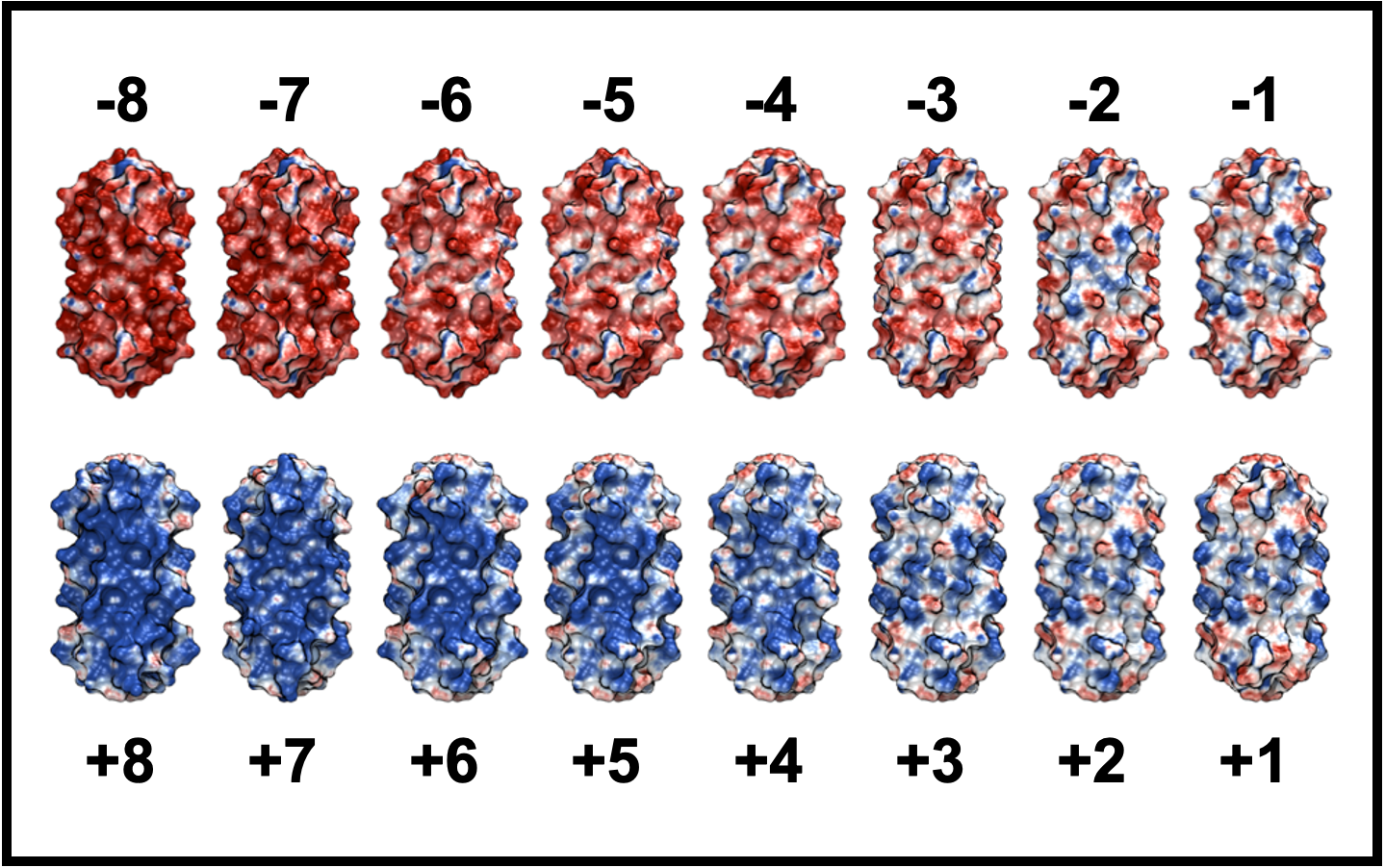
- A homotetrameric helical bundle was computationally designed to have a variety of net charges.
- The charged bundle variants showcase how charge state can be controlled for a common peptide structure, as well as the properties of the fibril nanomaterials constructed by the peptide building blocks.
Key Advances
- A probabilistic peptide design algorithm was applied to identify peptide sequences with putative charge states spanning -8 to +8 for a tetrahelical backbone.
- The peptides folded as designed despite the drastic variation of exterior charges, confirmed by experimental studies: circular dichroism, analytical ultracentrifugation, and small-angle neutron scattering spectra.
- Highly negative peptides (sequence net charge from -8 to -4) were less thermally stable with lower melting temperatures.
- One dimensional nanofibrils constructed by positive peptides and negative peptides showed different morphologies under transmission electron microscopy.
 Download

Center for Hybrid, Active, and Responsive Materials (2020)
UD CHARM advances foundational understanding of new materials driven by theoretical and computational predictions paired with cutting-edge experiments to enable the integration of unconventional, ultra-small, building blocks.