Highlights
Apr 13, 2007
Carnegie Mellon University
Microstructural Statistics in Solid Oxide Fuel Cell Electrodes
G. Rohrer and P. Salvador/CMU MRSEC, Carnegie Mellon University, NSF DMR-
0520425
L. Wilson and C. Johnson/National Energy Technology Laboratory
Mar 15, 2007
University of Minnesota - Twin Cities
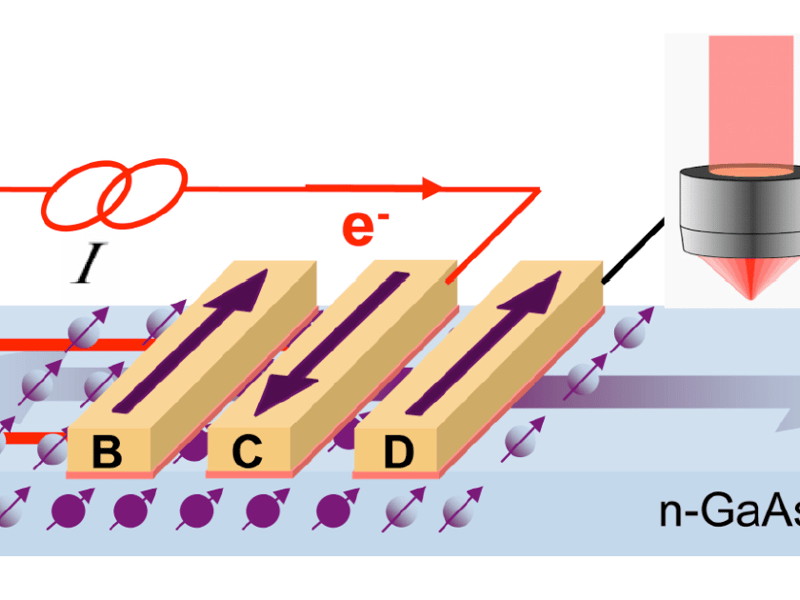
Electrical Detection of Spin Transport in Semiconductors
In semiconductor spintronics, the spin of the electron carries information for both storage and data processing. To some extent, the electron spin can be viewed as a miniature bar magnet that interacts with a magnetic field inside the semiconductor. The orientation of the bar magnet acts as a "bit" of information. Many laboratory demonstrations of spintronics have relied on sophisticated optical techniques for reading out the spin state of electrons.
Mar 15, 2007
University of Minnesota - Twin Cities
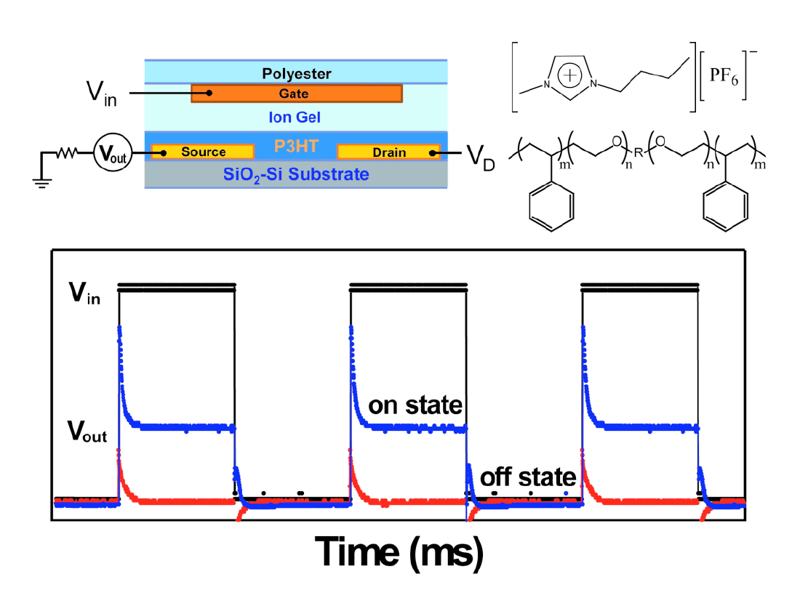
Ion Gel-Gated Polymer Thin Film Transistors
A major goal of organic electronics is the development of new kinds of solution processable organic dielectric materials that can serve as gate insulators in organic thin film transistors (OTFTs).
Feb 8, 2007
University of Wisconsin - Madison
Materials Stiffer Than Diamond
T. Jaglinski, D. Kochmann, D. Stone and R.S. Lakes
For hardness and stiffness, it's long been thought that nothing beats diamond. But Roderic Lakes and Don Stone, from the University of Wisconsin MRSEC and their colleagues have made a material that is almost ten times stiffer, by embedding small particles of barium titanate in a matrix of tin.
Feb 8, 2007
Princeton University
Industry/International: Nanowire Grids Polarize Ultraviolet Light
The increased speed and power of microelectronic devices has come from a steady reduction in the size of their constituent features, which has been achieved by using progressively shorter wavelengths for the photolithography used in their fabrication. Today, the most advanced production photolithography uses 193 nm ultraviolet (UV) light from an ArF excimer laser.
Showing 1371 to 1380 of 1452