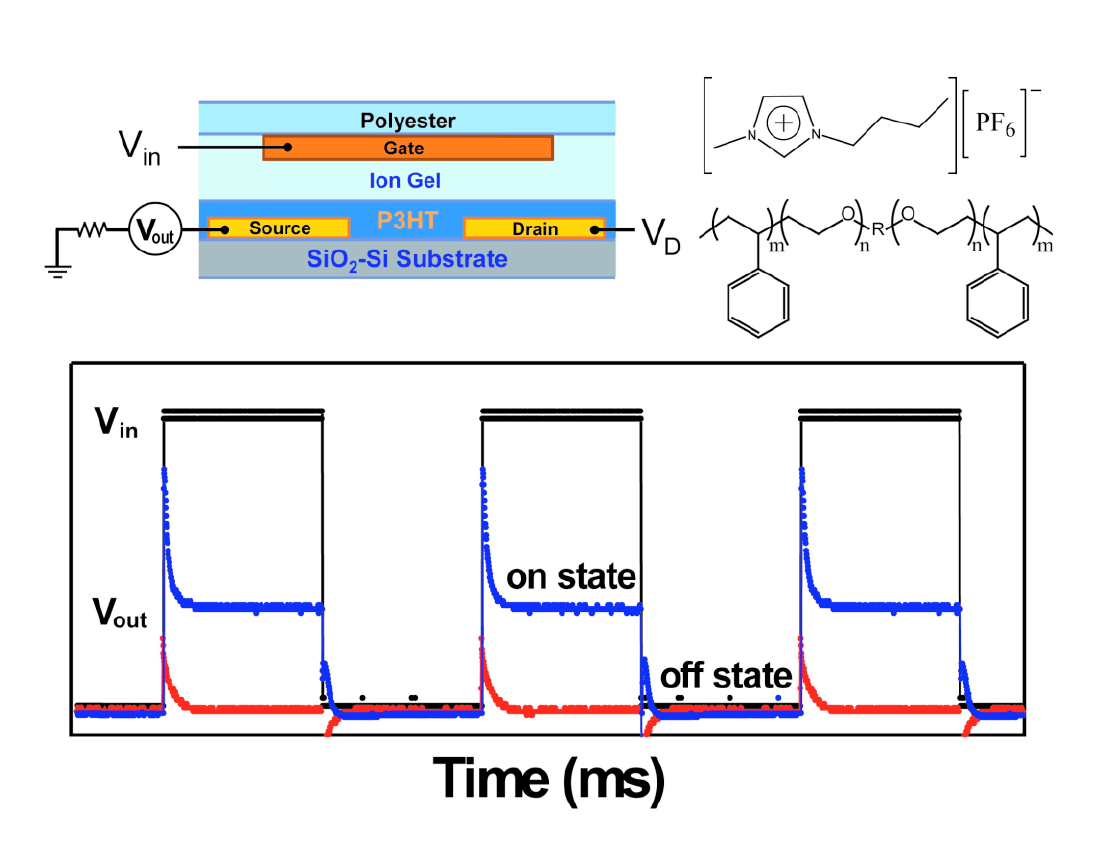
A major goal of organic electronics is the development of new kinds of solution processable organic dielectric materials that can serve as gate insulators in organic thin film transistors (OTFTs). An important figure of merit for prospective gate dielectrics is the specific capacitance, which determines how much charge can be induced in the semiconductor channel of an OTFT for a given applied gate voltage; higher capacitance translates into higher induced charge densities and therefore both higher ON currents and lower switching voltages. In an inter-IRG collaboration, postdoctoral fellows Jiyoul Lee (IRG 2) and Yiyong He (IRG 1) and graduate student Matt Panzer (IRG 2) demonstrated that a gel electrolyte (a so-called “ion gel”) based on a mixture of an ionic liquid and a block-copolymer can provide both large specific capacitance (>10 mF/cm2) and greatly improved polarization response times (~1 ms) when used as the gate dielectric in a polymer TFT (Figure 1). The improved properties allow transistor operation at frequencies greater than 500 Hz, significantly faster than what has been demonstrated previously with conventional polymer electrolytes and opening the door to a broader range of applications. Furthermore, the ion gel material is solution processable, making it potentially compatible with high throughput patterning methods (e.g., ink jet printing).