• Home
  • About
    • Logo Usage Guidelines
    • Program Overview
    • Reports and Guidelines
  • Centers
  • Education & Outreach
  • Highlights
  • News
  • Events
    About
    • Logo Usage Guidelines
    • Program Overview
    • Reports and Guidelines
  • Centers
  • Education & Outreach
  • Highlights
  • News
  • Events
Highlights
Beating the World's Smallest Drum

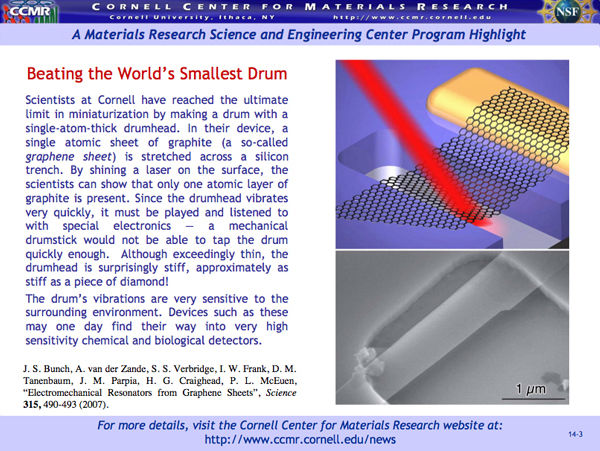
Scientists at Cornell have reached the ultimate limit in miniaturization by making a drum with a single-atom-thick drumhead. In their device, a single atomic sheet of graphite (a so-called graphene sheet) is stretched across a silicon trench. By shining a laser on the surface, the scientists can show that only one atomic layer of graphite is present. Since the drumhead vibrates very quickly, it must be played and listened to with special electronics — a mechanical drumstick would not be able to tap the drum quickly enough. Although exceedingly thin, the drumhead is surprisingly stiff, approximately as stiff as a piece of diamond!<br /> The drum's vibrations are very sensitive to the surrounding environment. Devices such as these may one day find their way into very high sensitivity chemical and biological detectors.<br /> J. S. Bunch, A. van der Zande, S. S. Verbridge, I. W. Frank, D. M. Tanenbaum, J. M. Parpia, H. G. Craighead, P. L. McEuen,

Share:

Cornell Center for Materials Research (2017)
National Science Foundation
Any opinions, findings, and conclusions or recommendations expressed on this website are those of the participants and do not necessarily reflect the views of the National Science Foundation or the participating institutions. This site is maintained collaboratively by principal investigators of the Materials Research Science and Engineering Centers awards, independent of the NSF.