Highlights
Apr 30, 2014
Supporting STEM Education, Career Development, and Collaboration through the REU Program
Catherine Reyes, Duke University
The
long term goals
of
the Research
Triangle MRSEC REU program are to maximize opportunities
for undergraduate involvement in
MRSEC research, recruit diverse
undergraduate students from across the country, and support future careers in
Apr 23, 2014
University of Utah
Design, fabrication and characterization of Mie resonance-based three-dimensional metamaterials for tuning thermal radiative properties
Spencer J. Petersen, University of Utah Graduate Student Bart Raeymaekers, University of Utah Mechanical Engineering A Mathieu Francoeur
Objective:
Demonstrate that Mie resonance-based metamaterials with isotropic electromagnetic responses
Apr 23, 2014
University of Utah
Utah MRSEC Teaching the Teachers
Debra Mascaro, Education & Outreach Director, Utah MRSEC Chelsey Short, Education & Outreach Program Manager, Utah MRSEC
Utah MRSEC taught fifth-grade
teachers to build electromagnetic ping pong ball launchers to demonstrate
electromagnetism to their students.
Apr 16, 2014
Massachusetts Institute of Technology
Better Batteries Through Biology
Angela Belcher (MIT), Yang Shao-Horn (MIT)
Lithium-oxygen
batteries have a great potential to enhance the gravimetric energy density of
fully packaged batteries by 2-3 times that of lithium-ion cells,
thus
greatly increasing the range of electric vehicles.
Apr 16, 2014
University of Chicago
Soft nanoscale epitaxy
Sara M. Rupich, Fernando C. Castro, William T.M. Irvine, Dmitri V. Talapin
Researchers in the Irvine and Talapin groups at the University of Chicago MRSEC used nanoparticle membranes discovered by the Jaeger and Lin groups to develop a platform for studies of homo= and heteroepitaxy in nanocrystal assemblies.
Apr 1, 2014
University of Minnesota - Twin Cities
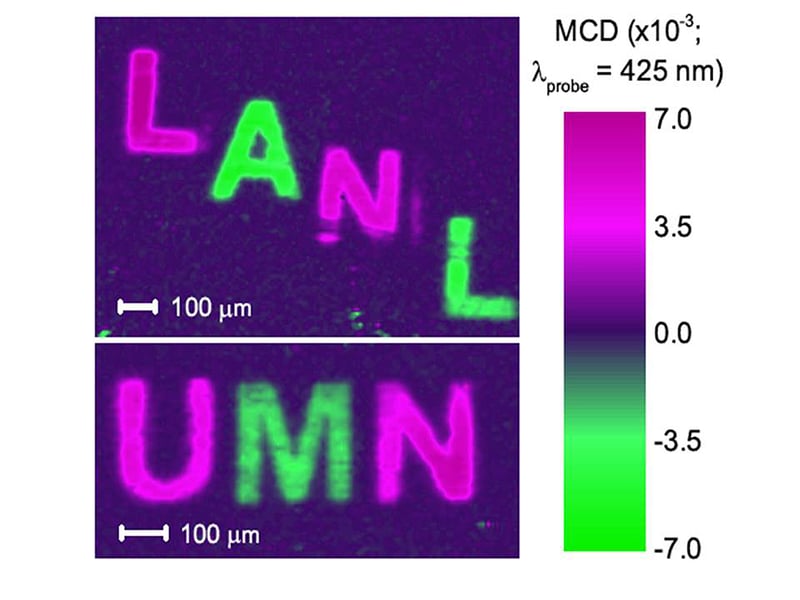
Persistent optically-induced magnetism in SrTiO3-d
P. Ambwani & C. Leighton, G Haugstad (UMN). W. D. Rice & S. A. Crooker (LANL), M. Bombeck (Technische Universität Dortmund)
In collaboration with the group of Scott Crooker at Los Alamos National Lab and Greg Haugstad of the CSE Characterization Facility, graduate student Palak Ambwani and faculty member Chris Leighton have recently reported a remarkable finding in the area of complex oxides.
Mar 14, 2014
University of Nebraska - Lincoln
Polarization Control of the Magnetic State of a Molecule
Xin Zhang and Peter A. Dowben (Nebraska MRSEC)
Spin crossover molecules form a vast class of materials for which the magnetic structure can be altered at the atomic level by an external stimulus. Diamagnetic low spin to paramagnetic high spin transitions can be induced by pressure, temperature, illumination with light, or magnetic pulses.
Showing 781 to 790 of 1452