Highlights

Cross section of a thin film of BaTiO3 on Ge imaged using transmission electron microscopy.
May 25, 2016
Yale University

Revealing Hidden Phases in Materials

Ismail-Beigi, Ahn, and Walker  

Strong interactions at the interface between a crystalline film and substrate can impart new structure to thin films. Here, a germanium surface (purple atoms) squeezes a BaTiO3 thin film above, revealing a hidden phase not seen in the bulk. The hidden phase of BaTiO3 shows oxygen octahedra cages (shaded in aqua) alternating in size. By combining theory, synchrotron x-ray diffraction, and electron microscopy, a new materials design approach has uncovered hidden traits of a material that can be expressed through articulated forces at an interface.
test caption
test caption
May 25, 2016
Yale University

Electrocatalytic Surfaces Using Bulk Metallic Glass Nanostructures

Osuji, Schroers, and Taylor

Metallic glass nanostructures provide a new platform for electrocatalytic applications. Several surface modification strategies that remove or add metal species (top images) improve the catalytic activity of metallic glass nanostructures. These strategies were demonstrated for three key electrocatalytic reactions important for renewable energy.
May 18, 2016
University of Utah

Leveraging MRSEC Equipment Purchases

Ian R. Harvey, Shared Facilities Director, Utah MRSEC, University of Utah

Leveraged upgrades to Scanning Transmission Electron Microscope (S/TEM) and Focused Ion Beam System (FIB):
MRSEC Shared Facilities: A Vital Resource
May 13, 2016
University of Wisconsin - Madison

MRSEC Shared Facilities: A Vital Resource

Jerry Hunter, University of Wisconsin-Madison

The resources of the Wisconsin MRSEC Shared Facilities impact researchers campus-wide and beyond. Over the past year >79,000 usage hours accounted for:
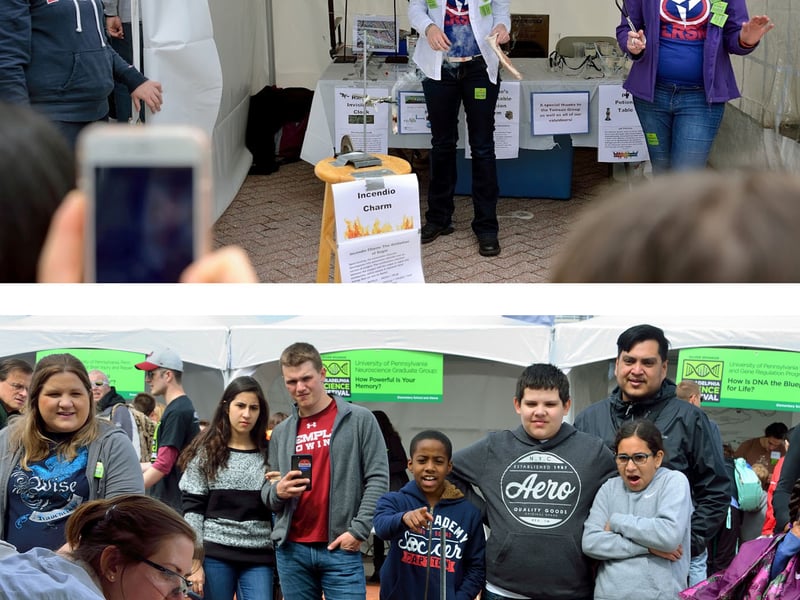
Assistant Director of Education, Ben Taylor, leads materials science activities with a student at the St. Vincent de Paul Society food pantry in Madison, Wisconsin.
May 13, 2016
University of Wisconsin - Madison

Wisconsin MRSEC Outreach Impacts 255,000 People This Year!

Anne Lynn Gillian-Daniel, Benjamin Taylor University of Wisconsin-Madison

Since 2011, the Wisconsin MRSEC has created over 40 unique research-inspired education resources. These resources are disseminated through educational kits, outreach activities, instructional videos and other online resources, all based on cutting-edge research going on in the Wisconsin MRSEC. These resources have impacted: >650,000 people in 194 countries. Over the last year:
Templating Nanomaterials from Defects in Liquid Crystals
New semiconductor alloys have been developed that have band gap tunability allowing materials to be tailor-made to the application despite the limits imposed by nature. One such alloy is GaAs(1-x-y)P(x)Sb(y) with wide bandgap tunability.
Atom probe tomography (right) provides three-dimensional maps of the positions of atoms comprising a material. Each dot in the right hand image is a captured and identified atom of a semiconductor.
Efficient and uniform doping of zinc oxide nanocrystals via plasma synthesis
May 5, 2016
University of Minnesota - Twin Cities

Efficient and uniform doping of zinc oxide nanocrystals via plasma synthesis

Eray Aydil, Uwe Kortshagen, Andre Mkhoyan

In solution-based synthesis, often doping efficiencies are low and dopants are excluded from the nanocrystals’ central cores. The research team developed a fundamentally different plasma-based process for synthesizing aluminum-doped zinc oxide nanocrystals.