Highlights

Top: Photograph of a cylindrical polymer fiber undergoing cold-drawing under axial stress at a speed of approximately 5 mm/s. Multiple shots taken over 1 min are overlaid to highlight the extent of fiber elongation. Bottom: Transmission optical micrograph of a multimaterial cylindrical fiber after undergoing cold-drawing, as shown in the top panel. The fiber consists of a brittle glass core (diameter ~ 10 – 20 microns) embedded in a larger diameter ductile polymer cladding ( diameter ~ 1 mm).
Jun 7, 2017
Massachusetts Institute of Technology

Controlled Fragmentation of Multimaterial Fibers Via Polymer Cold-Drawing

Ayman Abouraddy and Yoel Fink

MIT MRSEC researchers have demonstrated for the first time a selective cold drawing process in multi-material fibers in which one material undergoes cold-drawing while the others do not.
A hybrid MoS2/BaTiO3 ferroelectric tunnel junction showing (a) its nanoscale topography and (b) local polarization switching for different amplitude and duration of the applied voltage pulse.
Jun 7, 2017
University of Nebraska - Lincoln

Hybrid 2D-Ferroelectric Structures for Information Technology

Alexei Gruverman, Alexander Sinitskii, and Evgeny Tsymbal (University of Nebraska-Lincoln) and Chang-Beom Eom (University of Wisconsin-Madison)

Nebraska MRSEC researchers have implemented hybrid electronic devices comprising two-dimensional (2D) materials and ferroelectric thin films of barium titanate (BaTiO3) that exhibit polarization-controlled non-volatile modulation of the electronic properties.
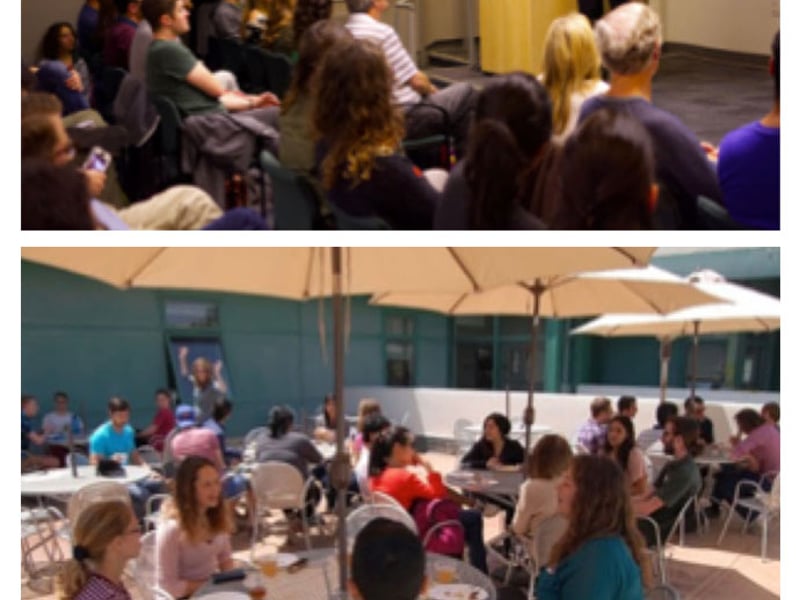
Attendees converse with scientists from the University of Nebraska and across the country during a “scientist speed-dating” activity at Science Night Live! in the Lincoln Railyard.
Jun 7, 2017
University of Nebraska - Lincoln

Science Night Live! : Bringing Science to the Public

Rebecca Lai and Jocelyn Bosley (Nebraska MRSEC)

Nebraska MRSEC sponsored and organized Science Night Live!, a unique event that created opportunities for Nebraska scientists to engage the general public with science in ways that challenged stereotypes about who scientists are, how science is done, and why basic research is valuable. 
Local density of states on the surface of bismuth at magnetic field B = 12.9 T and energy E = 780 µeV. Dark concentric ellipses reflect the shape of individual electronic states. The anisotropy points in different directions for states at other energies.
Jun 5, 2017
Princeton University

Real-Space Imaging of a Nematic Quantum Liquid

B. E. Feldman1, M. T. Randeria1, A. Gyenis1, F. Wu2, H. Ji1, R. J. Cava1, A. H. MacDonald2, A. Yazdani1 1Princeton University 2University of Texas at Austin

Interactions among electrons can give rise to a variety of exotic quantum phases in solids. An intriguing example is the formation of “nematic” electronic states, whose wave functions break the rotational symmetry of the host material.
Princeton MRSEC: Dia De la Ciencia/Science Day
Jun 5, 2017
Princeton University

Princeton MRSEC: Dia De la Ciencia/Science Day

On April 8, 2017, PCCM held its first Día de la Ciencia at the Princeton Public Library. Forty scientists, mostly PCCM members, at 20 tables, met with over 500 members of the community.
Students from Zahra Fakhraai's group demonstrate Harry Potter science.
May 24, 2017
University of Pennsylvania

Philadelphia Science Festival

Zahra Fakhraai (Chemistry), Andrew R. McGhie (LRSM EDU) & Mark Licurse (LRSM EDU)

The Philadelphia Science Festival is an annual nine day celebration of science aimed to engage and excite kids of all ages. Each day there are multiple events building up to the Science Carnival, which was held on April 30th, 2016, and attracted approximately 55,000 attendees.
Jack Olsen (top) and Nina Zimakas (bottom)
May 24, 2017
University of Pennsylvania

MRSEC-Related Research by High School Students

V. Percec (Chemistry), M. Kozlowski (Chemistry), D. Durian (Physics), A.R. McGhie (LRSM EDU) & M.W. Licurse (LRSM EDU)

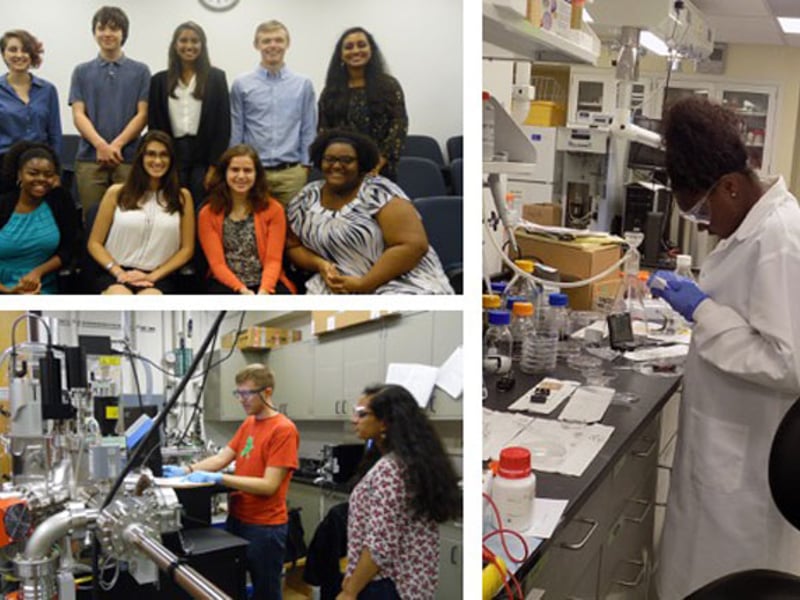
For many years now, MRSEC-affiliated faculty have accepted high school students into their labs during the summer, or on weekends during the semester, to undertake research projects that are supervised by a post-doctoral scholar or a senior graduate student. Student selection is made by the faculty member, who is responsible for the student during the program, and students first undertake safety training with EHRS. The number of students chosen for this program has been increasing: 10 in 2013, 17 in 2014, 16 in 2015, 19 in 2016.
Dewetting pattern of an organic glass thin film with a gradient of thickness. Thickness increases from left to right, resulting in a dramatically slower dewetting rate when the film is held at Tg-12 K.
May 24, 2017
University of Pennsylvania

Intellectual Merit: Long correlation length for glassy dynamics

Zahra Fakhraai (Chemistry), Karen Winey (Materials Science & Engineering), and Robert Riggleman (Chemical and Biomolecular Engineering) Graduate student Sarah Wolf demonstrates optical cloaking to Philadelphia high-school students at an event organized by the National Society of Black Engineers.

Measuring correlated dynamics in molecular glasses:  Properties of molecular glasses change as they are made into nanometer sized films. Fakhraai and Riggleman showed that when the film thickness is reduced below 30 nm, the solid glass films become liquid-like and flow. This results in dewetting as shown in the figure.
(a) Gold nanoparticles are linked by DNA strands and form thin films. (b) Expanding the DNA strands on one side of the film causes curling. (c) 0.2 mm long films curl and uncurl in response to added DNA commands. (d) Films can be commanded to ‘roll-over’ repeatedly.
(a) Nanocrystal oligomers of increasing size.  (b) Optical scattering spectra for 7, 13, 19 and 31 member oligomers. Inset: Electromagnetic simulation of a 13 member oligomer.
(a) Nanocrystal oligomers of increasing size. (b) Optical scattering spectra for 7, 13, 19 and 31 member oligomers. Inset: Electromagnetic simulation of a 13 member oligomer.
May 24, 2017
University of Pennsylvania

Probing the Evolution of Plasmonic Properties in Nanocrystal Oligomer Metamolecules

N.J. Greybush, I. Liberal, L. Malassis, J.M. Kikkawa (Physics), N. Engheta (Electrical and Systems Engineering), C.B. Murray (Chemistry), C.R. Kagan (Electrical and Systems Engineering) MRSEC student Nick Greybush demon-strates shape-memory materials  

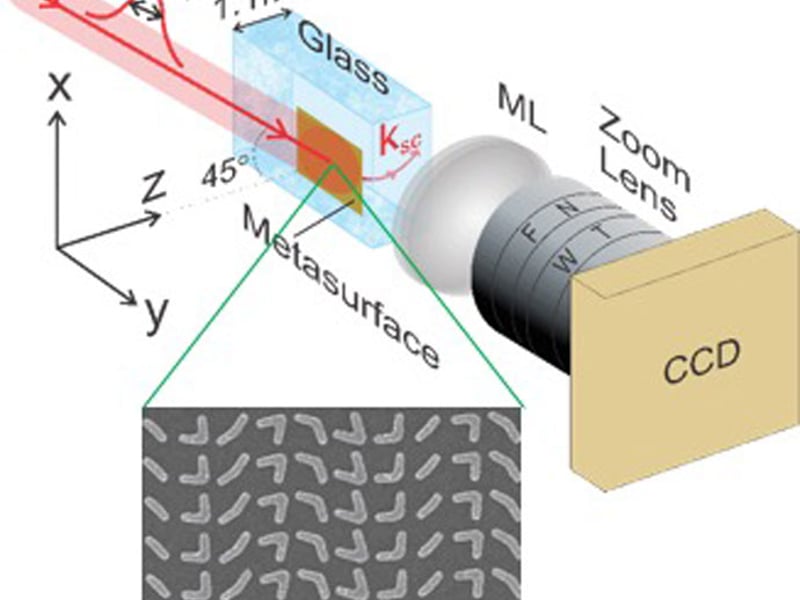
Nanocrystal “molecules” or “oligomers”: precise-number assemblies of nanocrystals  with well-defined geometrical arrangements. IRG-4 self-assembles, models, and measures these plasmonic metal nanocrystal oligomers in order to tailor their optical properties. The progression of the optical response with increasing oligomer size maps the evolution of the collective interactions within the structure. Applications may include decorating surfaces with these assemblies to form “metasurfaces” having engineerable interaction with light.