Highlights
Jan 25, 2007
Massachusetts Institute of Technology
A New MIT-Wide Vehicle for NSF MRSEC Knowledge Outreach
The MIT MRSEC, in collaboration with the Materials Processing Center (MPC) and the Department of Materials Science and Engineering (DMSE), has launched a new MIT-wide materials website...The MIT MRSEC, in collaboration with the Materials Processing Center (MPC) and the Department of Materials Science and Engineering (DMSE), has launched a new MIT-wide materials website designed to help interested parties navigate the diverse and sometimes confusing labyrinth of departments, labs and centers (and associated user facilities) on campus involved in materials research.
Jan 22, 2007
University of Wisconsin - Madison
Materials Integration for Micro-Controlled 3D Culture of Human Embryonic Stem Cells
Mohr J.C., de Pablo J.J., and Palecek S.P.
Human embryonic stem cells (hESCs) hold vast promise in science and medicine because of their potential to replicate indefinitely and their capability to differentiate to any cell type found in the adult. Many environmental cues, including soluble factors and intercellular signals, affect hESC differentiation and self-renewal decisions.
Jan 16, 2007
Massachusetts Institute of Technology
Quantum Dot “Sandwiches" Emit White Light
Members of IRG-III of the MIT MRSEC have demonstrated a light emitting device application of such quantum dots. They show that white light can be generated in a layered device that combines organic semiconductor layers with a single monolayer of quantum dots. The composition and the sizes of the quantum dots were chosen to cover the color spectrum required for the perception of white light, as in an incandescent light bulb. The ability to synthesize nanomaterials with nearly atomic precision
Jan 16, 2007
Massachusetts Institute of Technology
Nanocoatings Harvest Water from Fog
In the Namib Desert in Namibia, Africa, a tiny beetle is able to convert
microscopic droplets of water present in a morning fog into larger
sized droplets that are directed into the beetle's mouth to quench a
Jan 10, 2007
University of Minnesota - Twin Cities
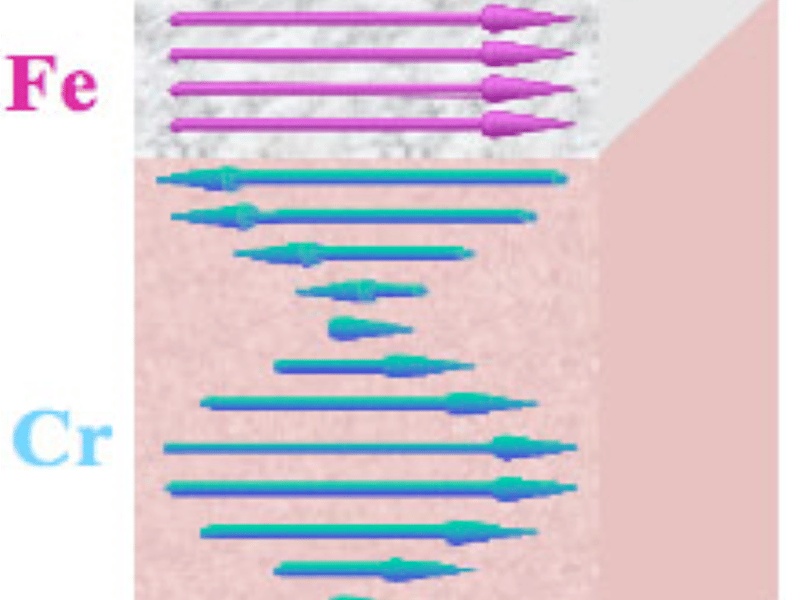
Probing Spin Density Waves
Magnetism in metallic films and interfaces has been intensively studied since the discovery of Giant MagnetoResistance (GMR) in the late 1980s. This effect enabled fabrication of high sensitivity magnetic field sensors for the read heads in magnetic hard disks, revolutionizing magnetic recording. GMR occurs in structures where an ultra-thin "non-magnetic" film is sandwiched between two magnets, Fe / Cr / Fe being a popular example. Although often ignored, the weak magnetism of the Cr film is fascinating in its own right.
Dec 20, 2006
Stanford University
Patterning of Large Arrays of Organic Semiconductor Single Crystals
Alejandro L. Briseno1,2, Stefan C.B. Mannsfeld1, Mang M. Ling1, Shuhong Liu1, Ricky J. Tseng2, Colin Reese1, Mark E. Roberts1, Yang Yang2, Fred Wudl2, Zhenan Bao1 1. Department of Chemical Engineering, Stanford University, Stanford, California 94305, USA 2. Department of Chemistry and Biochemistry and Exotic Materials Institute, Department of Materials Science and Engineering, University of California-Los Angeles, Los Angeles, California 90095, USA
Field-effect transistors made of single organic crystals are ideal for studying the charge transport characteristics of organic semiconductor materials. Their outstanding device performance, relative to that of transistors made of organic thin films, makes them also attractive candidates for electronic applications such as active matrix displays and sensor arrays. The only approach currently available for creating single crystal devices is manual selection and placing of individual crystals—a process prohibitive for producing devices at high density and with reasonable throughput.
Dec 15, 2006
University of Wisconsin - Madison
A New Organic-Inorganic Heterojunction: GaN-Pentacene
Organic semiconductor materials have shown promise in recent years for use in low-cost electronics applications such as photovoltaics, chemical sensors, and flat-panel displays. In particular, pentacene thin films have been shown to exhibit high a large field-effect mobility on the order of 1 cm2/Vs, which is sufficient for organic thin-film transistors (TFTs) for displays.
Dec 7, 2006
University of Nebraska - Lincoln
Light Used as a Magnetic Hammer
Roger Kirby Group (Nebraska MRSEC)
Scientists in the University of Nebraska MRSEC are using very short light pulses from a femtosecond laser to perturb magnetic materials and to probe their behavior at times after the perturbation. The light pulses are only about 100 millionth-billionths of a second long.
Dec 6, 2006
California Institute of Technology
Active Nanophotonic Materials and Devices
The recent decade has seen an explosion of optical communication. Yet much of the information processing is conducted electronically since there have been few truly tunable optical devices. Ferroelectric materials offer a potential solution. They possess interesting nonlinear properties that can be used to design and fabricate unique active tunable nanophotonic devices. Photonic crystals are synthetic hetero-structures that provide an unprecedented ability to manipulate light including slowing down and reflecting selected frequencies.
Showing 1381 to 1390 of 1452