• Home
  • About
    • Logo Usage Guidelines
    • Program Overview
    • Reports and Guidelines
  • Centers
  • Education & Outreach
  • Highlights
  • News
  • Events
    About
    • Logo Usage Guidelines
    • Program Overview
    • Reports and Guidelines
  • Centers
  • Education & Outreach
  • Highlights
  • News
  • Events
Highlights
Frozen Silicon "Trees" tell Story of Melting

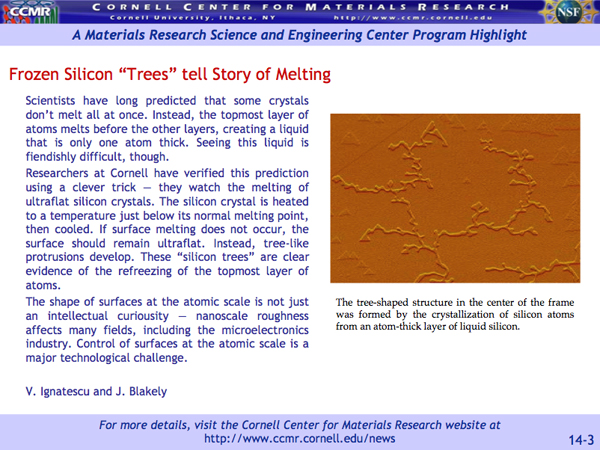
Scientists have long predicted that some crystals don't melt all at once. Instead, the topmost layer of atoms melts before the other layers, creating a liquid that is only one atom thick. Seeing this liquid is fiendishly difficult, though. Researchers at Cornell have verified this prediction using a clever trick — they watch the melting of ultraflat silicon crystals. The silicon crystal is heated to a temperature just below its normal melting point, then cooled. If surface melting does not occur, the surface should remain ultraflat. Instead, tree-like protrusions develop. These

Share:

Cornell Center for Materials Research (2017)
National Science Foundation
Any opinions, findings, and conclusions or recommendations expressed on this website are those of the participants and do not necessarily reflect the views of the National Science Foundation or the participating institutions. This site is maintained collaboratively by principal investigators of the Materials Research Science and Engineering Centers awards, independent of the NSF.