Highlights

(A) Spatial distribution of particles with different machine-learned softness, strongly correlated with localized particle rearrangements within the glass. (B,C) Rearrangement barriers (entropic and energetic), rescaled to be dimensionless, against the ML-informed excess entropy of thermal configurations. Approximate collapse is observed in the data at the same temperatures relative to the onset of glassy dynamics. Agreement improves as one moves deeper into the supercooled regime.
May 21, 2024
UPENN Materials Research Science and Engineering Centers

Predicting the Softness of Glasses from Thermodynamics

Paulo Arratia and Robert Riggleman (University of Pennsylvania)

The properties of glasses – disordered, amorphous materials – can be hard to predict because of this lack of long-range order and the associate properties of crystal symmetry.  Work in this IRG has developed two fundamental descriptors to describe glass properties.  The first of these – softness – is a machine-learning derived descriptor that characterizes structural defects in glasses and predicts rearrangements or yield that will occur in disordered materials in response to applied loads. The second – excess entropy – is a thermodynamic quantity that is a simple function of that describes the deviation of atomic arrangements from what would be predicated from ideal gas theory.
May 20, 2024
Big Idea: Understanding the Rules of Life

Accessing pluripotent materials through tempering of dynamic covalent polymer networks

In this highlight, researchers at the University of Chicago MRSEC report the development of a polymeric, pluripotent material that can be tempered (akin to the process in metallurgy) to access a wide range of room temperature mechanical properties, from stiff and high strength to soft and extensible, from a single feedstock. The feedstock was composed of a benzalcyanoacetate-based Michael acceptor, a tetrathiol crosslinker, and a dithiol chain extender to form dynamic thia-Michael networks.
May 20, 2024
Big Idea: Machine Learning / Artificial Intelligence, Understanding the Rules of Life

Machine learning interpretable models of biomaterials from chemistry

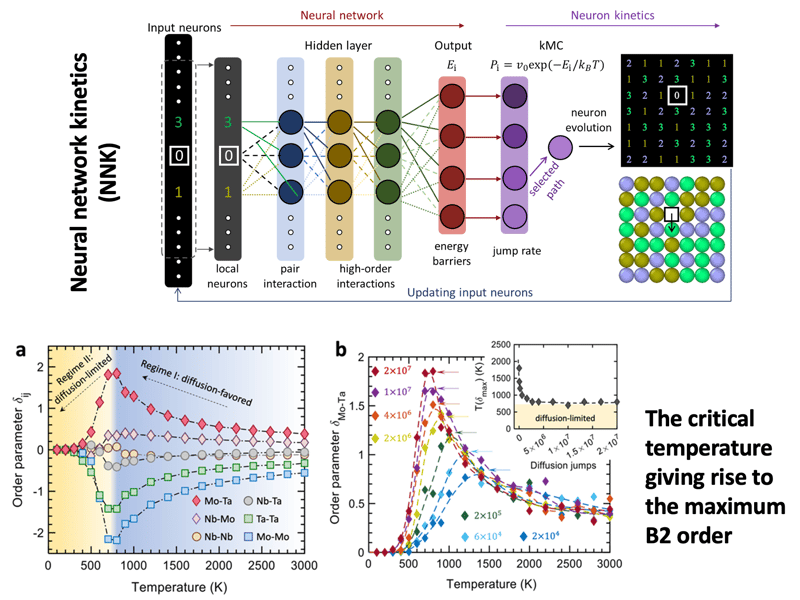
This work, carried out by the University of Chicago MRSEC, shows how to integrate neural networks in the construction of predictive phenomenological models in cell biology, even when little knowledge of the underlying microscopic mechanisms exist.
May 16, 2024
Center for Complex and Active Materials

CryoEM finds complexity in structural evolution of active materials

UCI MRSEC researchers have performed the first in-depth time-resolved cryo-electron microscopy study on molecular active materials formed under dissipative self-assembly conditions and compared the results to the same molecular formed under thermodynamic control. They found that the dissipative self-assembly conditions can stabilize the formation on transient, thermodynamically unstable phases and that these phases can be highly ordered.
May 16, 2024
Center for Complex and Active Materials

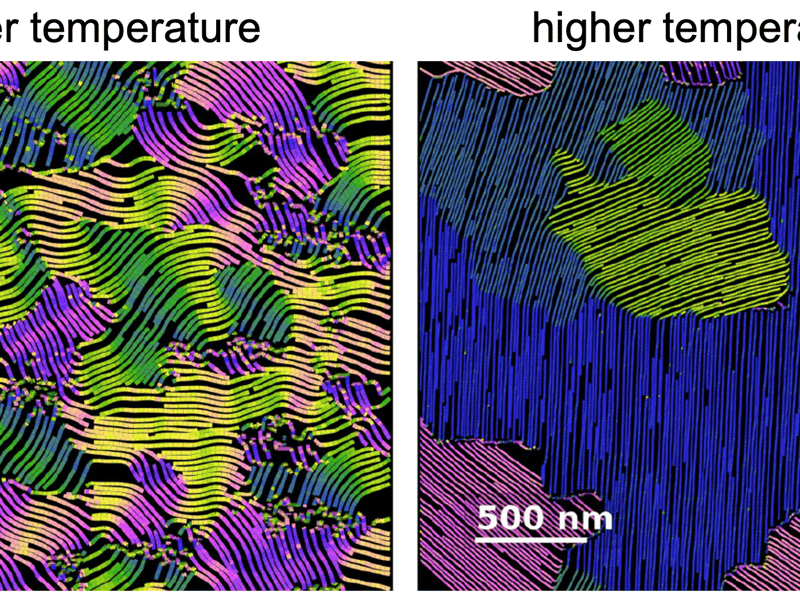
Discovery of Ni Activated Sintering of MoNbTaW Guided by a Computed Grain Boundary “Phase” Diagram

This study, carried out by researchers at UCI MRSEC, demonstrated the first example of activated sintering of a high-entropy alloy. It also revealed a segregation-induced grain boundary prewetting (disordering) transition.
May 16, 2024
Penn State Center for Nanoscale Science (2020)

Sustainability efforts gain institutional support and international recognition

​The MRSEC’s sustainability initiative for research labs expanded in its second year to 29 labs across Penn State University Park and six branch campuses. Over 400 researchers have been involved thus far. Labs completing My Green Lab certification can be paired with one of 17 undergraduate Sustainable Lab Ambassadors who apply their sustainability training to the lab setting through engaged scholarship.
May 16, 2024
Big Idea: Quantum Leap

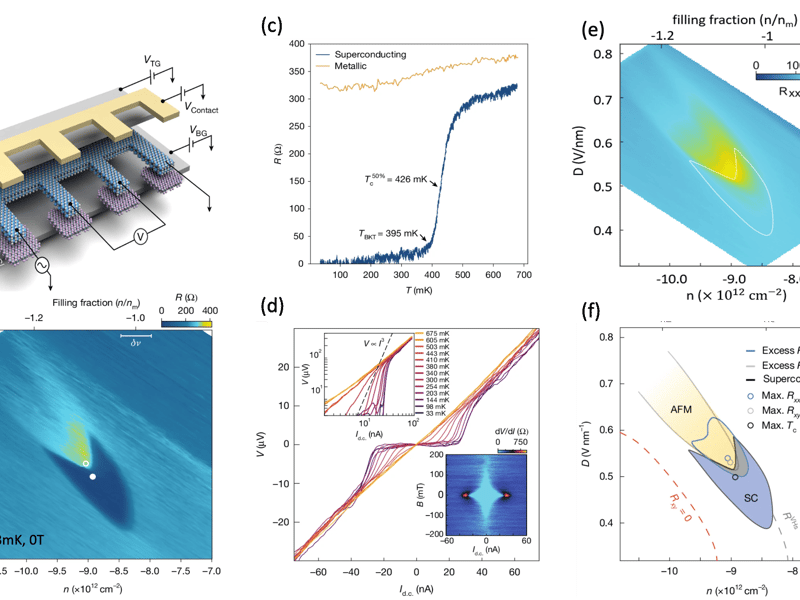
Interface-induced superconductivity in magnetic topological insulators

An IRG1 team employed molecular beam epitaxy to synthesize heterostructures stacking a ferromagnetic topological insulator with a quantum anomalous Hall state, Cr-doped (Bi, Sb)2Te3, and an antiferromagnetic iron chalcogenide, FeTe, with an atomically sharp interface. An unexpected phenomenon emerges: interface-induced superconductivity.
May 16, 2024
Big Idea: Quantum Leap

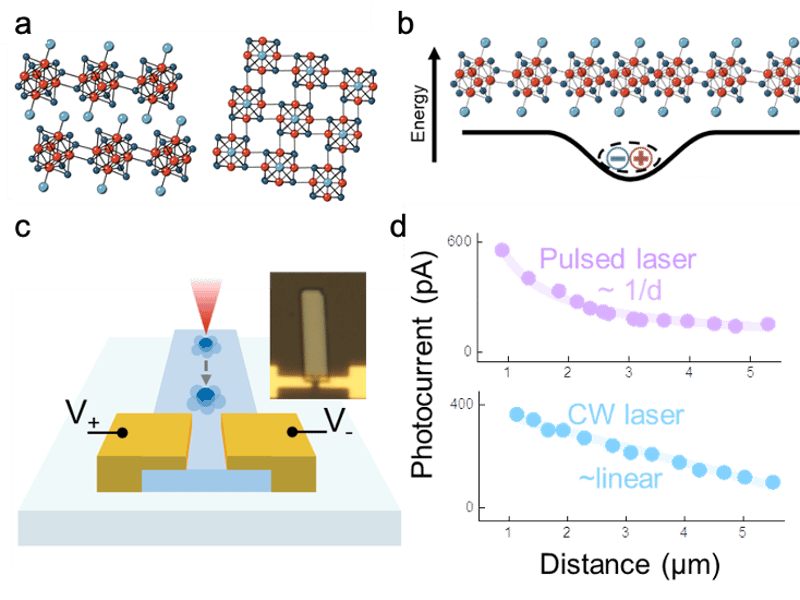
High-entropy engineering of the crystal and electronic structures in a Dirac material

Quantum materials have the potential to revolutionize technologies ranging from sensing to telecommunication and computation. However, advancement has been limited by the development of topological and Dirac materials. IRG2 researchers demonstrated a novel and widely applicable strategy to engineer relativistic electron states to develop such materials through a high-entropy approach.
Monomer conversion at the surface of the gel at various polymerization times as a function of depth from the gel surface. Image source: Chau, Edwards, Helgeson, Pitenis
May 15, 2024
Materials Research Science and Engineering Center at UCSB

Superlubricious Hydrogels from Oxidation Gradients

Chau, Edwards, Helgeson, Pitenis - University of California, Santa Barbara

Hydrogels are hydrated three-dimensional networksof hydrophilic polymers that are commonly used in the biomedical industry due to their mechanical and structural tunability, biocompatibility, and similar water content to biological tissues.
Scheme of the synthesis and separation of block copolymers and a typical morphology analysis as a function of molecular weight and phase fraction. Image source: Murphy, Skala, Kottage, Kohl, Li, Zhang, Hawker, Bates
May 15, 2024
Materials Research Science and Engineering Center at UCSB

Rapid Generation and Screening of Complex Polymer Morphologies

Murphy, Skala, Kottage, Kohl, Li, Zhang, Hawker, Bates - University of California, Santa Barbara

Block copolymers, with their complex morphologies, are widely used in many applications. A grand challenge associated with these materials is accelerating their design and discovery. UC Santa Barbara MRSEC researchers have developed a versatile and efficient strategy by rapidly building expansive, high-quality, and detailed block copolymer libraries through a combination of controlled polymerization and chromatographic separation. X-ray scattering studies aid in screening block copolymer morphology.