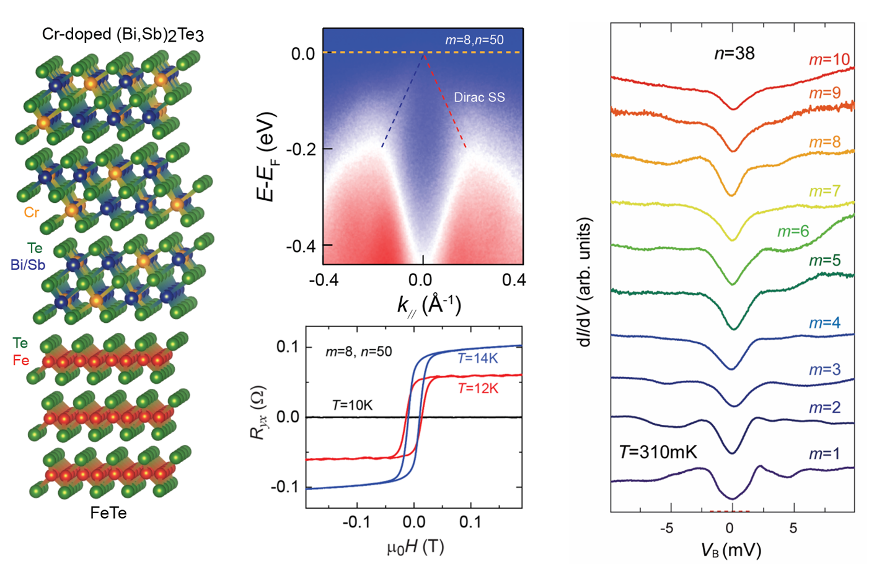
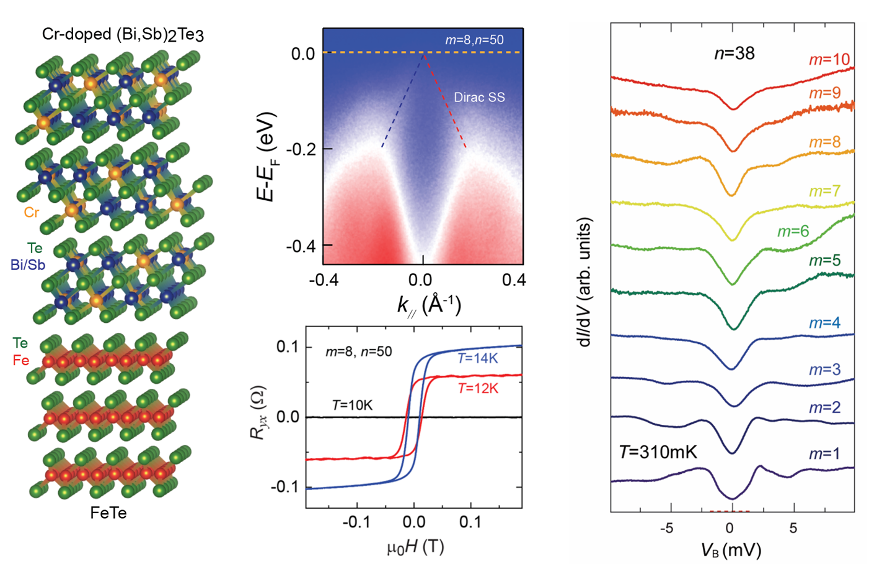
 An IRG1 team employed molecular beam epitaxy to synthesize heterostructures stacking a ferromagnetic topological insulator with a quantum anomalous Hall state, Cr-doped (Bi, Sb)2Te3, and an antiferromagnetic iron chalcogenide, FeTe, with an atomically sharp interface. An unexpected phenomenon emerges: interface-induced superconductivity.
Electrical transport, reflective magnetic circular dichroism, magnetic force microscopy, and angle-resolved photoemission spectroscopy demonstrate the coexistence of superconductivity, ferromagnetism, and topological band structure.
These QAH/FeTe heterostructures with robust interface-induced superconductivity provide an ideal platform for the exploration of chiral topological superconductivity and Majorana physics and thus constitute an important step toward scalable topological quantum computation.
 Download

Penn State Center for Nanoscale Science (2020)
The Center for Nanoscale Science supports collaborative, interdisciplinary research efforts on nanoscale materials. Principal research activities are organized into two interdisciplinary research groups: 2D Polar Metals & Heterostructures and Crystalline Oxides with High Entropy. Center-initiated programs encourage collaborative partnerships with science museums and non-R1 universities as well as engagement in outreach, education, and workforce development initiatives.