Highlights

Glycodendrimersomes from sequence-defined Lac-presenting Janus glycodendrimers reveal high activity and sensor capacity for the agglutination by natural variants of human lectins Gal-8.
May 25, 2016
University of Pennsylvania

Glycodendrimers Can Sense Variants of Lectins by Agglutination

V. Percec, M. L. Klein, & D. A. Hammer (IRG-2)

A dendrimer is a synthetically made branched molecule. In this work, a family of amphiphilic Janus dendrimers bearing precise carbohydrate residues arranged in a defined sequence – glycodendrimers – were used to make vesicles that could be agglutinated by naturally occurring lectins that binds to carbohydrates. The lectins, called galectins, are human adhesion and growth regulatory lectins. Very small differences in the chemistry of different galectin were detected through differences in agglutination with different Janus glycodendrimers.
The 6th Annual Philadelphia Materials Day
May 25, 2016
University of Pennsylvania

6th Annual Philadelphia Materials Day

A. R. McGhie & M. W. Licurse

The 6th annual Philadelphia Materials Day was held on Saturday, February 6, 2016 at the Bossone Research Center at Drexel University. This joint venture between Penn and Drexel Universities was attended by over 1100 students and parents. Each year faculty and their students present demos on materials-related themes of interest to K-12 students. The themes this year were: Communications, Earth, Environment, Energy, and Sports.
(a) Crystal structure of Cu3NZn.  (b) First octant of 3D Brillouin zone (BZ) projected onto the 2D surface BZ of the (100) surface. The DLN and the projected interior of DLNs are shown in red and blue. (c) Electronic band structure of a slab. Bulk bands are black, while  nearly flat surface  states  are blue.
(a) Crystal structure of Cu3NZn. (b) First octant of 3D Brillouin zone (BZ) projected onto the 2D surface BZ of the (100) surface. The DLN and the projected interior of DLNs are shown in red and blue. (c) Electronic band structure of a slab. Bulk bands are black, while nearly flat surface states are blue.
May 25, 2016
University of Pennsylvania

Dirac Line Nodes in Inversion Symmetric Crystals

C. L. Kane & A. M. Rappe (SuperSeed 1)

Topological insulators, which were first introduced at Penn, are new materials with novel features such as protected states that hold potential for quantum computing. We have identified a class of 3D crystals that feature a new kind of topological band phenomena: Dirac line nodes (DLN).   These are lines in momentum space where the conduction band and valence band touch, and their degeneracy is required by inversion symmetry even in the absence of spin orbit interactions.
Snapshot of a two-dimensional experimental granular pillar being compressed by moving the top plate downwards (gravity is into the page). The color of each particle indicates its softness (its structural propensity to rearrange), from a blue (low softness) to red (high softness) scale.
May 25, 2016
University of Pennsylvania

Identifying Structural Flow Defects in Disordered SolidsUsing Machine Learning Methods

D. J. Durian, E. Kaxiras (Harvard MRSEC), A. J. Liu (IRG-3)

We are often taught that the difference between solids and liquids is that in solids, each of the constituent particles has a well-defined average position while in liquids, particles are constantly rearranging and changing their neighbors. In fact, particle rearrangements do occur in solids, and all solids flow under enough stress. Crystalline solids flow via localized particle rearrangements that occur preferentially at structural defects known as dislocations.  The population of dislocations therefore controls how crystalline solids flow.
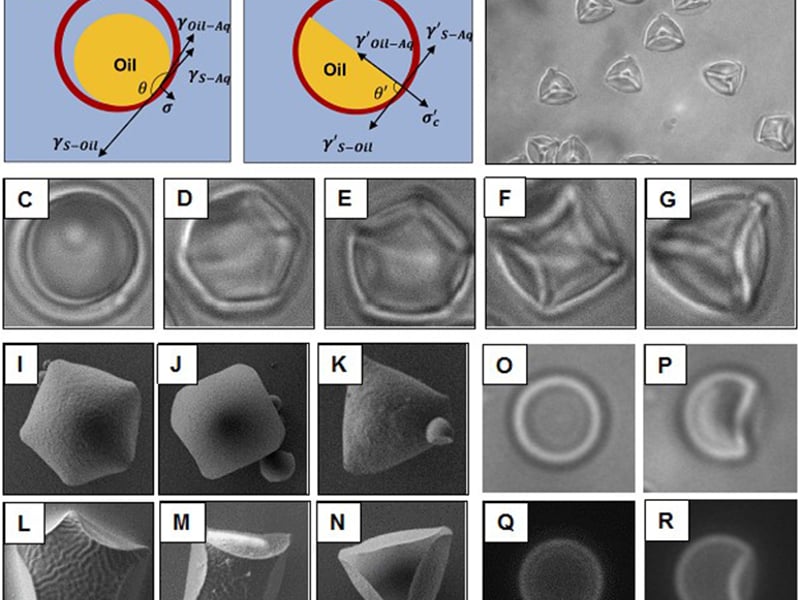
Schematic illustration (top) and optical microscope images (bottom) showing one-step generation of polyelectrolyte microcapsules using nanoscale interfacial complexation in emulsions (NICE).
May 25, 2016
University of Pennsylvania

Nanoscale Interfacial Complexation in Emulsion (NICE)

D. Lee & J. A. Burdick (IRG-2)

Microcapsules that encapsulate and protect molecules and materials by forming isolated aqueous compartments inside hollow shells are widely used in a variety of applications in the food, pharmaceutical, cosmetics, and agriculture industries. One promising method that has emerged is layer by layer (LbL) assembly, but this method to make microcapsules has low encapsulation yield, is tedious, and is time consuming.
Fig. 1 (left) Schematic of a Janus droplet with two phase-separated compartments: polymer (top) and LC (bottom). (others) Bright-field images of LC Janus droplets with different polymer:LC volume ratios and background surfactant.
May 25, 2016
University of Pennsylvania

Liquid Crystal Janus Droplets

D. Lee, P. Collings, & A. G. Yodh (IRG-1)

Janus colloids are composed of two-faced particles with distinctive surfaces and/or compartments. Lee, Collings, & Yodh have created the first Janus particles with a liquid crystal (LC) compartment. The droplets were prepared by combining microfluidic and phase separation techniques, and the LC compartment morphologies can be easily controlled to realize unique confining geometries (Fig. 1).
Colloidal nanocrystal inks of metallic silver, semiconducting cadmium selenide, and insulating aluminum oxide nanocrystals are used to construct the high conductivity electrodes, high mobility semiconductor channel layers, and high dielectric constant insulator layers of transistors. Colloidal indium nanocrystals are mixed into the silver nanocrystal inks to dope the semiconductor channel upon annealing. High mobility, all nanocrystal devices operating at low voltage are fabricated by solution-based methods over a large area on flexible plastics.
May 25, 2016
University of Pennsylvania

All Nanocrystal Electronics

C.B. Murray & C.R. Kagan (IRG-4)

Synthetic methods produce colloidal nanocrystals that are metallic, semiconducting, and insulating. These nanocrystals have been typically used to form only a single component in devices. IRG-4 has exploited the library of colloidal nanocrystals and designed the materials, surfaces, and interfaces to construct all the components of field-effect transistors.The transistors are fabricated from solution over large areas and on flexible plastics and have excellent electrical performance.   This work was published in  Science, 352, 205-208 (2016).
Cross section of a thin film of BaTiO3 on Ge imaged using transmission electron microscopy.
May 25, 2016
Yale University

Revealing Hidden Phases in Materials

Ismail-Beigi, Ahn, and Walker  

Strong interactions at the interface between a crystalline film and substrate can impart new structure to thin films. Here, a germanium surface (purple atoms) squeezes a BaTiO3 thin film above, revealing a hidden phase not seen in the bulk. The hidden phase of BaTiO3 shows oxygen octahedra cages (shaded in aqua) alternating in size. By combining theory, synchrotron x-ray diffraction, and electron microscopy, a new materials design approach has uncovered hidden traits of a material that can be expressed through articulated forces at an interface.
test caption
test caption
May 25, 2016
Yale University

Electrocatalytic Surfaces Using Bulk Metallic Glass Nanostructures

Osuji, Schroers, and Taylor

Metallic glass nanostructures provide a new platform for electrocatalytic applications. Several surface modification strategies that remove or add metal species (top images) improve the catalytic activity of metallic glass nanostructures. These strategies were demonstrated for three key electrocatalytic reactions important for renewable energy.
May 18, 2016
University of Utah

Leveraging MRSEC Equipment Purchases

Ian R. Harvey, Shared Facilities Director, Utah MRSEC, University of Utah

Leveraged upgrades to Scanning Transmission Electron Microscope (S/TEM) and Focused Ion Beam System (FIB):