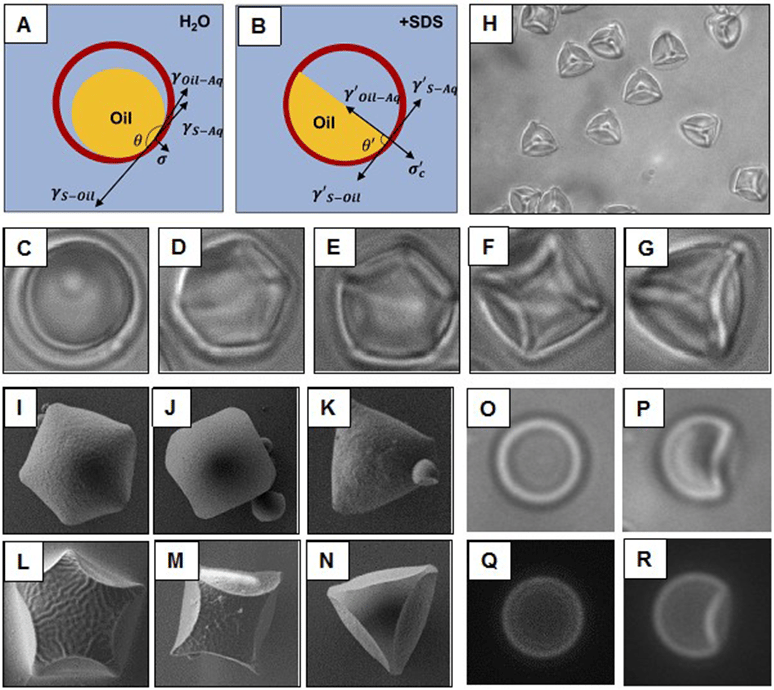
Spherical particles are easy to synthesize because a sphere is a shape that minimizes surface area. Non-spherical particles, however, have properties that can be very different from spherical particles, but they are challenging to fabricate. Researchers at University of Wisconsin-Madison have discovered that it is possible to transform spherical polymer shells into non-spherical shapes by partially filling their interiors with oils. The polymer shells can be strained into a remarkable range of shapes with six-, five-, four- and three-fold symmetries (see figure), and then polymerized to create non-spherical particles. The method is scalable and potentially provides assess to a new class of technological materials. The biological, optical and mechanical properties of these new materials are being explored.

Wisconsin Materials Research Science and Engineering Center
The U.S. National Science Foundation-sponsored Wisconsin Materials Research Science and Engineering Center brings together teams of researchers from diverse disciplinary backgrounds to tackle grand challenges in the materials science of liquids and glasses and non-equilibrium magnetism.