Highlights
Jun 16, 2017
University of Utah
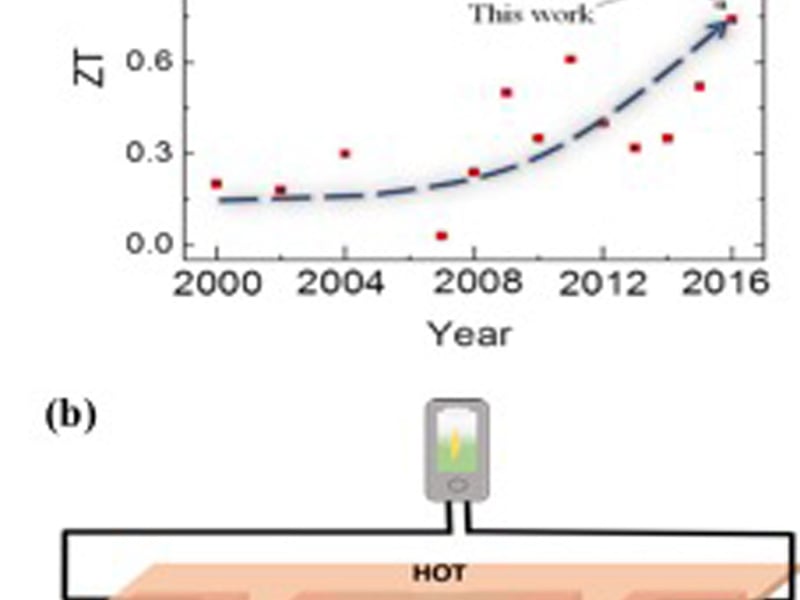
Terbium Ion Doping in Ca3Co4O9: A Step Towards High-Performance Thermoelectric Materials
Shrikant Saini, Yinong Yin, Ashutosh Tiwari; University of Utah
We have achieved the enhanced thermoelectric response in polycrystalline Ca3Co4O9 on doping Tb ions in the material. Specifically, a high figure of merit (ZT) of 0.74 at 800 K was observed for Ca2.5Tb0.5Co4O9.
Jun 16, 2017
University of Utah
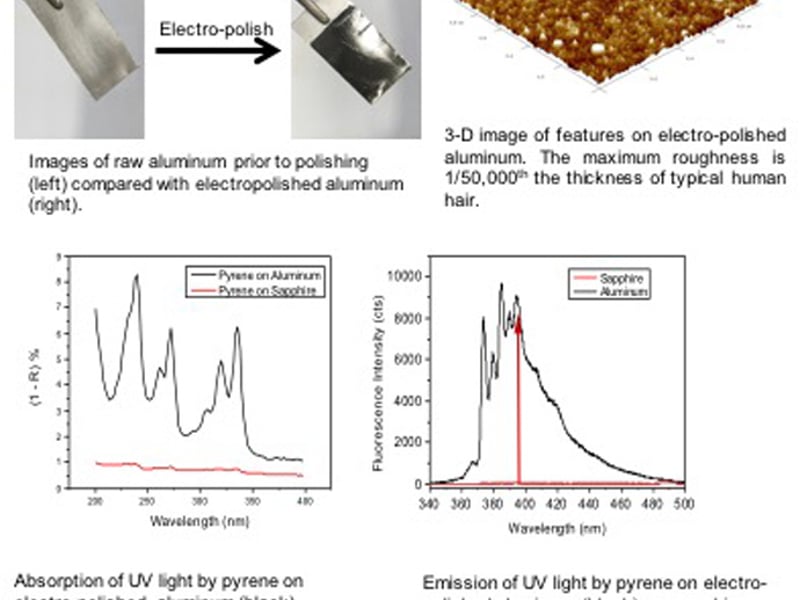
Surface-Enhanced Fluorescence of Pyrene on Nanostructured Aluminum
Danielle Montanari, Joel Harris, Steve Blair; University of Utah
Both the absorption and emission of ultraviolet light by pyrene (PAH compound) are enhanced by more than 30-fold on nanostructured aluminum, compared to an equivalent control sample on sapphire (aluminum oxide).
Jun 16, 2017
University of Utah
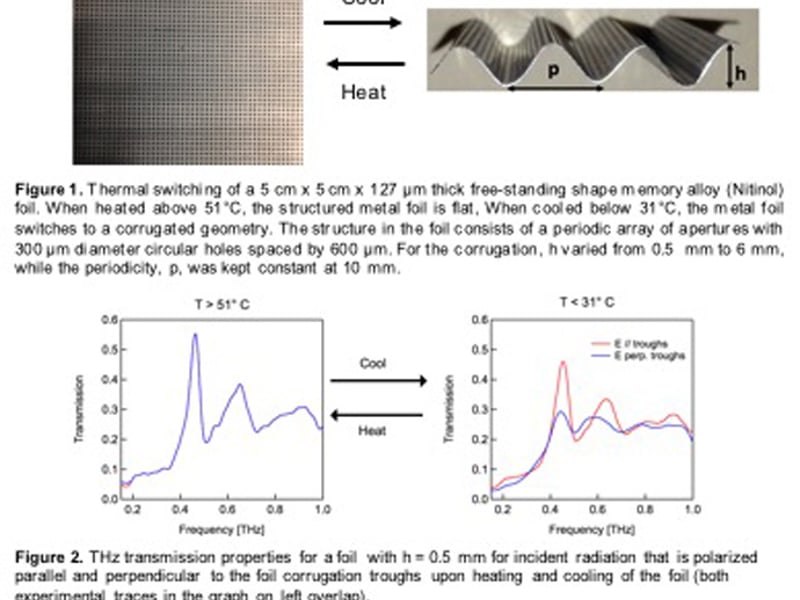
Using Shape Memory Alloys for Active Terahertz Plasmonic Devices
Barun Gupta, Shashank Pandey, Anjali Nahata, Ting Zhang, Sivaraman Guruswamy and Ajay Nahata; University of Utah
We show the first demonstration of shape memory alloys being used for active THz devices. The metal foil was found to reproducibly cycle between the two geometries over 100 times.

Jun 16, 2017
University of Utah
Hands-on Science After School
Chelsey Short, University of Utah
Utah MRSEC establishes science and engineering afterschool clubs at community centers and schools serving predominately underrepresented minority (URM) students in those fields. The Education and Outreach team then hires and trains University of Utah undergraduates to lead the clubs and deliver hands-on activities each week.
Jun 15, 2017
University of Minnesota - Twin Cities
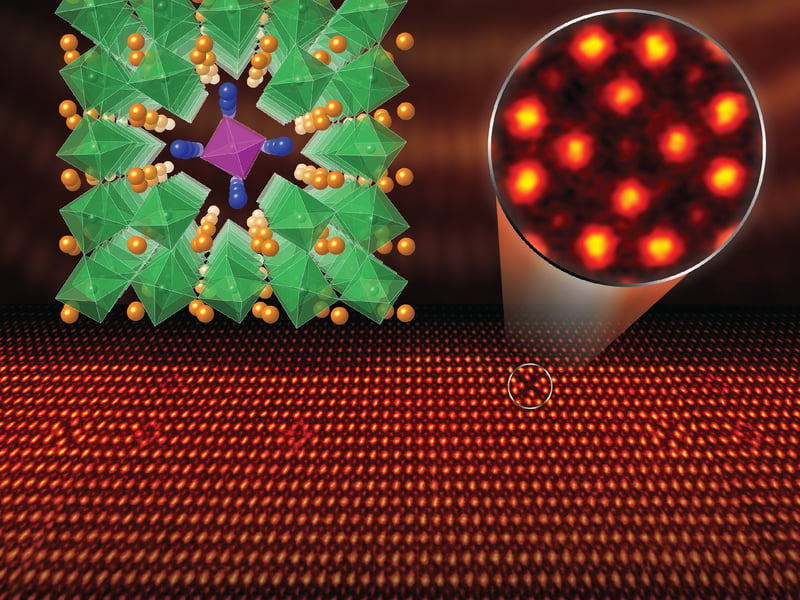
Discovery of a New Line Defect in a Perovskite Oxide
Bharat Jalan, Renata Wentzcovitch, Andre Mkhoyan University of Minnesota
Defects, essentially locations in a crystal where the perfect arrangement of atoms is disturbed, are inherent in materials, and play a key role in their function.
Jun 15, 2017
University of Minnesota - Twin Cities
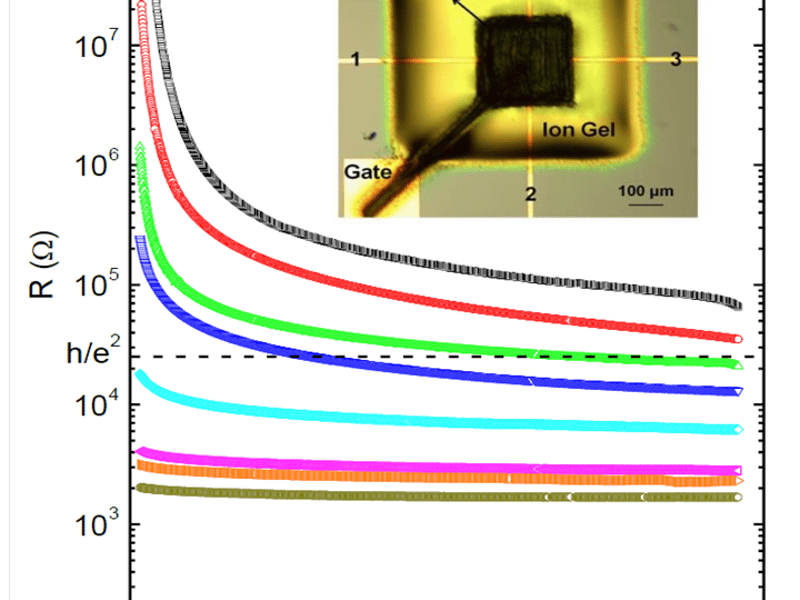
Solution-Processed Indium Oxide Transistors: Printing Two-Dimensional Metals
Dan Frisbie, Chris Leighton University of Minnesota
Transistors, the building blocks of all computer technologies, are currently based on semi-conductors such as silicon, manufactured using energy-intensive processes.

Jun 14, 2017
University of Colorado at Boulder
Spooling Instability of Self-Propelled Flexible Filaments
Meredith Betterton, Matthew Glaser University of Colorado Boulder
Cytoskeletal filaments with chemical motors attached are the basic elements in cells that enable biological motion. Computer simulation of model biomotive systems show that even systems with minimal ingredients are able to generate the kind of exotic nonequilibrium behavior observed in cells.
Jun 14, 2017
University of Colorado at Boulder
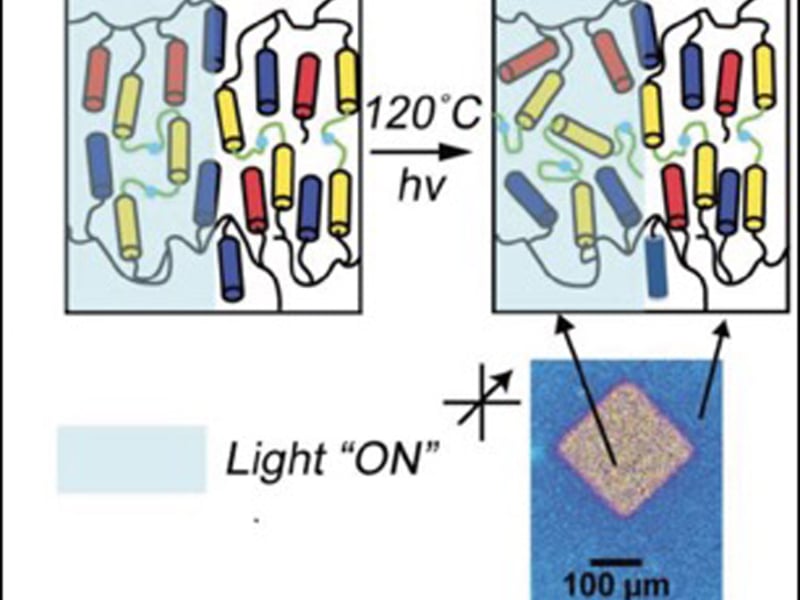
Photoinduced Plasticity In Cross-linked Polymer Networks
Christopher Bowman, University of Colorado Boulder
Researchers in the Soft Materials Research Center of the University of Colorado Boulder have employed dynamic covalent chemistry to make cross-links that can be controlled optically, enabling materials that can be softened or changed in shape by light.

Jun 14, 2017
University of Colorado at Boulder
Inexpensive Polymer Films for Efficient Daytime Radiative Cooling
Xiaobo Yin & Ronggui Yang, University of Colorado Boulder
Researchers at the University of Colorado Boulder have made a discovery that explores an inexpensive way to eliminate waste heat in buildings, cooling systems, and even cars and trucks.
Jun 13, 2017
University of Wisconsin - Madison
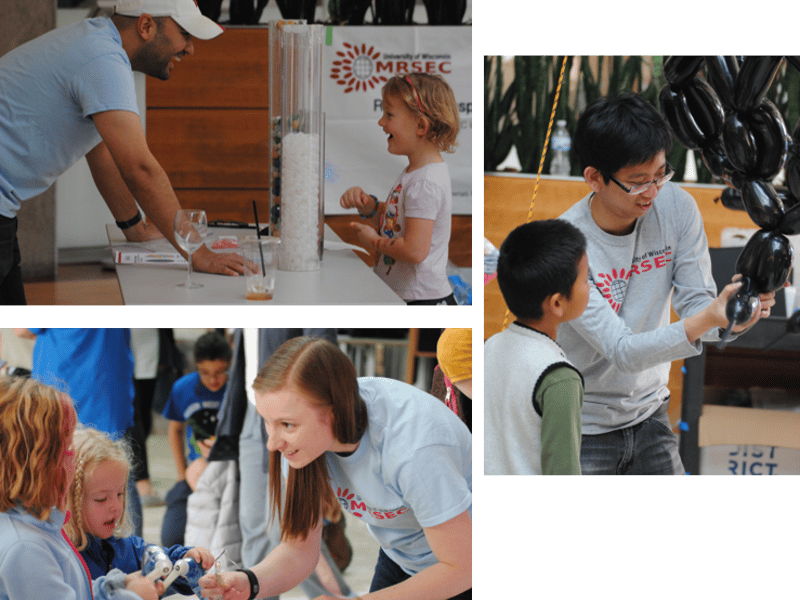
NSF MRSEC Members Teach the Public about Materials Science during the Wisconsin Science Festival
Anne Lynn Gillian-Daniel, University of Wisconsin-Madison
Over the course of two days, the Wisconsin MRSEC presented exciting hands-on, research-inspired materials science activities to over 1500 people during the 2016 Wisconsin Science Festival. The 2016 Wisconsin Science Festival was the largest ever with over 250 events in 20 communities across Wisconsin.
Showing 531 to 540 of 1452