Siderophores are compounds in microorganisms that bind and store iron. Parallels between the chemistry of compounds secreted by mussels to aid adhesion to rocks, and the chemistry of some siderophores inspired UCSB researchers Butler, Israelachvili, and Waite and their coworkers to study their adhesive properties.
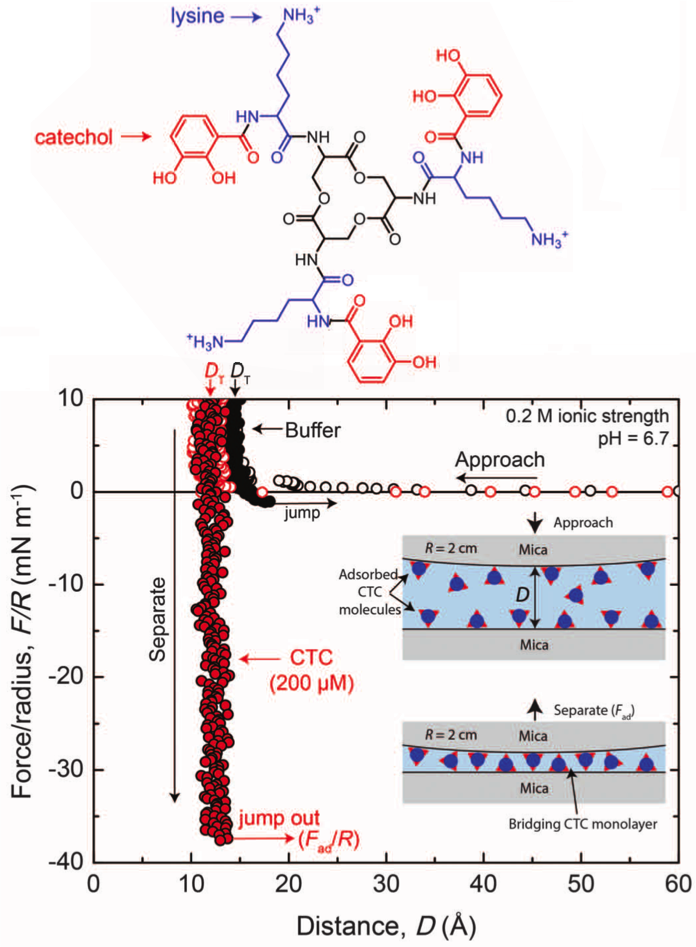
Siderophores appear to synergistically employ catchecol and lysine functionalities to adhere to hard oxide (minerals such as mica) surfaces, as verified using the surface forces apparatus (force-distance traces shown at right). The key molecule cyclic trichrysobactin (a siderophore, abbreviated CTC) is displayed alongside, with the catechol and lysine moieties indicated.
Published in Science 349 (2015) 628–632.
 Download

Materials Research Science and Engineering Center at UCSB
The U.S. National Science Foundation Materials Research Science and Engineering Center at UC Santa Barbara develops and sustains a productive, collaborative, and engaged community that drives a portfolio of transformative materials research and empowers a diverse workforce.