Highlights

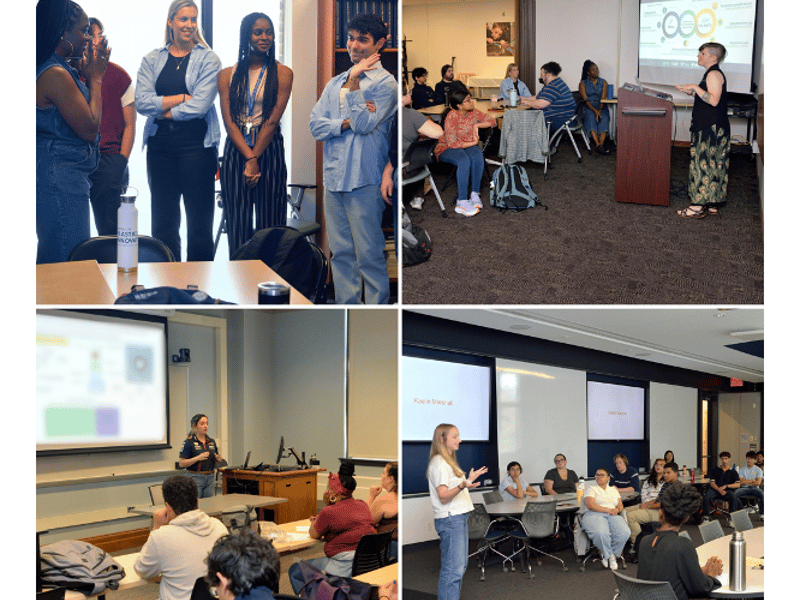
Top: Photo of the CREATE 2024 student cohort taken at the program’s capstone poster session in July 2024. Left: Perylenediimide dyes synthesized by CREATE student Paige Melancon. Bottom Left: CREATE seminar held in February 2025 featuring CDCM Seed investigator Wennie Wang. Bottom: CREATE student Burna Leao Souza pictured with her capstone poster.
May 7, 2025
The Bioinspired Soft Materials Center

CREATE: Connecting Research and Education At TExas

Sean Roberts (UT Austin), Shawn Amorde (ACC), Purna Murthy (ACC)

Connecting Research and Education At TExas (CREATE) is a partnership program established between UT Austin and Austin Community College (ACC) whose goal is to increase retention of community college students in STEM. CREATE works to achieve this goal by building relationships between ACC students and UT Austin researchers through a fall/spring seminar series held at ACC that features UT faculty speakers and a 9-week summer research program that pairs ACC students with research mentors at UT Austin.
Structure models for Cs2Ni3S4 from experimental powder x-ray
diffraction refinements and calculated band structure.
The stacking direction of the nickel layers sandwiched between
double layers of cesium can be seen in (A) along with the stacking
direction along the c axis. The slightly distorted kagome lattice is
depicted in (B) with color-coded bond lengths. The square-planar Ni-S
coordination environment is shown in (C). The Fmmm (D)
and P63/mmc (E) band structure show the flat bands close to the
Fermi level.
Structure models for Cs2Ni3S4 from experimental powder x-ray diffraction refinements and calculated band structure. The stacking direction of the nickel layers sandwiched between double layers of cesium can be seen in (A) along with the stacking direction along the c axis. The slightly distorted kagome lattice is depicted in (B) with color-coded bond lengths. The square-planar Ni-S coordination environment is shown in (C). The Fmmm (D) and P63/mmc (E) band structure show the flat bands close to the Fermi level.
May 5, 2025
The Bioinspired Soft Materials Center

Accessing Bands with Extended Quantum Metric in Kagome Cs2Ni3S4 through Soft Chemical Processing

Leslie M Schoop and B. Andrei Bernevig

Flat bands have been associated with excoct effects in materials, such as strong correlations, superconductivity, or the fractional quantum Hall effect. In bulk materials they are difficult to be isolated form other electronic states. In addition, they are often at non-accessible energies. In this work, Schoop and Bernevig collaborated to access flat bands in a new material using soft-chemical modification of a known materials.
May 5, 2025
Princeton Center for Complex Materials

Holiday Lecture 2024: “Science by Candlelight”

Professor Howard A. Stone and colleagues

The 2024 Holiday Science Lecture “Science by Candlelight” was held at Princeton University on December 7, 2024 with over 530 people attending two lectures at McDonnell Hall. Howard Stone led the lecture, and was joined by Julia Mikhailova, Angie Miller (chemistry department demonstrator) and other PCCM researchers (including graduate students and postdocs).
Top: Teachers learn about the science of noodles with local chef Tracy Chang during summer 2024 in-person teacher workshop. Bottom left: Teachers learn about the science of boba and encapsulation at Navajo Technical University. Bottom right: MRSEC student Reena Paink works with high school students during a February 2025 workshop.
May 2, 2025
Harvard Materials Research Center

Everyday Materials Science: Teacher and Student Workshops on Science & Cooking

David Weitz, Kathryn Hollar, Pia Sörensen, and Kate Strangfeld

The Harvard MRSEC engages K-12 teachers and students through the science of everyday materials. Led by former HS teacher Strangfeld, the MRSEC hosts workshops for teachers and K-12 students that are modeled on the undergraduate Science and Cooking course developed by Weitz and Brenner, which is now led by Sörensen. In February 2025, Strangfeld and Sörensen, with the help of MRSEC researchers, piloted a 4-day program at Harvard for high school students during school break.
Figure 1. (A) In operando X-ray characterization of LCE alignment during printing. (B) Radially-resolved alignment for LCE filaments printed at Wimax = 0.5 (top images) and orientational order parameter across LCE filament radius (bottom plot). (C) Average orientational order parameter in printed LCEs as a function of Wimax alongside compared to theory. (D) Tensile stress as a function of strain. (E) Actuation strain measured parallel to print path versue temperature.
May 2, 2025
Harvard Materials Research Center

Spatially Programmed Alignment and Actuation in Printed Liquid Crystal Elastomers

Jennifer Lewis, Caitlyn Cook (LLNL) and Ronald Pindak (BNL)

Aligned liquid crystal elastomers (LCEs) are soft materials that exhibit reversible actuation akin to human muscles when thermally cycled above their nematic-to-isotropic transition temperature. Lewis and collaborators studied the effects of LCE ink composition, nozzle geometry, and printing parameters on director alignment.
(a) Surface functionalization of 2D WSe2 with trifluoromethyl
groups is achieved using an electrophilic trifluoromethylation
reagent. (b,c) Atomic force microscopy images before and
after trifluoromethylation confirm uniform functionalization.
(a) Surface functionalization of 2D WSe2 with trifluoromethyl groups is achieved using an electrophilic trifluoromethylation reagent. (b,c) Atomic force microscopy images before and after trifluoromethylation confirm uniform functionalization.
Apr 21, 2025
The Bioinspired Soft Materials Center

2D Semiconductor Electronic Property Tuning via Trifluoromethylation

IRG-2, Northwestern University MRSEC

Two-dimensional (2D) semiconductors are promising materials for next-generation electronic and iontronic devices. As a consequence of their ultrathin dimensions, 2D materials offer the opportunity for continued device scaling while avoiding the short-channel effects that hinder bulk semiconductors.
Apr 21, 2025
The Bioinspired Soft Materials Center

Modular Protein Scaffolds Enable Tunable Matrix Materials

IRG-1, Northwestern University MRSEC

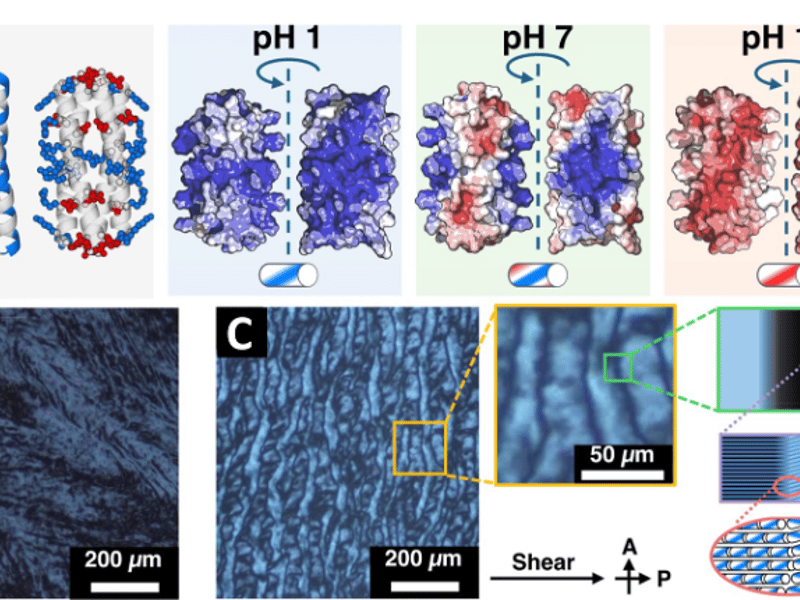
Northwestern University IRG-1 has identified novel protein building blocks that form high-aspect ratio structures with genetic-level programmability and tunability.
(Left) Schematic of three different elastoresistivity techniques. (Right) The temperature dependence of the elastoresistivity coefficients of CsV3Sb5. The A1g isotropic coefficient shows a diverging response, whereas the E2g anisotropic coefficient shows a weak and temperature independent response.
Apr 4, 2025
University of Washington Molecular Engineering Materials Center

MEM-C IRG-2: Absence of E2g Nematic Instability and Dominant A1g Response in Kagome Metal CsV3Sb5

Jihui Yang, Xiaodong Xu, Jiun-Haw Chu

Electronic nematicity, the spontaneous breaking of crystalline rotational symmetry, has been discovered in several strongly correlated electronic systems, including high Tc superconductors. Recently, several studies have suggested that the charge density wave in the kagome superconductor CsV3Sb5 breaks rotational symmetry—an intriguing possibility, as it would be a rare example of “three-state Potts nematicity,” in which there are three possible orientations in a hexagonal lattice. Here, we report that  CsV3Sb5 is probably not nematic, but it is very sensitive to isotropic strain.
Synthesis of colloidal CuCr2Se4 NCs starts with formation of  copper selenide NCs followed by slow in-diffusion of Cr3+ to form the spinel. Colloidal annealing activates ferrimagnetism. A TEM image of single-crystalline CuCr2Se4 NCs, and 300K magnetic circular dichroism results showing strong near-IR magneto-optical response.
Synthesis of colloidal CuCr2Se4 NCs starts with formation of copper selenide NCs followed by slow in-diffusion of Cr3+ to form the spinel. Colloidal annealing activates ferrimagnetism. A TEM image of single-crystalline CuCr2Se4 NCs, and 300K magnetic circular dichroism results showing strong near-IR magneto-optical response.
Apr 4, 2025
University of Washington Molecular Engineering Materials Center

MEM-C IRG-1: Ferrimagnetic CuCr2Se4 Nanocrystals with Strong Room-Temperature Magnetic Circular Dichroism

Brandi Cossairt, Daniel R. Gamelin, Jiun-Haw Chu

Magnetic materials are vital in technologies from spintronics to biomedicine. Coupling magnetism with optical responses broadens their utility to sensing, magneto-optical memory, and optical isolation. Chromium chalcogenide spinels display particularly rich magnetism and magneto-optical properties. Colloidal nanocrystals (NCs) offer routes to solution-processing, heterointegration, and property modulation through size, shape, or heterostructure control, but many chalcogenide spinels have never been synthesized at the nanoscale, and little control over size or morphology has been demonstrated.
Jan 22, 2025
Center for Advanced Materials & Manufacturing

CAMM Partners with ORNL to Host “Neutron Day”

CAMM’s ECOR Team & Antonio dos Santos of ORNL coordinated the event

UTK-MRSEC The Center for Advanced Materials & Manufacturing partnered with Oak Ridge National Laboratory to host the inaugural "Neutron Day," an event designed to deepen collaboration and foster interdisciplinary research connections.