Highlights

Mfp3-2S-pep is a mimic of the actual mussel-foot protein that helps mussel adhesion (sequences displayed at the top). This mimic undergoes single component coacervation, thereby enhancing adhesion.
May 17, 2018
Materials Research Science and Engineering Center at UCSB

Simple Coacervation of a Mussel-inspired Peptide Improves Wet Adhesion

Upon spontaneous deposition on surfaces underwater and moderate compression, single-component coacervates of adhesive peptide mimics (mfp-3S-pep) display orders of magnitude improvement compared with un-coacervated native (mfp-3S) or synthetic peptides. The increase in the work of adhesion is due to the peptide’s intrinsic cohesive properties upon coacervation correlated with dehydration, tight peptide packing and restricted peptide mobility.
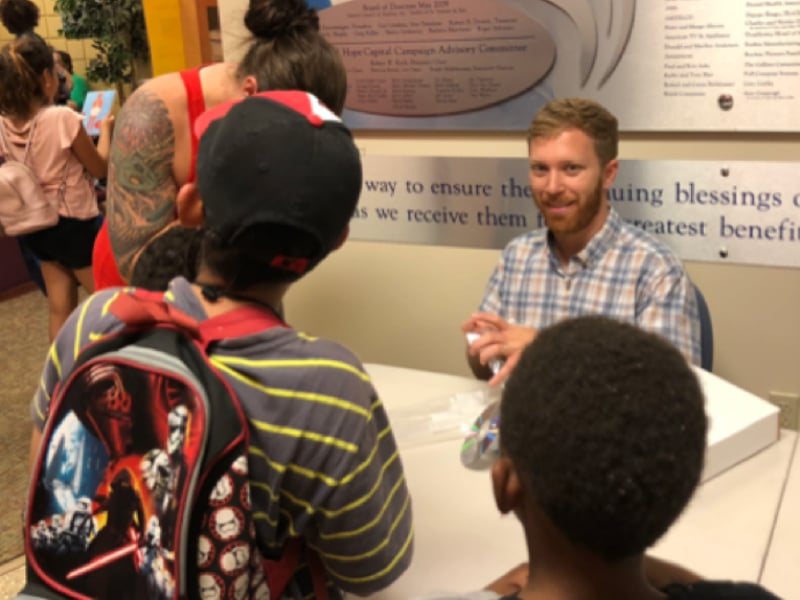
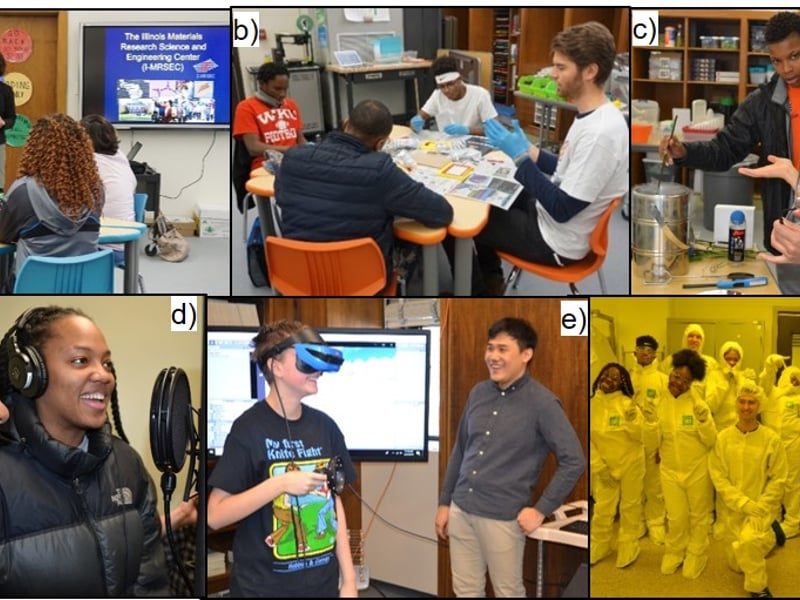
Teachers and K-12 student sengage in soft robotic maker activities led by UCSB MRSEC graduate student volunteers.
May 17, 2018
Materials Research Science and Engineering Center at UCSB

UCSB MRSEC Maker Activities

In response to the needs of teachers, the UCSB MRSEC has placed a new focus on the development of maker activities for K-12 students. These encourage the integration of maker activities into the school curriculum as well as within out-of-school environments (Maker Faires), supporting the adoption of Next Generation Science Standards (NGSS).
(top) Schematic of the selective etching process and false-color cross-sectional STEM image of a 2D heterostructure showing atomic precision of the etched structure. (bottom) Demonstrated applications using this technique: Accessing buried electronic layers within a heterostructure to form low contact resistance and high mobility devices and a 3D integrated device with multiple active layers.
May 16, 2018
Illinois Materials Research Science and Engineering Center

Atomically-precise graphene etch masks for 3D integrated systems from 2D material heterostructures

A. van der Zande, P. Huang, N. Mason, E. Ertekin University of Illinois Urbana-Champaign

Atomically-precise fabrication methods are critical for the development of next-generation technologies which rely on nanomaterials. New methods are particularly needed in van der Waals (vdW) heterostructures where it is necessary to individually address each molecular layer to form devices with nanometer thicknesses. The Illinois MRSEC has demonstrated a highly selective etching technique using graphene as a monolayer etch stop within vdW heterostructures. This technique is a versatile and simple nanofabrication process that bridges the challenging technological divide between atomic-precision and wafer scale uniformity.
Data showing onset of surface-state magnetoresistance peak below 4K (above) and schematic showing origin of magnetoresistance (below).
May 16, 2018
Illinois Materials Research Science and Engineering Center

Surface state anisotropic magnetoresistance in proximity magnetized topological insulators

N. Mason, M. J. Gilbert, A. Hoffmann, University of Illinois Urbana-Champaign

Information stored in magnetic materials is often read-out by measuring changes in magnetoresistance. Large magnetoresistance effects are thus important for establishing well-defined memory states within materials that store information. The Illinois MRSEC discovered a new and large magnetoresistance effect generated when a topological insulator (TI) is placed on top of an ordinary magnetic insulator. The surface of the TI becomes magnetic and exhibits a  so-called surface-state anisotropic magnetoresistance. This effect is two-orders of magnitude larger than previous effects induced in similar materials.
Figure 1 | a, Magnetic hysteresis loop of an Fe3GeTe2 monolayer at 15 K. Inset: atomic lattice of monolayer Fe3GeTe2. b, MFM image of a 300 nm flake at 0.03 T, showing labyrinthine domain structures. c, Compiled thickness-temperature phase diagram.
May 16, 2018
University of Washington Molecular Engineering Materials Center

Two-Dimensional Itinerant Ising Ferromagnetism

David Cobden and Xiaosong Xu Molecular Engineering Materials Center (MEM-C), University of Washington, Seattle

Ferromagnetism in monolayer van der Waals materials (vdW) has recently drawn tremendous attention since they were first discovered last year. Most of the materials found, however, are semiconductors and extremely air sensitive, so a vdW material that is metallic and stable under ambient conditions is highly desirable.
May 16, 2018
University of Washington Molecular Engineering Materials Center

Silicon vacancy color center in nanodiamonds for high pressure temperature sensing and quantum cryptography.

Xiaosong Li and Peter Pauzauskie Molecular Engineering Materials Center (MEM-C), University of Washington, Seattle

The presence of isolated defects in the lattice of large band-gap semiconductors can introduce colored centers, by altering their electronic properties giving rise to transitions within the visible region.  Diamond has a rigid and dense lattice preventing defect diffusion and phase transitions under high pressure and temperature settings.
May 16, 2018
Center for Dynamics and Control of Materials (2017)

Arts+Sciences Collaboratory Residence Program

University of Texas at Austin

The CDCM Arts+Sciences Collaboratory Residence Program is educating MRSEC students, post-docs and faculty about the ways in which contemporary artists are using and developing advanced technologies.
Scheme 1. (a) Electron equivalents generated from S. oneidensis MR-1 reduce a metal catalyst from an inactive state (MOX) to an active state (MRED) to enable ATRP, (b) molecular weight and polydispersity of poly(OEOMA500) as a function of monomer conversion, (c) rescue of normal polymerization activity via knockout complementation with a plasmid encoding MtrC.
May 16, 2018
Center for Dynamics and Control of Materials (2017)

Shewanella oneidensis as a Living Electrode for Controlled Radical Polymerization

N. A. Lynd, B. K. Keitz:  University of Texas at Austin

Researchers at the University of Texas - Austin find that manipulating biological electron transport pathways may be a general strategy for allowing bacteria to produce or communicate with synthetic materials.
May 16, 2018
Center for Dynamics and Control of Materials (2017)

Routing Valley Excitons with a Metasurface

X. Li, A. Alu, C. K. Shih:  University of Texas at Austin

Researchers at the University of Texas - Austin have discovered a new method to separate valley index using a designed metasurface. Excitons that carry different valley index are routed toward different directions in real space and momentum space, and photons emitted go to different directions according to their helicity.
This CEM-nucleated team was awarded a major DARPA grant in February 2018 to work on skyrmion materials.
May 7, 2018
Center for Emergent Materials (2014)

Proto-IRG: Spin Textures in Chiral Magnetic Materials

A. Ahmed, J. Rowland, B. Esser, S. Dunsiger, D. McComb, M. Randeria, R. Kawakami, Phys. Rev. Materials, 2, 041401 (2018).

Experimental evidence in MBE-grown FeGe thin films for “chiral bobbers”, topological spin texture that exist near an interface. Theoretical modeling  predicts stable chiral bobbers in materials with both bulk and interfacial DMI. Lorentz TEM imaging of skyrmions in FeGe thinned crystals Topological Hall effect measurements of skyrmions in FeGe thin films and novel oxide heterostructures of SrIrO3/SrRuO3. Development of microwave absorption spectroscopy to probe skyrmion materials.