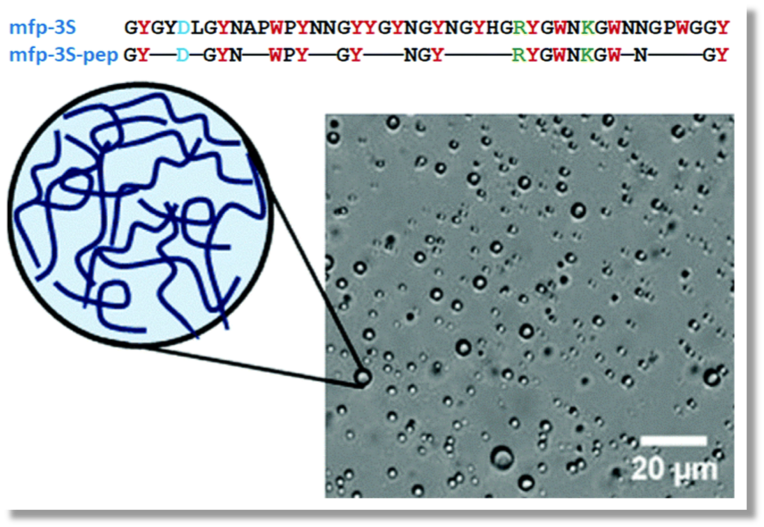
Upon spontaneous deposition on surfaces underwater and moderate compression, single-component coacervates of adhesive peptide mimics (mfp-3S-pep) display orders of magnitude improvement compared with un-coacervated native (mfp-3S) or synthetic peptides. The increase in the work of adhesion is due to the peptide’s intrinsic cohesive properties upon coacervation correlated with dehydration, tight peptide packing and restricted peptide mobility.
Broader Impacts: Dense single-component coacervate liquids represent an essential adaptation for the priming stages of mussel adhesive deposition, and provide a previously untapped design principle for synthetic underwater adhesives.

Materials Research Science and Engineering Center at UCSB
The U.S. National Science Foundation Materials Research Science and Engineering Center at UC Santa Barbara develops and sustains a productive, collaborative, and engaged community that drives a portfolio of transformative materials research and empowers a diverse workforce.