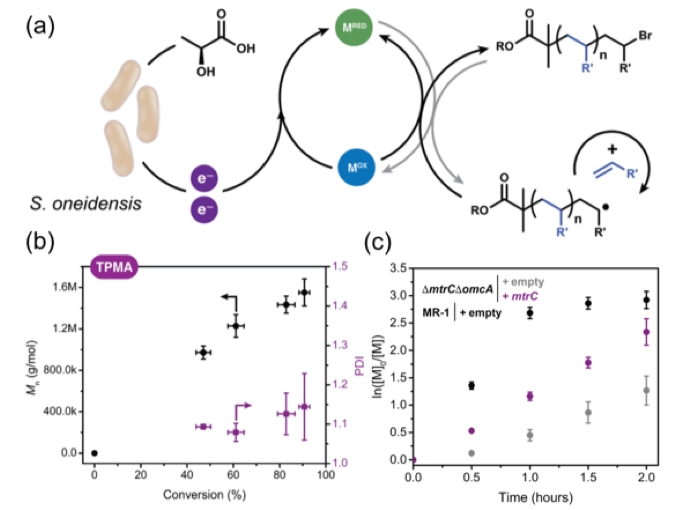
Metabolic engineering produces fuels, pharmaceuticals, and materials using microbial catalysts. We sought to expand the power of these catalysts by redirecting respiratory electron flux from Shewanella oneidensis to a metal polymerization catalyst.
Our microbial polymerization features characteristics of controlled radical polymerization such as first-order kinetics, narrow molecular weight distributions and block-copolymer synthesis. Catalyst performance and polymer microstructure were a strong function of bacterial metabolism, specific electron transport proteins, and catalyst design.
Overall, our results suggest that manipulating biological electron transport pathways may be a general strategy for allowing bacteria to produce or communicate with synthetic materials.
 Download