Highlights

Jun 9, 2020
Harvard Materials Research Center (2014)

Building Enduring Pathways in STEM: Incorporating Traditional Ways of Knowing in Materials Research

David A. Weitz (Physics and AppPhy) and Thiagarajan Soundappan (Navajo Tech Univ, Chem)

This unique partnership between Navajo Technical University and the Harvard MRSEC builds enduring pathways for undergraduate Native American students into STEM by including traditional Navajo  perspectives and methods of scientific inquiry in materials science research and education.
Jun 9, 2020
Harvard Materials Research Center (2014)

Shape-Shifting Lattices via Multimaterial 4D Printing

L. Mahadevan (Applied Math) & J.A. Lewis (MatSci &  BioEng)

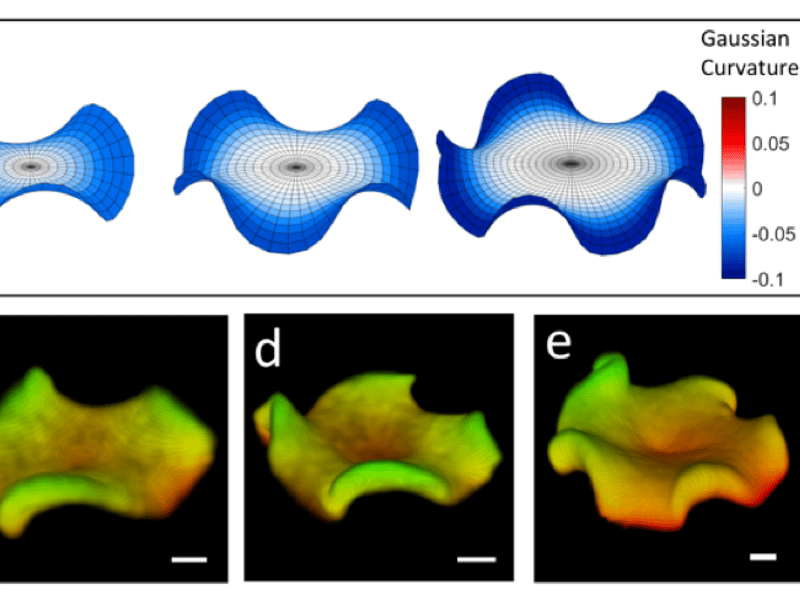
A team at the Harvard MRSEC led by Lakshminarayanan Mahadevan and Jennifer A. Lewis has created shape-shifting lattices by combining predictive design and multimaterial 4D printing.
Figure: Secondary electron image of a microfabricated metal/polymer multilayer structure. A conventional gallium FIB would take days to remove such a large amount of material.  Images like these provide input for three dimensional reconstructions of materials structure.
Figure: Secondary electron image of a microfabricated metal/polymer multilayer structure. A conventional gallium FIB would take days to remove such a large amount of material. Images like these provide input for three dimensional reconstructions of materials structure.
May 27, 2020
UPENN Materials Research Science and Engineering Centers

Focused Ion Beam / Scanning Electron Microscope: TESCAN S8000X

Eric A. Stach, Mark Allen, Marija Drndic and Deep Jariwala, University of Pennsylvania

In the Fall of 2019, the LRSM installed a uniquely equipped focused ion beam / scanning electron microscope from the TESCAN corporation. The instrument has a high flux xenon source, allowing rapid sample removal. It is equipped with two novel accessories, a cryogenic transfer system and a time-of-flight secondary ion mass spectrometer (ToF-SIMS). These two capabilities will allow the development of novel methods for the microanalytical characterization of soft matter and soft/hard matter interfaces.
Adriana Santiago-Ruiz (Middle): Explaining details of the materials science experiment to the high school participants at “Experimenta con PREM”
May 27, 2020
UPENN Materials Research Science and Engineering Centers

Experimenta con PREM

Mark Licurse & Ashley Wallace, University of Pennsylvania

“Experimenta con PREM” is a summer high school program organized by PREM-UPR (Univ. of Puerto Rico [PR]) faculty. Led by Wallace and Licurse, Penn participates annually by creating workshops and staffing those workshops with LRSM post-docs and grad students. This year at Penn, our volunteer facilitators (grad students Genesis Quiles-Galarza and Adriana Santiago-Ruiz) designed a series of materials science focused experiments and demos for 29 high school students.
Fig. 1. A. Sequence of disordered RGG domain of Laf-1. B. Coarse-grain simulations identifies hydrophobic motif 21-28 that self-associates for condensation. C. Re-design of charge partitioning tunes phase behavior. D-F. Photocleavable RGG construct undergoes soluble to condensed transition upon 405 nm illum. G-H. Expression and optically induced condensation construct (D) in a model single cell system.
May 27, 2020
UPENN Materials Research Science and Engineering Centers

Membraneless Organelles Built from Engineered Assemblies of Intrinsically Disordered Proteins

Matthew C. Good, Daniel A. Hammer and Elizabeth Rhoades, University of Pennsylvania. Jeetain Mittal, Lehigh University

The SuperSeed labs of Hammer and Good designed a disordered protein material called ‘SPLIT’ capable of self-assembly into micron size protein condensates when illuminated with brief pulses of 405 nm laser light [1]. The saturation concentration of these photo-regulated coacervates were characterized biochemically in vitro, and imaging confirmed optically-induced condensation from genetically encoded components in living cells.
Figure 1: showing the structure of Xe encapsulated in a tetra cobalt cage and the temperature-dependent xenon-129 MR signal.  Figure 2: showing xenon atoms encapsulated in the crystal lattice of tetra cobalt cages with xenon-xenon and inter-cage distances equal to 1.57 nanometer and 3.23 angstrom, respectively.
Figure 1: showing the structure of Xe encapsulated in a tetra cobalt cage and the temperature-dependent xenon-129 MR signal. Figure 2: showing xenon atoms encapsulated in the crystal lattice of tetra cobalt cages with xenon-xenon and inter-cage distances equal to 1.57 nanometer and 3.23 angstrom, respectively.
May 27, 2020
UPENN Materials Research Science and Engineering Centers

Paramagnetic Organocobalt Capsule Reveals Xe Host-Guest Chemistry

Kang Du, Serge D. Zemerov, Sebastian Hurtado Parra, James M. Kikkawa, Ivan J. Dmochowski, University of Pennsylvania

This collaboration between Dmochowski (Seed) and Kikkawa (IRG-3) addresses a  major challenge for molecular imaging with conventional MRI: the probes typically have low sensitivity and lack of responsiveness to local environment. The team developed a Co4 129Xe MRI sensor, which takes advantage of the high sensitivity of hyperpolarized 129Xe (~104 times greater signal than conventional MRI), and also has a very temperature-responsive 129Xe chemical shift.
Figure illustrating reconfigurable nematic liquid crystal drops filled with polydisperse nematic liquid crystal oligomers (NLCOs)
May 27, 2020
UPENN Materials Research Science and Engineering Centers

Molecular Heterogeneity Drives Reconfigurable Nematic Liquid Crystal Drops

W. S. Wei, Y. Xia, S. Ettinger, Shu Yang and A.G. Yodh, University of Pennsylvania

With few exceptions, polydispersity or molecular heterogeneity in matter tends to impede assembly Shape transformations of liquid droplets, for example, are readily understood on the basis of homogeneous material responses. Here, Yodh and Yang in IRG-3 studied drops filled with polydisperse nematic liquid crystal oligomers (NLCOs). They discovered that chain-length heterogeneity in the drops promotes reversible shape transitions to a rich variety of non-spherical morphologies with unique internal structure.
Figure top left: multiaxial response of soft tissues, figure bottom left: predicted response of the network model from the Shenoy group, figure top right: Polymer networks that soften in compression but stiffen in extension can be converted to materials that stiffen in compression but not in extension by including within the network either cells or inert particles to restrict the relaxation modes of the fibrous networks that surround them, figure bottom right: predicted response of the network model from the Shenoy group
May 27, 2020
UPENN Materials Research Science and Engineering Centers

Emergence of Tissue-like Mechanics from Fibrous Networks Confined by Close-packed Cells

Anne van Oosten, Xingyu Chen, Vivek Shenoy, Paul Janmey, University of Pennsylvania

The Janmey and Shenoy groups in IRG-2 studied multiaxial response of soft tissues (top left image). Measurements (Janmey) and a theoretical model (Shenoy) show that the tissue rheology emerges from an interplay between strain-stiffening polymer networks and the volume-conserving cells within them.
Figure Top: capillary-rise infiltration (CaRI) method in which polymer (polystyrene) is infiltrated into a nanoparticle film  to form highly confined states. Figure Bottom: Experiments show that both the characteristic time of degradation and the activation energy for degradation increase, with values that correlate with increased Tg in these systems
Figure Top: capillary-rise infiltration (CaRI) method in which polymer (polystyrene) is infiltrated into a nanoparticle film to form highly confined states. Figure Bottom: Experiments show that both the characteristic time of degradation and the activation energy for degradation increase, with values that correlate with increased Tg in these systems
May 27, 2020
UPENN Materials Research Science and Engineering Centers

Thermal Degradation of Polymers under Extreme Nanoconfinement

H. Wang, Y. Qiang, A. A. Shamsabadi, P. Mazumder, K. T. Turner, D. Lee, Z. Fakhraai, University of Pennsylvania

A collaboration between members of IRG-1 (Fakhraai, Lee, Turner) explored the properties of disordered packings in different environments. Specifically, they investigated the effects of extreme confinement on the thermal properties of polymer-infiltrated nanoparticle films. The films are formed using capillary-rise infiltration (CaRI) method in which polymer (polystyrene [PS]) is infiltrated into a nanoparticle film to form highly confined disordered solids (top panel).
Figure top: Evaporation of a bidisperse suspension, figure bottom: monodisperse aggregates are weaker than polydisperse ones, highlighting the effects of particle size dispersivity. Interestingly, particles segregate by size during the evaporation process due to capillary forces to form remarkable self-similar, fractal structures
May 27, 2020
UPENN Materials Research Science and Engineering Centers

Formation of Stable and Hierarchical Particle Aggregates by “Solid Bridging”

A. Seiphoori, X-G Ma, P.E. Arratia, D. Jerolmack, University of Pennsylvania

This IRG-1 collaboration, is focused on the mechanics of disordered solid granular matter and is led by Arratia, Ma (post-doc, Yodh lab) and Jerolmack (MRSEC collaborator). This work[1] discovered that stable particle aggregates can be formed by a continuous wetting and evaporation process via formation of solid bridges: particle strands that connect larger aggregates. These strands can increase the strength (bonding) of particle aggregates by an order of magnitude or more.