Highlights

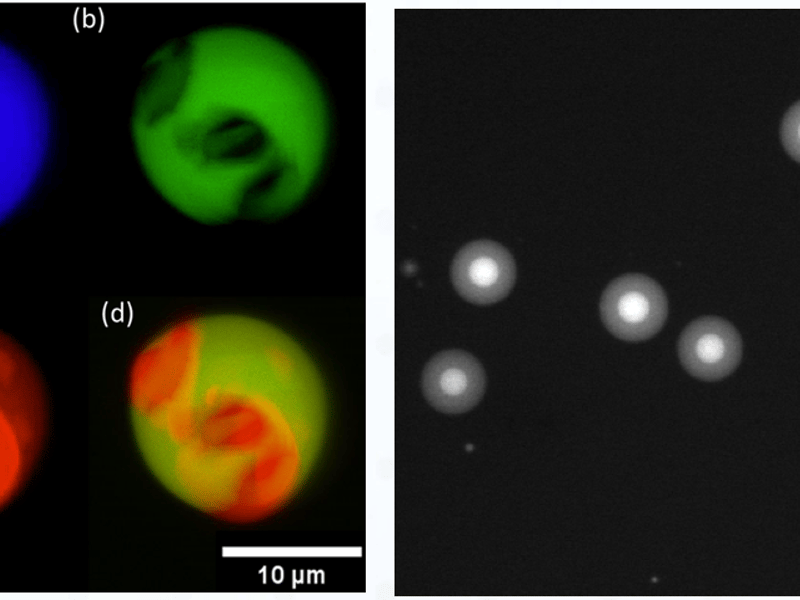
Figure: fibers of  hyaluronic acid modified with either hydrazides (red) or aldehydes (green).
Figure: fibers of hyaluronic acid modified with either hydrazides (red) or aldehydes (green).
May 12, 2021
UPENN Materials Research Science and Engineering Centers

Mechanochemical Adhesion and Plasticity in Multifiber Hydrogel Networks

Matthew Davidson, Ehsan Ban, Vivek Shenoy, Jason Burdick, University of Pennsylvania

Burdick and Shenoy have designed synthetic actively remodeling networks using electrospun fibers containing reactive groups that form covalent crosslinks at sites where fibers are brought together by localized strains. This approach uses the fibers of  hyaluronic acid modified with either hydrazides (red) or aldehydes (green).
The top left image is a photograph of the experimental apparatus (a), in which floating particles constitute a pillar with 2x1 aspect ratio and are subjected to tensile strain all while tracking particles and measuring stress by deflection of a soft beam.  An image with identified particle positions, for a small subset of particles, is shown at upper right (b).  Just underneath is an example force versus strain curve (c).  The bottom image is a collage of tracked particles, now shaded by the traditional ‘d2min’ measure of local nonaffine motion that reliably indicates local rearrangements and failure. In this image, each row is for a different particle size.  It demonstrates that the failure zone is sharp for large particles and progressively less so for smaller particles where the cohesive interaction range is larger than particle size.  Thus, the large-particle pillars are more brittle, and the small-particle pillars are more ductile.
The top left image is a photograph of the experimental apparatus (a), in which floating particles constitute a pillar with 2x1 aspect ratio and are subjected to tensile strain all while tracking particles and measuring stress by deflection of a soft beam. An image with identified particle positions, for a small subset of particles, is shown at upper right (b). Just underneath is an example force versus strain curve (c). The bottom image is a collage of tracked particles, now shaded by the traditional ‘d2min’ measure of local nonaffine motion that reliably indicates local rearrangements and failure. In this image, each row is for a different particle size. It demonstrates that the failure zone is sharp for large particles and progressively less so for smaller particles where the cohesive interaction range is larger than particle size. Thus, the large-particle pillars are more brittle, and the small-particle pillars are more ductile.
May 12, 2021
UPENN Materials Research Science and Engineering Centers

Interaction Range Can be Tuned to Control Failure Mode in a Model Experimental Disordered Solid

Douglas J. Durian, Andrea J. Liu, and Robert A. Riggleman, University of Pennsylvania

The long-standing goal of increasing material toughness and decreasing brittle failure is elusive in part due to lack of model experimental systems in which ductility can be tuned while observing both macro- and micro-scale response of the constituent “atoms”.  We have now created such a system, as illustrated, wher
This project has developed finger-like 3D printed hydrogel actuators with autonomic perspiratioon, as shown in the top left image. Actuation is created by using a Polyacrylamide-based dorsal layer, and a Poly(N-isopropylacrylamide) finger. when the finger bends,  In the figures at bottom left, when body temperature is below 30 degrees C, 'skin' pores are closed and allow for mechanical actuation. When temperature rises above 30 degrees C, skin pores open, allowing localized perspiration and actuation simultaneously.
This project has developed finger-like 3D printed hydrogel actuators with autonomic perspiratioon, as shown in the top left image. Actuation is created by using a Polyacrylamide-based dorsal layer, and a Poly(N-isopropylacrylamide) finger. when the finger bends, In the figures at bottom left, when body temperature is below 30 degrees C, 'skin' pores are closed and allow for mechanical actuation. When temperature rises above 30 degrees C, skin pores open, allowing localized perspiration and actuation simultaneously.
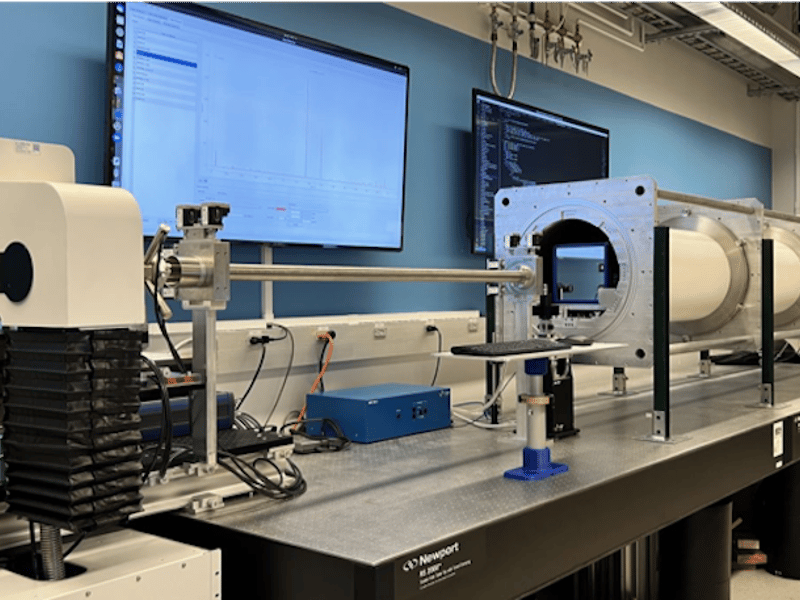
The EMPAD detector (a). Magnetic field lines determined with EMPAD (b). Nanoscale strains imaged with EMPAD (c) due to buckling and stretching of dissimilar 2D materials (d). Image source: IRG-1, IRG-3
May 12, 2021
Big Idea: Mid-scale Research Infrastructure

Partnerships for Commercializing New Technologies

Faculty at Cornell have combined detector-building experience with electron microscopy expertise to develop the Electron Microscope Pixel Array Detector, or EMPAD. Partnering with a leading scientific instrument manufacturer, this technology is now available as an option on new electron microscopes from Thermo Fisher Scientific.
May 10, 2021
Big Idea: Quantum Leap

Solid-Phase Epitaxy: A Means to Control Atomic-Scale Structure in Complex Materials

Wisconsin MRSEC researchers have developed a method to synthesize materials with precisely controlled crystal structures, even when the same atoms could arrange themselves into a different structure with nearly the same energy. The methods allow them to make highly perfect films of cubic aluminum oxide with widespread applications in electronic materials, catalysis, and surface passivation.
May 10, 2021
Big Idea: Growing Convergence Research

New Insights into Surface Diffusion on Glasses

Lian Yu, Dane Morgan, John Perepezko, Paul Voyles, Mark Ediger, University of Wisconsin-Madison

Understanding how atoms move is fundamental to making and using materials. Atoms on the surface of some glasses move at nearly the same rate as atoms on the inside. But for other glasses, surfaces atoms move a million times faster.
May 10, 2021
Big Idea: Growing Convergence Research

Accelerating Innovation through Licensing, Commercialization, and Startups

Knowledge Transfer, Northwestern University MRSEC

The NU-MRSEC amplifies its societal impact by engaging industry and other partners, promoting commercialization, and providing shared facilities that are informed by the latest materials research.  In this manner, the latest scientific developments are efficiently brought to the marketplace, and society at large.
May 10, 2021
Big Idea: Quantum Leap

Synthesis of Borophane Polymorphs through Hydrogenation of Borophene

Q. Li, V. S. C. Kolluru, M. S. Rahn, E. Schwenker, S. Li, R. G. Hennig, P. Darancet, M. K. Y. Chan, and M. C. Hersam, “Synthesis of borophane polymorphs through hydrogenation of borophene,” Science, 371, 1143-1148 (2021).

In a three PI collaboration within NU-MRSEC IRG-1, “borophane” polymorphs have been synthesized by hydrogenating borophene with atomic hydrogen in ultrahigh vacuum. Borophane polymorphs are metallic and can be reversibly returned to pristine borophene through thermal desorption of hydrogen.
May 3, 2021
Center for Emergent Materials

STEM: Science and Beyond

Hosted by Prof. Rolando Valdés Aguilar and graduate student Brandi Wooten, CEM Podcasts were started in 2020 during the COVID-19 pandemic in an effort to inform and bring the MRSEC community together.
Fig. 1: a) Director Mason leads a lesson on how temperature affects materials, b) Perry leads students as they take apart a magnetic drawing board, c) Schleife lets students explore atomic structure with a VR lesson; d) Walsh shows the surfaces of a pencil using an optical profiler, then leads students in writing haikus about it, e)  a 7th grader’s haiku inspired by examining the pencil (shown in background).
Fig. 1: a) Director Mason leads a lesson on how temperature affects materials, b) Perry leads students as they take apart a magnetic drawing board, c) Schleife lets students explore atomic structure with a VR lesson; d) Walsh shows the surfaces of a pencil using an optical profiler, then leads students in writing haikus about it, e) a 7th grader’s haiku inspired by examining the pencil (shown in background).
Apr 29, 2021
Illinois Materials Research Science and Engineering Center

Virtual Musical Magnetism Engages Middle School Students in Materials Science

The Illinois MRSEC implemented its middle school outreach program “Musical Magnetism” for the third year starting in Feb. 2021, in a six-week, virtual format. The program engages middle school students in materials science demos as they practice creative expression with a science theme. The program reached 50 7th and 8th graders at Franklin STEAM Academy, a school with majority URM students.