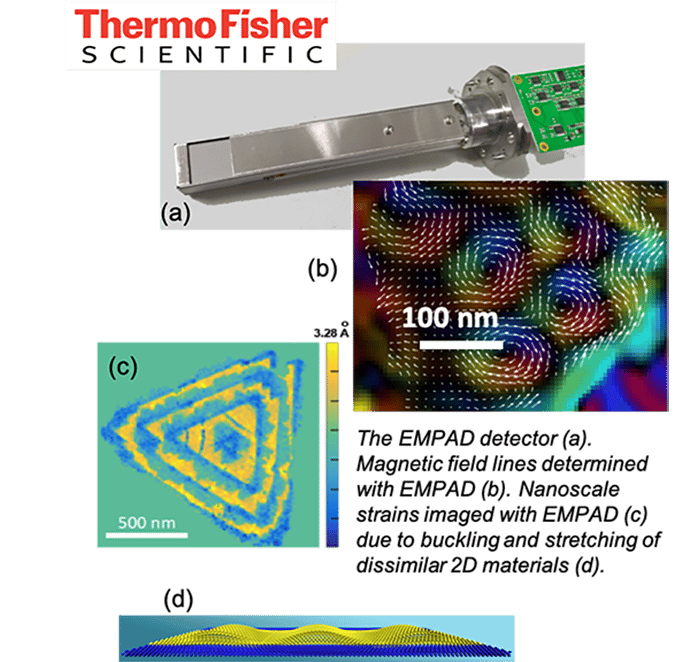
Faculty at Cornell have combined detector-building experience with electron microscopy expertise to develop the Electron Microscope Pixel Array Detector, or EMPAD. Partnering with a leading scientific instrument manufacturer, this technology is now available as an option on new electron microscopes from Thermo Fisher Scientific.
EMPAD detector technology is essentially a camera, with another camera at every pixel. This allows an EMPAD user to deduce the path of every electron going through a material. This immediately improves microscope resolution, already leading to a 2018 Guinness World Record for best microscope resolution. More importantly, the Cornell team has recently shown that properties like strain and magnetic fields in materials can imaged using the EMPAD.
 Download