Highlights
Sep 23, 2015
Columbia University in the City of New York
Summer MRSEC outreach and education programs at Columbia University / CCNY
The center seeks to provide graduate and postgraduate training in research and other professional skills; to guide hands-on education about materials and Materials Science, provide support for local teachers, and encourage student research at the secondary level.
Sep 22, 2015
Prediction and Design of Protein Polymer Phase Behavior at the Sequence Level
Ashutosh Chilkoti, Duke UniversityFelipe Garcia Quiroz, Duke University
In their recent publication in Nature Materials, Research Triangle MRSEC professor Ashutosh Chilkoti and graduate fellow Felipe Garcia Quiroz created test motifs to identify the amino acid sequences that determine phase behavior in proteins. They demonstrate that proteins can be designed to exhibit tunable phase transitions, allowing significant control over assembly and disassembly processes.
Aug 24, 2015
Nanocapillarity-mediated magnetic assembly of nanoparticles into ultraflexible filaments and reconfigurable networks
Bhuvnesh Bharti1, Anne-Laure Fameau2 Michael Rubinstein3 and Orlin D. Velev1 1Deptartment of Chemical and Biomolecular Engineering, North Carolina State University, Raleigh; 2National Institute of French Agricultural Research, Nantes; 3Department of Chemistry, University of North Carolina, Chapel Hill
In a paper published in Nature Materials, researchers from North Carolina State University and the University of North Carolina-Chapel Hill show that magnetic nanoparticles encased in oily liquid shells can bind together in water, much like sand particles mixed with the right amount of water can form sandcastles.
Aug 20, 2015
University of Minnesota - Twin Cities
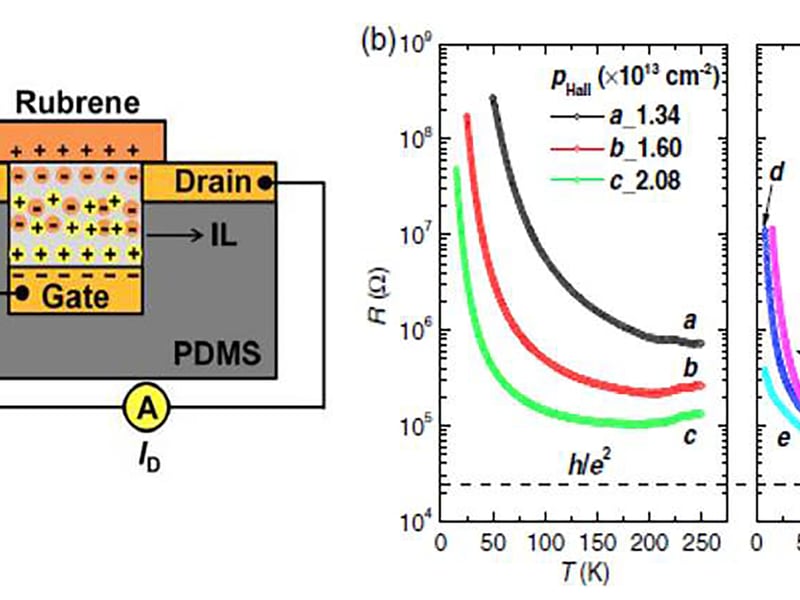
Approaching a Two-Dimensional (2D) Metallic State on the Surface of the Organic Semiconductor Rubrene
Dan Frisbie, Chris Leighton University of Minnesota
Whether metallic behavior can exist in 2D materials is a question that has troubled condensed matter physics for decades. Although originally thought impossible, evidence for such in ultra-clean high-purity doped inorganic semiconductor heterostructures based on materials such as Si and GaAs eventually changed the prevailing view.
Showing 661 to 670 of 1452