Highlights
May 16, 2012
University of Minnesota - Twin Cities
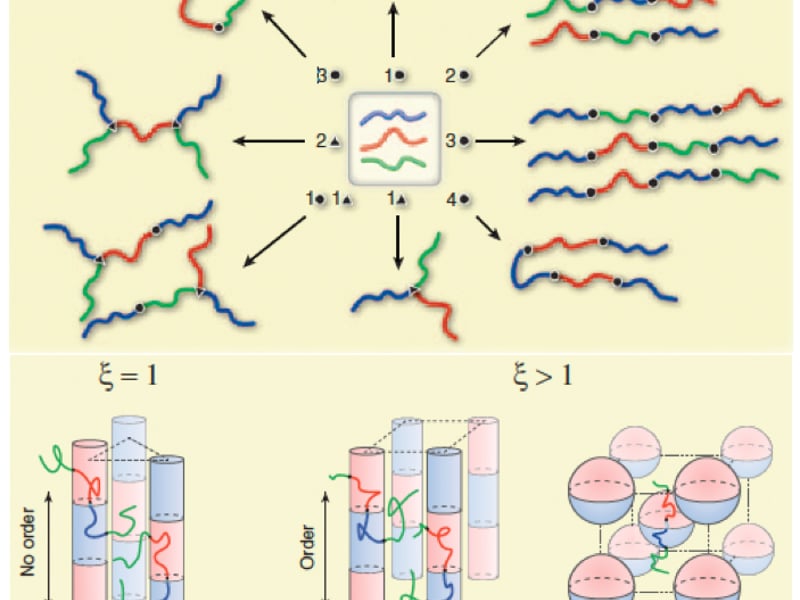
Multiblock Polymers: Panacea or Pandora’s Box
F.S. Bates, M.A. Hillmyer, T.P. Lodge (UMN); G.H. Fredrickson (UCSB)
Advances in polymer synthesis have enabled access to a vast array of multiblock polymer architectures, with rich opportunities for designing multiple functionalities into a single self-assembled material.
May 7, 2012
Cornell University
A Better Type of Computer Memory Demonstrated
L. Liu, C.-F. Pai, Y. Li, H. W. Tseng, D. C. Ralph, and R. A. Buhrman, Science 336, 555-558, (2012).
Newly discovered “giant” spin Hall effect enables simple and efficient magnetic memory
May 7, 2012
Cornell University
Visualizing the intricate electron pairing in iron-based superconductors
M. P. Allan, A. W. Rost, A. P. Mackenzie, Y. Xie, J. C. Davis, K. Kihou, C. H. Lee, A. Iyo, H. Eisaki, and T.-M. Chuang, , Science 336, 563-567, (2012).
Correlated
motion provides new clues to the magnetic origin of high-temperature
superconductivity
Superconducting
wires conduct electricity perfectly — without any energy losses — because
each electron spontaneously bonds to a partner electron. The pairs then perform
an intricate dance down the wire, never bumping into the walls or other pairs. Unfortunately,
May 3, 2012
University of Utah
FRG-2 – Using Weakly Spin-Coupled Polaron Pair States for a Calibration Free Absolute Magnetometry
W. J. Baker, K. Ambal, D. P. Waters, R. Bardaa, K. v. Schooten, D. R. McCamey, J. M. Lupton, C. Boehme
Objective:
A precise absolute magnetometer based on organic spintronics that is scalable to micron dimensions, has low cost and that is not adversely affected by environmental influences (temperature, air etc.).
Approach: Integrated bipolar MEH-PPV device above magnetic field strip lines for magnetic resonant excitation. The B-field is measured through spin-dependent current changes under magnetic resonance.
Results and Significance: For the p-conjugated polymer MEH-PPV, an ABSOLUTE sensitivity of
May 3, 2012
University of Utah
Liquid Metal-Based Plasmonics
Ajay Nahata and Z. Valy Vardeny
Objective: To develop and characterize new plasmonic metamaterials in the terahertz (THz) spectral range.
Approach: Explore unconventional materials that are typically not suitable for plasmonics applications at optical frequencies but exhibit reasonable conductivities at THz frequencies.
Results and Significance: Liquid metals and well-developed microfluidic technology can be used successfully to create useful devices in a frequency range commonly referred to as the “gap in the electromagnetic spectrum.”
May 3, 2012
University of Utah
Seed Project: The Dynamics of Organic Magneto-resistance (OMAR)
Andrey Rogachev and Tho Nguyen
Objective: To study the dynamics of magneto-resistance in organic diodes
Approach: Measure electronic transport and magneto-transport of organic diodes as a function of frequency with an applied magnetic field using admittance spectroscopy
Showing 941 to 950 of 1452