Highlights

Utilization and hourly cost for USTAR – MRSEC equipment from the time of purchase
Jun 16, 2017
University of Utah

Leveraging MRSEC Equipment Purchases

Ian Harvey; University of Utah

Leveraged upgrades to Scanning Transmission Electron Microscope (S/TEM) and Focused Ion Beam System (FIB) include Gas-phase Environmental TEM, 3D EDS tomography (S/TEM), and others. 
Synthesis of a Family of 2D Coordination Polymers using Hexaaminobenzene as the Building Block
Jun 16, 2017
University of Utah

Synthesis of a Family of 2D Coordination Polymers using Hexaaminobenzene as the Building Block

Nabajit Lahiri, Neda Lotfizadeh, Ryuichi Tsuchikawa, Vikram Deshpande and Janis Louie; University of Utah

Since the discovery of Graphene, there has been a significant interest in the search of new 2D materials which would show similar interesting properties such as electrical and thermal conductivity, superconductivity, and topological gap.
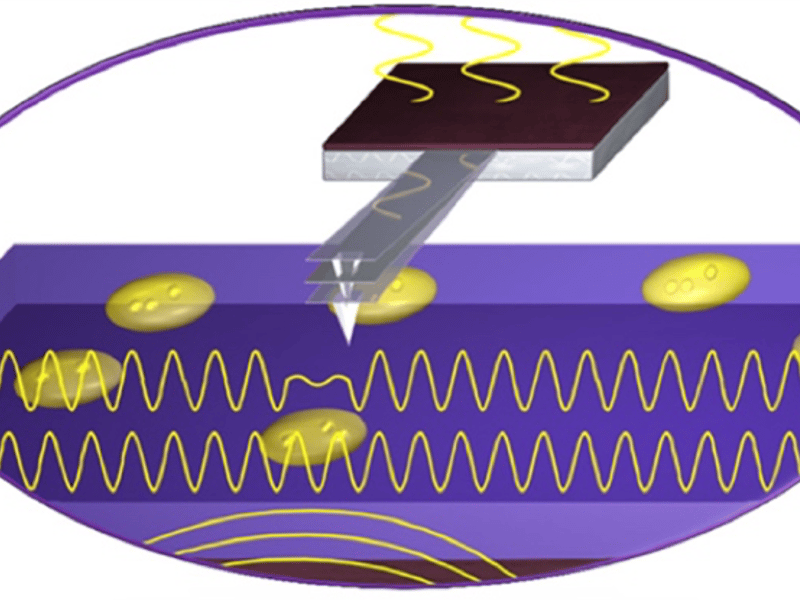
A thermal gradient is applied to the permalloy (Ni81Fe19) ferromagnetic thin film, while the Sagnac interferometer microscope watches for subtle changes in magnetization due to spin currents in the film.
This non-contact optical technique allows the magnetization and/or thermal gradient to be in-plane or out-of-plane for studying the underlying spin-Seebeck physics.
A thermal gradient is applied to the permalloy (Ni81Fe19) ferromagnetic thin film, while the Sagnac interferometer microscope watches for subtle changes in magnetization due to spin currents in the film. This non-contact optical technique allows the magnetization and/or thermal gradient to be in-plane or out-of-plane for studying the underlying spin-Seebeck physics.
Jun 16, 2017
University of Utah

“Optical Detection of Transverse Spin-Seebeck Effect in Permalloy Films using Sagnac Interferometer Microscopy”

R. McLauglin, D. Sun, and Z.V. Vardeny; University of Utah

The field of spintronics, which involves the design of novel electronic devices that utilize the spin of electrons, requires researchers to develop a robust source of spin-polarized currents to fuel future technology. 
(a) Performance of Ca3Co4O9 based thermoelectric material over two decades and the performance achieved in our present work. (b) Schematic of thermo
Jun 16, 2017
University of Utah

Terbium Ion Doping in Ca3Co4O9: A Step Towards High-Performance Thermoelectric Materials

Shrikant Saini, Yinong Yin, Ashutosh Tiwari; University of Utah

We have achieved the enhanced thermoelectric response in polycrystalline Ca3Co4O9 on doping Tb ions in the material. Specifically, a high figure of merit (ZT) of 0.74 at 800 K was observed for Ca2.5Tb0.5Co4O9.
Surface-Enhanced Fluorescence of Pyrene on Nanostructured Aluminum
Jun 16, 2017
University of Utah

Surface-Enhanced Fluorescence of Pyrene on Nanostructured Aluminum

Danielle Montanari, Joel Harris, Steve Blair; University of Utah

Both the absorption and emission of ultraviolet light by pyrene (PAH compound) are enhanced by more than 30-fold on nanostructured aluminum, compared to an equivalent control sample on sapphire (aluminum oxide). 
Using Shape Memory Alloys for Active Terahertz Plasmonic Devices
Jun 16, 2017
University of Utah

Using Shape Memory Alloys for Active Terahertz Plasmonic Devices

Barun Gupta, Shashank Pandey, Anjali Nahata, Ting Zhang, Sivaraman Guruswamy and Ajay Nahata; University of Utah

We show the first demonstration of shape memory alloys being used for active THz devices. The metal foil was found to reproducibly cycle between the two geometries over 100 times. 
Students exploring changing characteristics of household materials with chemical reactions at a local STEM festival organized by Utah MRSEC.
Jun 16, 2017
University of Utah

Hands-on Science After School

Chelsey Short, University of Utah

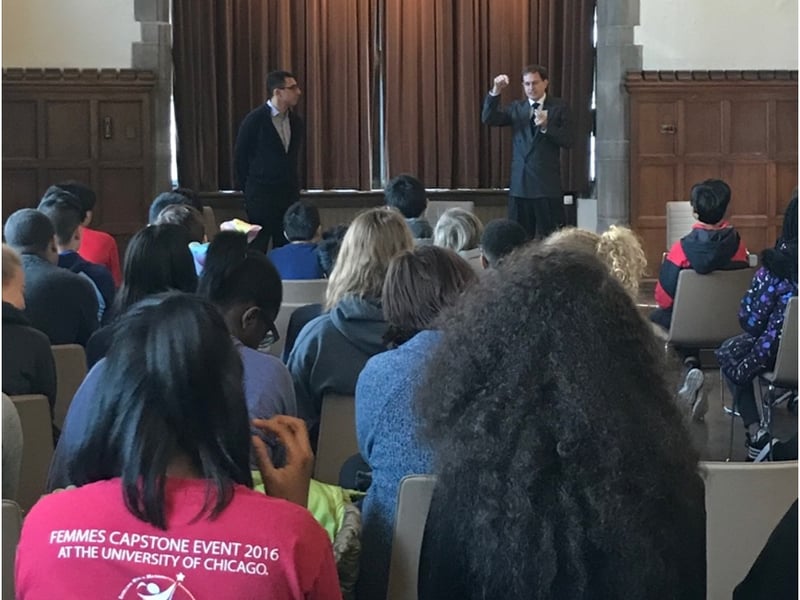
Utah MRSEC establishes science and engineering afterschool clubs at community centers and schools serving predominately underrepresented minority (URM) students in those fields. The Education and Outreach team then hires and trains University of Utah undergraduates to lead the clubs and deliver hands-on activities each week.
Discovery of a New Line Defect in a Perovskite Oxide
Jun 15, 2017
University of Minnesota - Twin Cities

Discovery of a New Line Defect in a Perovskite Oxide

Bharat Jalan, Renata Wentzcovitch, Andre Mkhoyan University of Minnesota

Defects, essentially locations in a crystal where the perfect arrangement of atoms is disturbed, are inherent in materials, and play a key role in their function.
Solution-Processed Indium Oxide Transistors: Printing Two-Dimensional Metals
Jun 15, 2017
University of Minnesota - Twin Cities

Solution-Processed Indium Oxide Transistors: Printing Two-Dimensional Metals

Dan Frisbie, Chris Leighton University of Minnesota

Transistors, the building blocks of all computer technologies, are currently based on semi-conductors such as silicon, manufactured using energy-intensive processes.
Spooling Instability  of Self-Propelled Flexible Filaments
Spooling Instability of Self-Propelled Flexible Filaments
Jun 14, 2017
University of Colorado at Boulder

Spooling Instability of Self-Propelled Flexible Filaments

Meredith Betterton, Matthew Glaser University of  Colorado Boulder

Cytoskeletal filaments with chemical motors attached are the basic elements in cells that enable biological motion. Computer simulation of model biomotive systems show that even systems with minimal ingredients are able to generate the kind of exotic nonequilibrium behavior observed in cells.