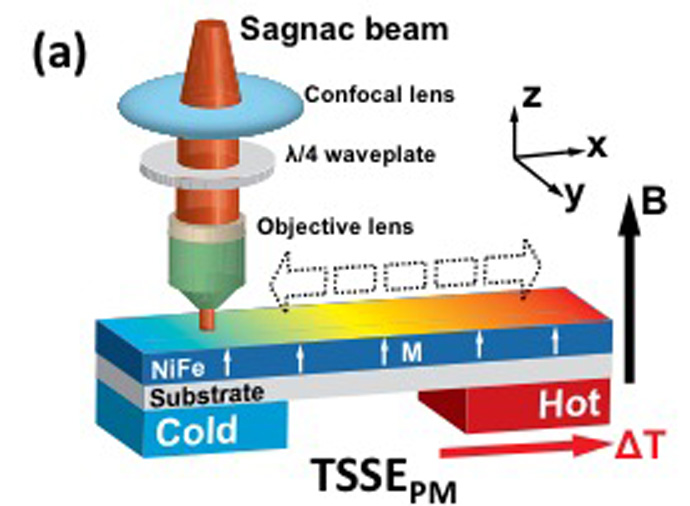
The field of spintronics, which involves the design of novel electronic devices that utilize the spin of electrons, requires researchers to develop a robust source of spin-polarized currents to fuel future technology. One promising avenue for a reliable spin-current source is the spin Seebeck effect, where a thermal gradient is used to drive a spin-current in a ferromagnet. We used the magneto-optical Kerr effect (the rotation of polarized light by a magnetic medium) to gain an unprecedented look into the microscopic physics of the spin-Seebeck effect in a permalloy ferromagnet film. The breakthrough required the ultra-high sensitivity of our homebuilt fiber optic Sagnac interferometer, which we adapted into a diffraction-limited confocal microscope in order to spatially map the magnetization change of magnetic thin films with 20 nano-radian angular resolution.
 Download