Highlights

Pure Spin Current in a Non-Equilibrium Magnetic Insulator
May 14, 2020
University of Texas at Austin

Pure Spin Current in a Non-Equilibrium Magnetic Insulator

X. Li, G. Fiete, J. Zhou: Univ. of Texas at Austin

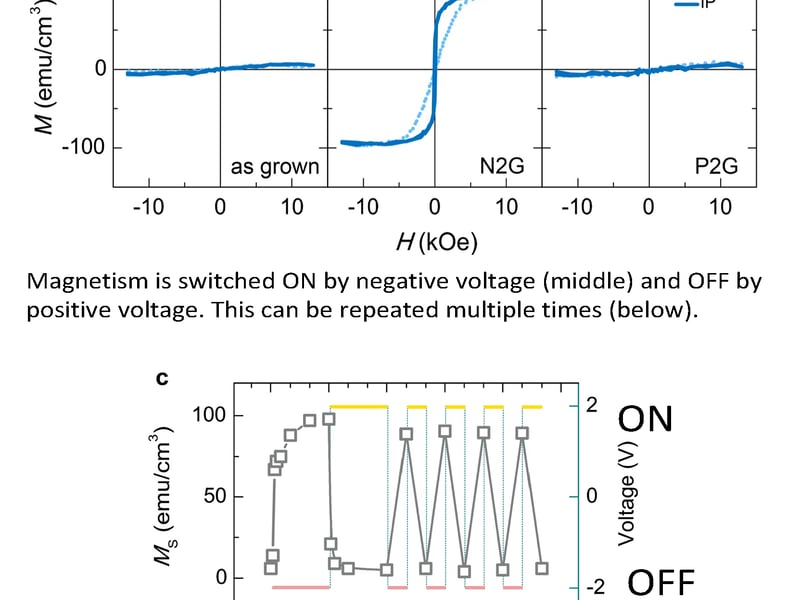
We investigate spin current in a magnetic insulator, YIG, under thermally driven  non-equilibrium conditions, a challenging task for conventional transport techniques. 
Chemically-Triggered Synthesis, Remodeling, and Degradation of Soft Materials
May 14, 2020
University of Texas at Austin

Chemically-Triggered Synthesis, Remodeling, and Degradation of Soft Materials

E. Anslyn, N. Lynd: Univ. of Texas at Austin

This works demonstrated a series of morphological changes could be induced with a small set of monomers due to the use of reversible covalent bonding interactions.
Unique Facilities: Benchtop X-ray Spectrometer for Accelerating Discovery and Characterization of Novel Phosphorous-Rich Materials
Magnetic properties of bilayer CrCl3. (a) Schematic of a magnetic tunnel junction. (b) Magnetic phase diagram vs temperature and in-plane magnetic fields. (c) Tunneling current vs magnetic fields with the corresponding magnetic states indicated.
May 12, 2020
University of Washington

MEM-C IRG-2: An atomically thin in-plane layered antiferromagnetic insulator

X. Cai*, T. Song, N. P. Wilson, G. Clark, M. He, X. Zhang, T. Taniguchi, K. Watanabe, W. Yao, D. Xiao, M. A., McGuire, D. Cobden*, X .Xu* *MEM-C participants

We investigate the magnetic order of atomically thin CrCl3 by employing vertical tunneling measurements, which are sensitive to the relative alignment of spins in different layers. 
A scene in the series in which the students are gathered in the garage and realize they have a strange new material.
May 8, 2020
University of Illinois Urbana-Champaign

I-MRSEC educational web series: “Magnetic Fields”

In Summer 2019 the I-MRSEC officially released the web series “Magnetic Fields,” which follows middle school aged characters as they encounter a new material at the I-MRSEC, and emphasizes the scientific process, persistence, and the diversity of scientists. The episodes include “Behind the science,” featuring interviews with I-MRSEC researchers sharing their paths in science and advice to those interested in STEM studies.
Schematic and image of graphene bending and a plot of bending stiffness.
May 8, 2020
University of Illinois Urbana-Champaign

Ultrasoft, Slip Mediated Bending of Multilayer Graphene

Two-dimensional (2D) materials like graphene are highly deformable due to their atomically thin structure. To fabricate deformable devices (e.g. flexible and wearable electronics) that capitalize on their ultrasoft nature, it is critical to assess the bending stiffness of graphene.
Unit cell of Cu0.82Mn1.18As showing the chemical and magnetic structure.
May 8, 2020
University of Illinois Urbana-Champaign

Discovery of a hexagonal easy-plane metallic antiferromagnet in the CuMnAs system

Daniel Shoemaker and Andre Schleife University of Illinois at Urbana-Champaign

We discovered a new hexagonal metallic antiferromagnetic phase in the Cu-Mn-As system.   Electrical switching and read-out of tetragonal CuMnAs inspired a world-wide research effort in metallic antiferromagnets. Phase equilibria in this system (Fig. a) however is poorly understood.
(A) Structures of icosahedral virus capsids, where T is the number of distinct local symmetry environments (indicated by color). (B) Cryo-electron microscopy reconstructions of DNA origami capsids. (C) (right) TEM tomogram of an origami capsid assembled around a DNA molecule labeled with gold nanoparticles. (left) Schematic of the structure. (D) Prediction of the yield T=3 capsid yield as a function of subunit-subunit interaction strengths that drive dimer formation (e11) and pentamer formation (e23), from Langevin Dynamic simulations.
Jan 31, 2020
Brandeis University

Bioinspired DNA Origami Capsids

S. Fraden1, G. Grason2, R. Hayward2, M. Hagan1, W. Rogers1, C. Santangelo2, H. Dietz3, 1Brandeis University, 2U. Mass. Amherst, 3Tech. Universität München

DNA origami technology is used to develop building blocks that self-assemble into predetermined finite-sized structures. The objectives of this research are to understand, control, and build self-closing structures inspired by self-assembling viruses, whose smallest capsids have an icosahedral symmetry and are decomposable into so-called “quasi-equivalent” triangular subunit arrangements, characterized by the “T” number (Fig. 1A). Assembly occurs using programmed edge-edge interactions based on a lock-and-key mechanism and base stacking between the blunt ends of the double-helices.
Dynamics of disclination loops in 3D active nematic. Topological loops can nucleate spontaneously from a uniformly aligned nematic through the bend instability. Loops can split from the existing percolating network. Equivalently, topological loops can also self-annihilate and merge with other existing loops. Colors highlight the loops of interest
Jan 24, 2020
Brandeis University

Disclination loops in 3D Active Nematics

G. Duclos4, D. Beller2, R. Adkins1, M. Varghese4 , M.  Peterson4, Arv. Baskaran4, R. Pelcovitz3, T. Powers3, S. Streichan1, Ap. Baskaran4, M.F. Hagan4, Z. Dogic1 1UCSB, 2UC Merced, 3Brown University, 4Brandeis University

Current active matter systems, such as self propelled colloids or migrating cells, are inherently 2D, which limits the potential engineering applications. Brandeis developed the first 3D active nematic material by mixing an isotropic active fluid (Microtubules + kinesin motors) with a passive nematic colloidal liquid crystal (fd viruses). Using multiview light sheet microscopy, they explored the structure and the dynamics of topological defects in a 3D active nematic.
Structure and rheology of active gels: (left) A confocal reconstruction of an active gels composed of continuously rearranging extensile microtubule bundles that is driven by continuous input of energy through the motion of molecular motors. (right) Effective viscosity of a microtubule based active gels for three different ATP concentrations which controls the speed at which kinesin motors slide microtubules apart. The dashed lines represent a molecular model that explains the peak in the sample viscosity  without any adjustable parameters.
Structure and rheology of active gels: (left) A confocal reconstruction of an active gels composed of continuously rearranging extensile microtubule bundles that is driven by continuous input of energy through the motion of molecular motors. (right) Effective viscosity of a microtubule based active gels for three different ATP concentrations which controls the speed at which kinesin motors slide microtubules apart. The dashed lines represent a molecular model that explains the peak in the sample viscosity without any adjustable parameters.
Jan 24, 2020
Brandeis University

Rheology of active isotropic gels

D. Gagnon, C. Dessii, D. Blair (Georgetown University), J. Berezney (Brandeis University), R. Boros, Z. Dogic (UCSB)

Cytoplasmic flows, bacterial colonies, and algal blooms are ubiquitous examples of active suspensions assembled from self-propelled particles, which internally inject energy into their suspending medium and, at sufficient concentrations, can produce large-scale flows. Linking macroscale material properties of active suspension to their underlying microscopic dynamics is a key challenge to describing these materials.