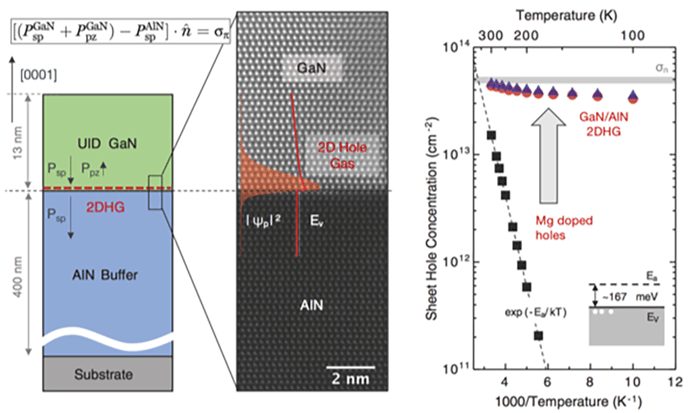
When an electrically-insulating material is grown on top of another insulator, the interface between the two insulators can be populated by mobile electrons. This has been achieved in interfaces that have a polarization discontinuity, such as AlGaN/GaN and LaAlO3/SrTiO3. It would be valuable to create a layer of mobile positive charges called holes, because electronic devices rely on charge carried by both electrons and holes.
A Cornell group’s discovery of high-conductivity holes at the interface between GaN and AlN completes the hunt for electrons and holes induced by polarization in the column III-nitride semiconductors. These materials have enabled solid-state lighting and highly-efficient microwave and power electronics. This finding creates a way to explore the physics of closed-packed high-density electron-hole systems in this technologically-relevant material system.
 Download