Highlights
Jul 5, 2023
UPENN Materials Research Science and Engineering Centers
UPENN Outreach: Supporting Diversity, Equity, and Engagement in STEM
Mark Licurse & Ashley Wallace, University of Pennsylvania
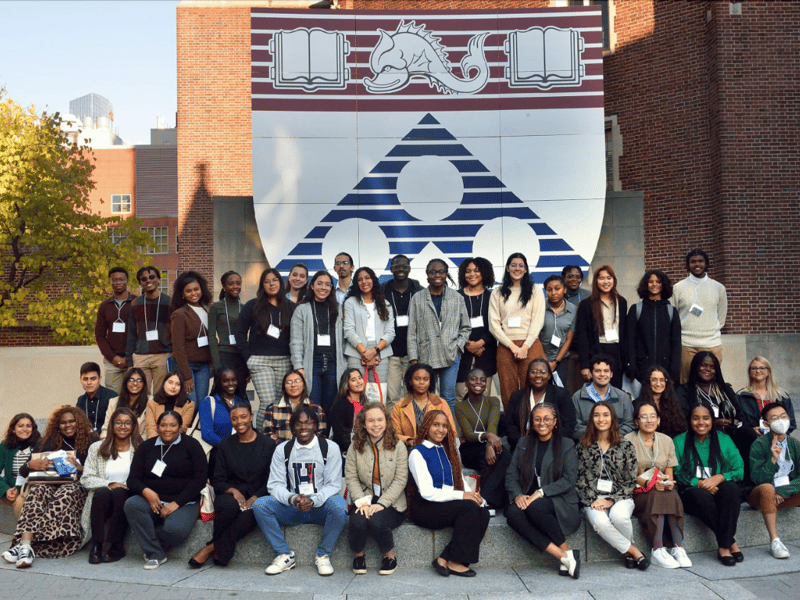
The LRSM spearheaded the inaugural Diversity Equity Engagement at Penn in STEM (DEEPenn STEM) weekend in October 2022. The initiative aims to proactively educate and recruit students from ethnically and racially minoritized communities (i.e. URMs), women, and first-generation low-income (FGLI) students to STEM-related graduate programs at Penn.
Jul 5, 2023
UPENN Materials Research Science and Engineering Centers
UPENN Outreach: 12th Annual Philadelphia Materials Day
Mark Licurse & Ashley Wallace, University of Pennsylvania
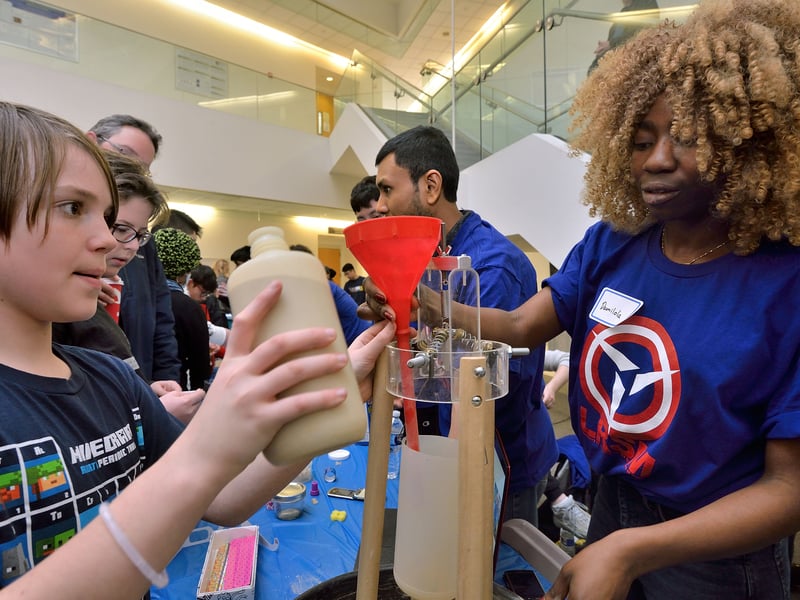
Philadelphia Materials Day is a collaborative effort between the University of Pennsylvania MRSEC and the Materials Science & Engineering Department at Drexel University to promote materials research in the region. The 12th annual Philadelphia Materials Day took place on February 11, 2023 at the Bossone Research Center at Drexel University.
Jul 5, 2023
UPENN Materials Research Science and Engineering Centers
UPENN Seed: Adding new dimensions to quantum communication
Liang Feng and Ritesh Agarwal, University of Pennsylvania
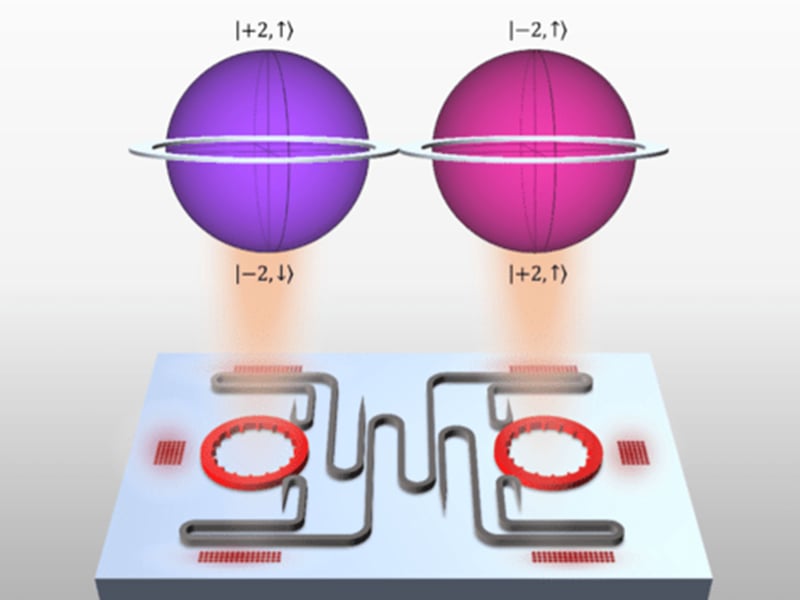
Researchers at the University of Pennsylvania have made a microfabricated laser using semiconductor fabrication methods that can control two features of the light particles: their orbit and their spin. This allows them to make light particles with four states simultaneously. These higher-dimensional quantum bits (qudits) can store more information and better avoid noise. They can also make quantum communication more secure and faster and allow more secure communications.
Jul 5, 2023
UPENN Materials Research Science and Engineering Centers
UPENN Seed: An electronic metamaterial capable of decentralized physics-driven learning
Douglas Durian and Andrea Liu, University of Pennsylvania
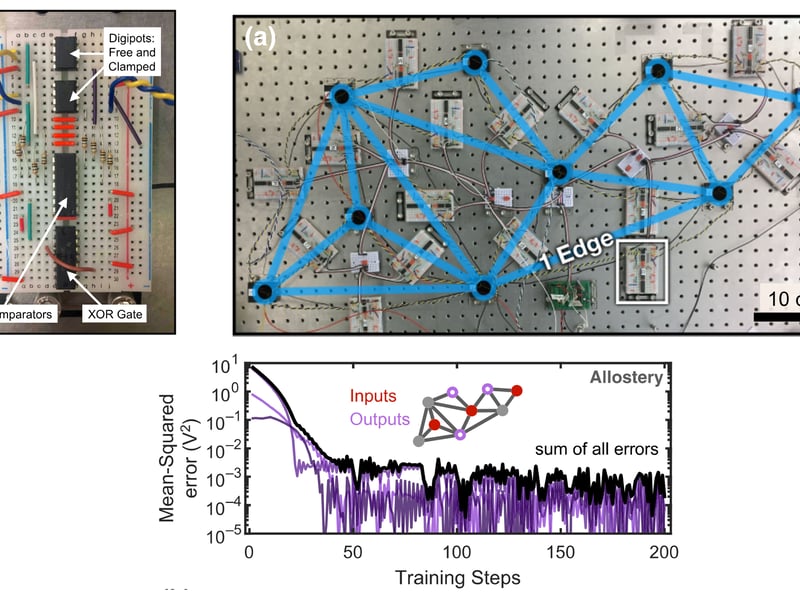
In conventional machine learning, a computer is used to minimize a cost function that specifies a desired task, using global information about the entire network. We have now demonstrated how machine learning tasks can be learned and performed without either a computer or global information by taking advantage of physics via a scheme called coupled learning1. Specifically, twin variable-resistor networks are run under different boundary conditions and corresponding edges are compared against only each other for determining resistance updates2.
Jul 5, 2023
UPENN Materials Research Science and Engineering Centers
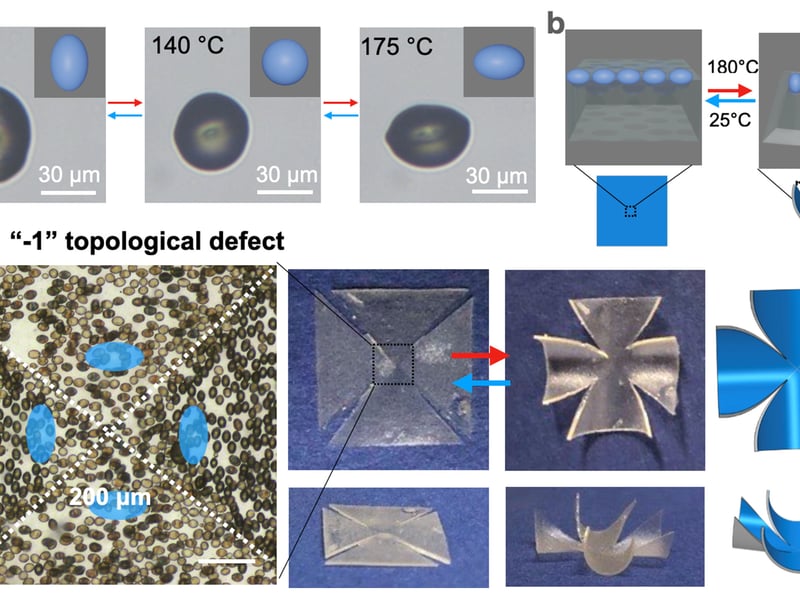
UPENN IRG3 Shape morphing directed by spatially encoded, dually responsive liquid crystalline elastomer micro-actuators
Shu Yang and Chris Murray, University of Pennsylvania
Liquid crystal elastomers (LCEs) with intrinsic molecular anisotropy can be preprogrammed to morph shapes from 2D to 3D under external stimuli. However, it is difficult to program the positions and orientations of individual building blocks separately and locally as they are chemically linked in the polymer network.
Jul 5, 2023
UPENN Materials Research Science and Engineering Centers
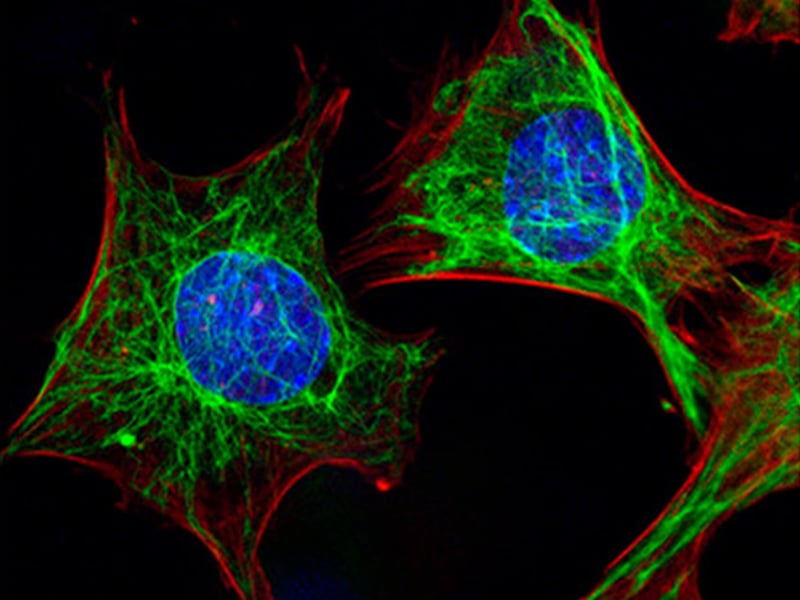
UPENN IRG2 Vimentin filaments protect cell nuclei from mechanical damage
Ekaterina Grishchuk and Paul Janmey, University of Pennsylvania
Cells and tissues are subjected to external mechanical stresses in the body, including compressive loads, pressure gradients, and shear. This study shows that single cells become harder when compressed and that the parts inside the cells that make them strong (called the cytoskeleton) change when they are compressed. Some cells, like fibroblasts, become harder when subjected to moderate compression. However, this does not happen if a part of the cytoskeleton called vimentin is removed. This is because vimentin networks become harder when compressed or extended. This is explained using a theoretical model to based on the flexibility of vimentin filaments and their surface charge, which resists volume changes of the network under compression.
Jul 5, 2023
UPENN Materials Research Science and Engineering Centers
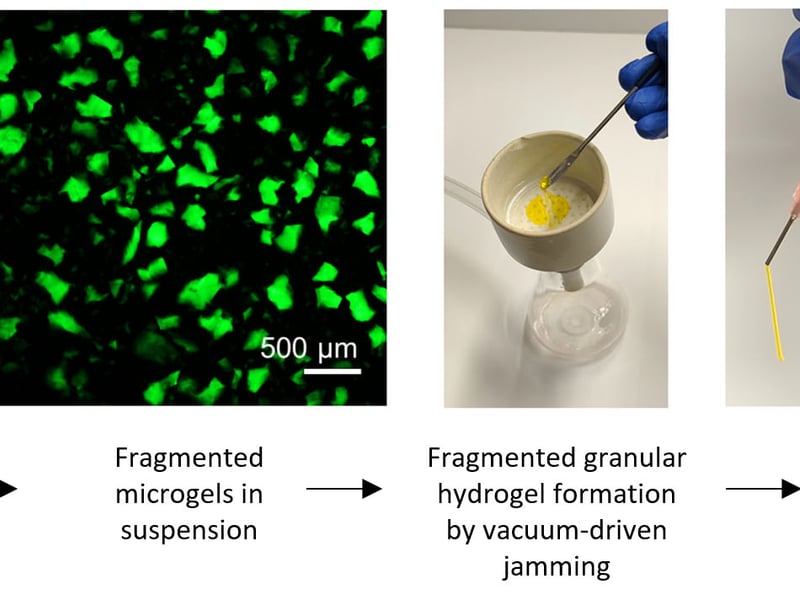
Fabricating Granular Hydrogels for 3D Printing
Paulo Arratia, University of Pennsylvania / Jason Burdick, University of Colorado
Granular hydrogels are jammed assemblies of hydrogel microparticles (i.e., “microgels”) widely explored in biomedical applications due to promising features such as shear-thinning to permit injectability and inherent porosity for cellular interactions. One area where this is particularly promising is in 3D printing.

Jul 5, 2023
UPENN Materials Research Science and Engineering Centers
Uncovering the Surprising Nature of Glassy Energy Landscapes
John C. Crocker (CBE) and Robert A. Riggleman (CBE), University of Pennsylvania
UPenn researchers explored the potential energy landscapes of three different glassy and glass-forming model systems in simulation; discovering that the lowest energy glassy states of the system have an unexpected arrangement in high-dimensional configuration space. Specifically, rather than being randomly scattered and separated by steep and tall energy barriers (akin to the lowest points in an Alpine landscape), the states were arranged into quasi-one-dimensional clusters, crumpled into a fractal shape, with only small barriers between them (akin to the low-lying points along the floor of the Grand Canyon).
Jul 5, 2023
UPENN Materials Research Science and Engineering Centers
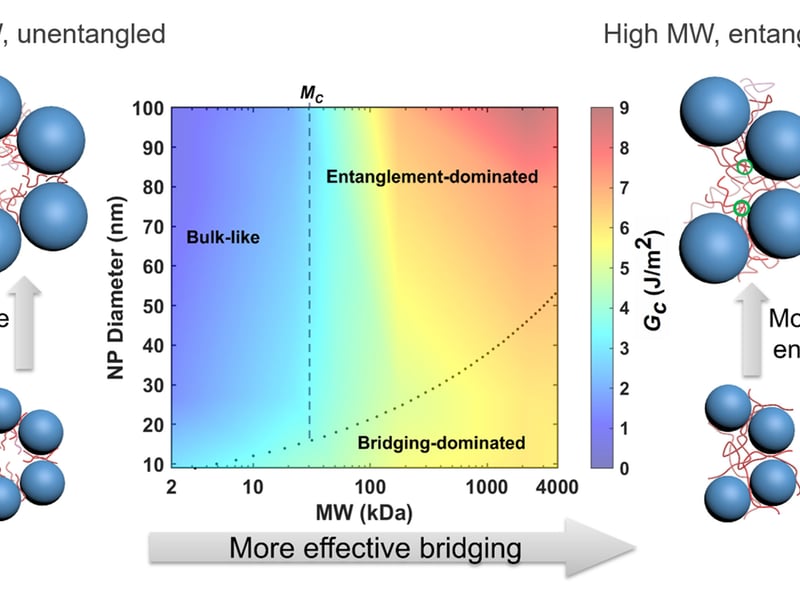
Toughening Infiltrated Nanoparticle Packings: Role of Bridging and Entanglement
Kevin Turner, Daeyeon Lee, University of Pennsylvania
Researchers at UPenn investigate the fracture behavior of disordered polymer-infiltrated nanoparticle films (PINFs). Here, the extent of polymer confinement in PINFs was tuned over three orders of magnitude NPs of varying size and polymers with varying molecular weight. The results show that brittle, low molecular weight (MW) polymers can significantly toughen NP packings, and this toughening effect becomes less pronounced with increasing NP size.
Jun 12, 2023
University of Washington Molecular Engineering Materials Center
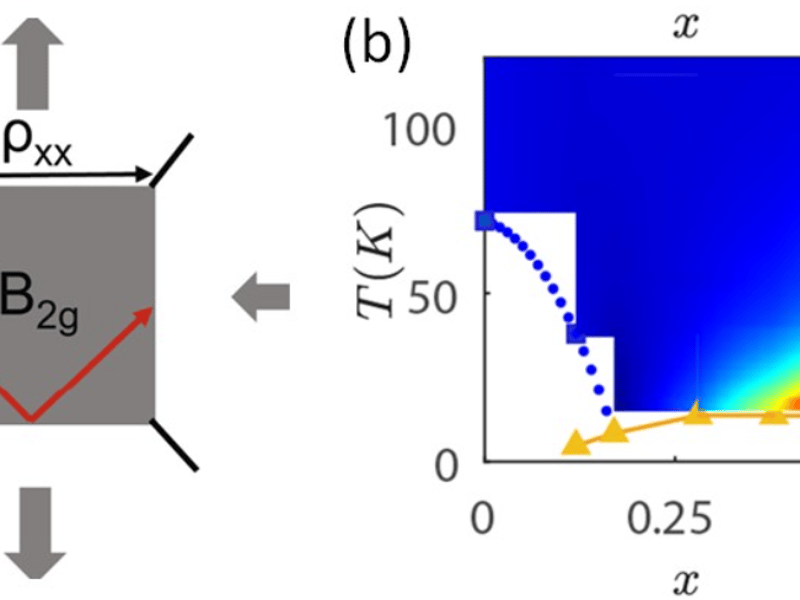
MEM-C IRG-2: Nematic Fluctuations in an Orbital Selective Superconductor Fe1+yTe1-xSex
Xiaodong Xu, Jiun-Haw Chu
Electronic nematicity is a correlated electronic state in solids that spontaneously breaks rotational symmetry. This work found that in Fe1+yTe1-xSex, one of the most strongly correlated iron-based superconductors, electronic nematicity is closely linked to magnetism, and its fluctuations may be responsible for superconducting pairing.
Showing 111 to 120 of 1394