Granular hydrogels are jammed assemblies of hydrogel microparticles (i.e., “microgels”) widely explored in biomedical applications due to promising features such as shear-thinning to permit injectability and inherent porosity for cellular interactions. One area where this is particularly promising is in 3D printing.
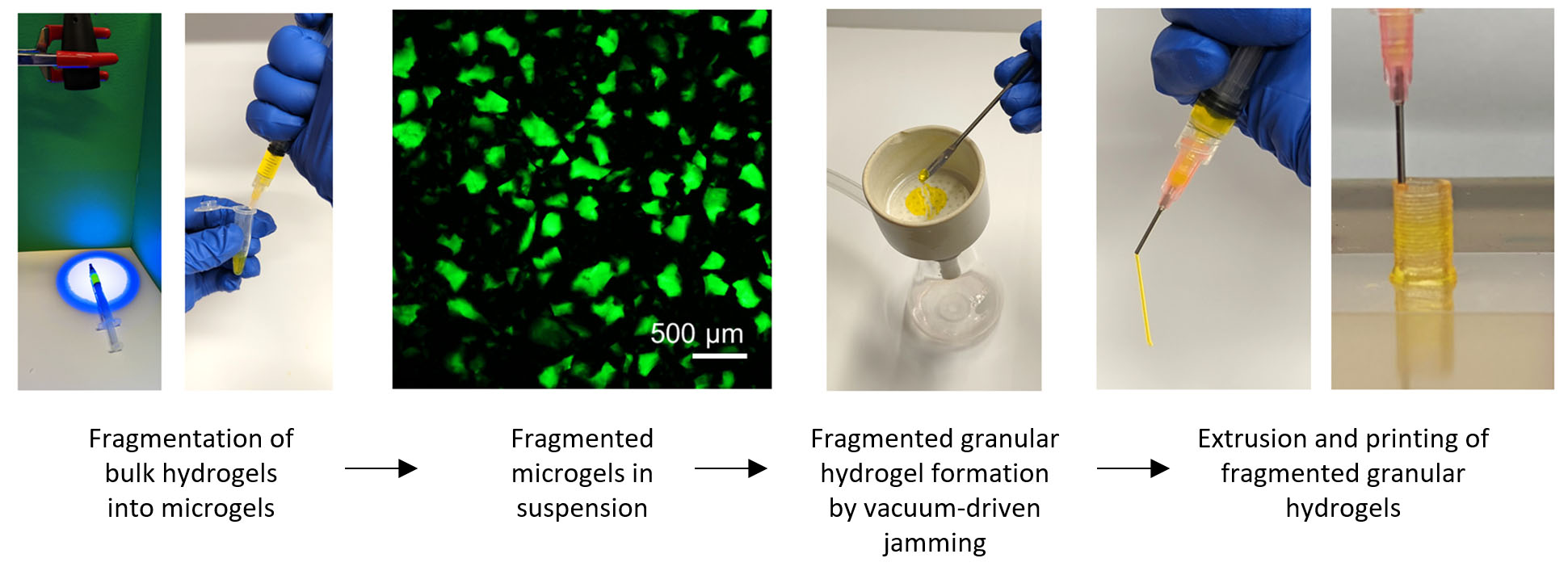
- To share this technology with others, we report a methods article on fabricating particles from photocrosslinked hydrogels, jamming the particles into extrudable solids, and then 3D printing the granular media into desired 3D structures (see figure) [1]. A great advantage to this platform technology is that hydrogel fragmentation was used to make particles, which allows for the processing of essentially any hydrogel into granular and printable formulations.
- Using this technology, the Arratia and Burdick groups collaborated to fabricate granular hydrogels by mixing microparticles with complementary chemical groups that formed dynamic covalent bonds when in contact [2]. These chemical interactions altered the flow behavior of the granular media but still permitted 3D printing. Interestingly, the printed constructs were stable due to these chemical interactions, without any post-crosslinking needed.
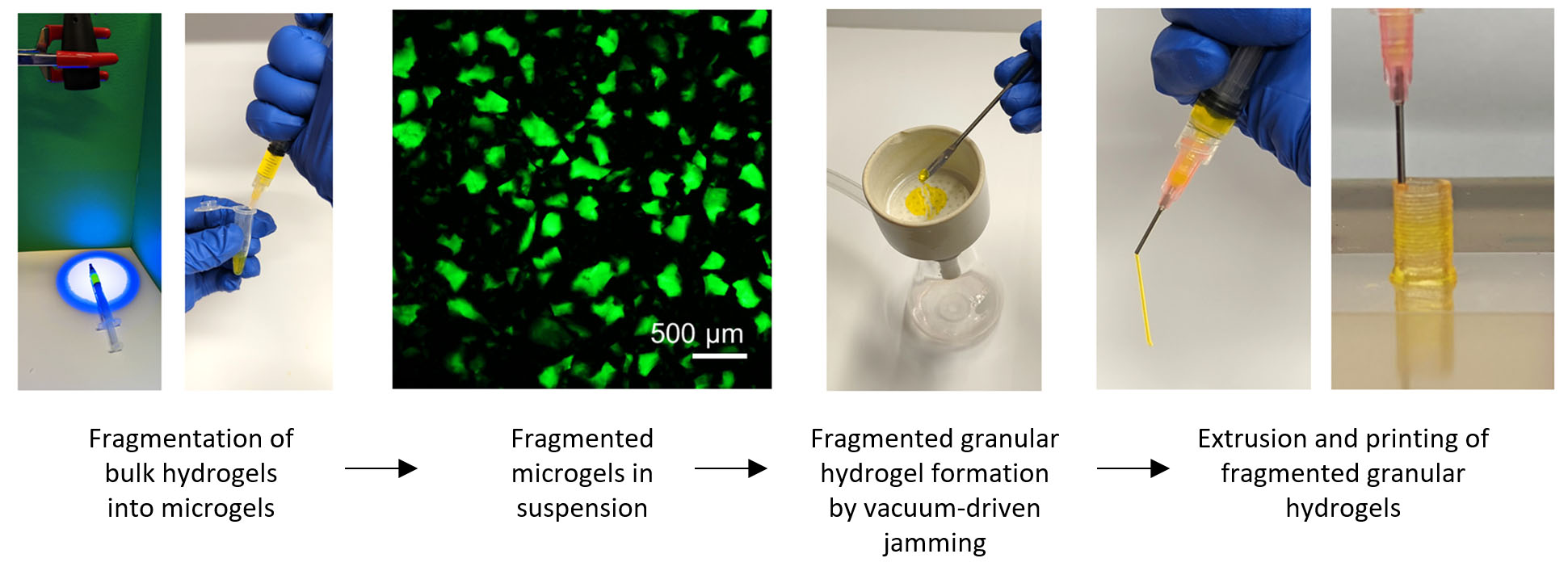
[1] V.G. Muir, M.E. Prendergast, J.A. Burdick, Methods to Fragment Bulk Hydrogels and Process into Granular Hydrogels for Biomedical Applications, Journal of Visualized Experiments, 183:e63867, 2022.
https://doi.org/10.3791/63867
[2} V.G. Muir, T.H. Qazi, S. Weintraub, B.O. Torres Maldonado, P.E. Arratia, J.A. Burdick, Sticking Together: Injectable Granular Hydrogels with Increased Functionality via Dynamic Covalent Inter-particle Crosslinking, Small, 18:2201115, 2022.
https://doi.org/10.1002/smll.202201115
 Download
Fragmenting Bulk Hydrogels and Processing into Granular Hydrogels for Biomedical Applications

UPENN Materials Research Science and Engineering Centers
The LRSM at UPENN is a center of excellence for materials research and education. It facilitates collaboration between researchers from different disciplines including physics, chemistry, engineering, and biology to advance transformative scientific projects and solve societal challenges.