Highlights

Jack Olsen (top) and Nina Zimakas (bottom)
May 24, 2017
UPENN Materials Research Science and Engineering Centers

MRSEC-Related Research by High School Students

V. Percec (Chemistry), M. Kozlowski (Chemistry), D. Durian (Physics), A.R. McGhie (LRSM EDU) & M.W. Licurse (LRSM EDU)

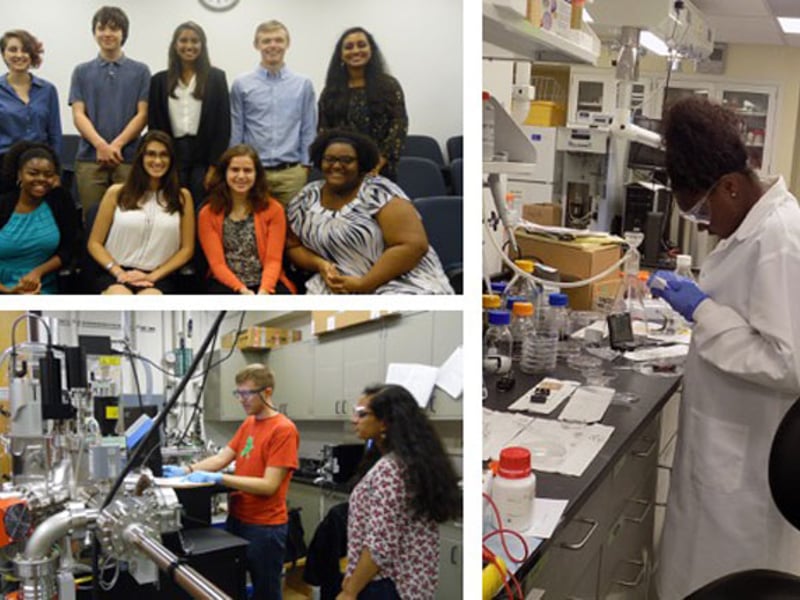
For many years now, MRSEC-affiliated faculty have accepted high school students into their labs during the summer, or on weekends during the semester, to undertake research projects that are supervised by a post-doctoral scholar or a senior graduate student. Student selection is made by the faculty member, who is responsible for the student during the program, and students first undertake safety training with EHRS. The number of students chosen for this program has been increasing: 10 in 2013, 17 in 2014, 16 in 2015, 19 in 2016.
Dewetting pattern of an organic glass thin film with a gradient of thickness. Thickness increases from left to right, resulting in a dramatically slower dewetting rate when the film is held at Tg-12 K.
May 24, 2017
UPENN Materials Research Science and Engineering Centers

Intellectual Merit: Long correlation length for glassy dynamics

Zahra Fakhraai (Chemistry), Karen Winey (Materials Science & Engineering), and Robert Riggleman (Chemical and Biomolecular Engineering) Graduate student Sarah Wolf demonstrates optical cloaking to Philadelphia high-school students at an event organized by the National Society of Black Engineers.

Measuring correlated dynamics in molecular glasses:  Properties of molecular glasses change as they are made into nanometer sized films. Fakhraai and Riggleman showed that when the film thickness is reduced below 30 nm, the solid glass films become liquid-like and flow. This results in dewetting as shown in the figure.
(a) Gold nanoparticles are linked by DNA strands and form thin films. (b) Expanding the DNA strands on one side of the film causes curling. (c) 0.2 mm long films curl and uncurl in response to added DNA commands. (d) Films can be commanded to ‘roll-over’ repeatedly.
(a) Nanocrystal oligomers of increasing size.  (b) Optical scattering spectra for 7, 13, 19 and 31 member oligomers. Inset: Electromagnetic simulation of a 13 member oligomer.
(a) Nanocrystal oligomers of increasing size. (b) Optical scattering spectra for 7, 13, 19 and 31 member oligomers. Inset: Electromagnetic simulation of a 13 member oligomer.
May 24, 2017
UPENN Materials Research Science and Engineering Centers

Probing the Evolution of Plasmonic Properties in Nanocrystal Oligomer Metamolecules

N.J. Greybush, I. Liberal, L. Malassis, J.M. Kikkawa (Physics), N. Engheta (Electrical and Systems Engineering), C.B. Murray (Chemistry), C.R. Kagan (Electrical and Systems Engineering) MRSEC student Nick Greybush demon-strates shape-memory materials  

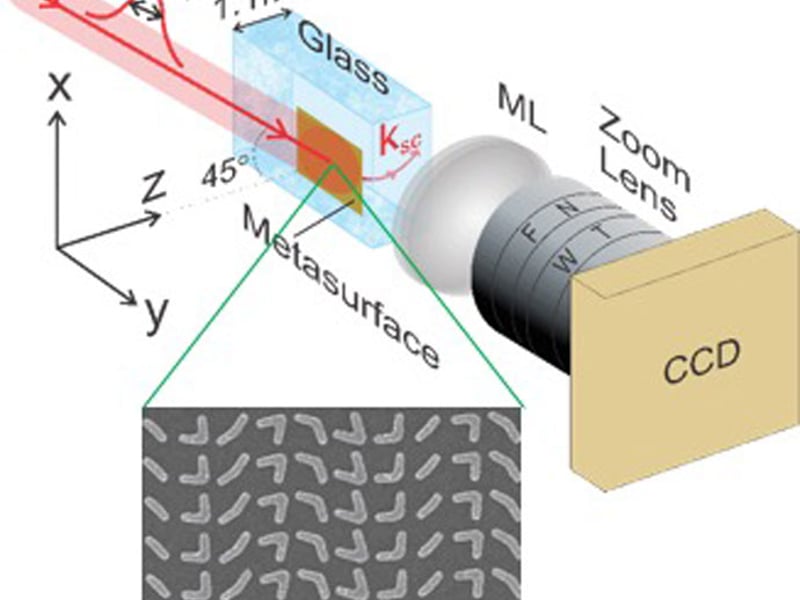
Nanocrystal “molecules” or “oligomers”: precise-number assemblies of nanocrystals  with well-defined geometrical arrangements. IRG-4 self-assembles, models, and measures these plasmonic metal nanocrystal oligomers in order to tailor their optical properties. The progression of the optical response with increasing oligomer size maps the evolution of the collective interactions within the structure. Applications may include decorating surfaces with these assemblies to form “metasurfaces” having engineerable interaction with light.  
Examples of new nanocrystal superlattices made possible by polycatenar ligands.
May 24, 2017
UPENN Materials Research Science and Engineering Centers

Polycatenar Ligands Control Nanocrystal Synthesis and Self-Assembly

Diroll, Jishkariani, Cargnello, C. Murray (Chemistry) MRSEC undergraduates Lizzy Dresselhaus and Natasha Iotov demonstrate diffraction of light to 6th-8th grade middle school girls participating in the Girls in Engineering Math and Science (GEMs) summer camp. (Kagan)

Penn-COMPASS Partnership: IRG4/Solvay/CNRS IRG-4 creates new forms of matter by assembling nanometer-sized crystals into large, ordered, complex assemblies (nanocrystal superlattices.  Murray (IRG-4) and Donnio (CNRS) have synthesized a library of molecules (polycatenars) that enable new kinds of nanocrystals and superlattices. Broader Impact Lego Optics Lab @GEMS Summer Camp The Kagan (IRG-4) group created a Lego Optics lab for Penn’s Girls in Engineering, Math and Science (GEMS) summer camp for 6th-8th grade girls.
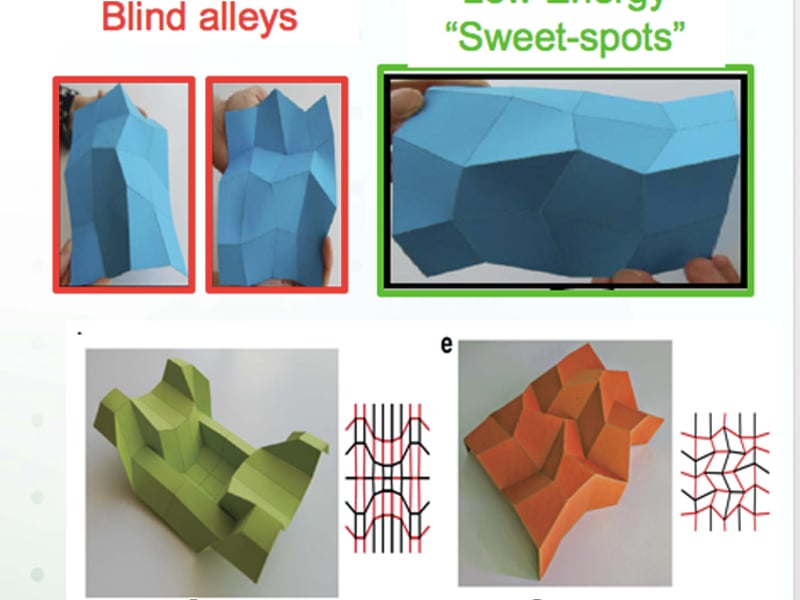
Pink arrows point from the center of a particle to the center of the blue polygonal cell in which it resides {actual size in (a); elongated by x8 in (b) for clarity}.  These arrows tend to point toward open/under-packed regions and away from close-packed regions.  This is the basis for a new and widely-applicable method to characterize structural defects in disordered materials.
Pink arrows point from the center of a particle to the center of the blue polygonal cell in which it resides {actual size in (a); elongated by x8 in (b) for clarity}. These arrows tend to point toward open/under-packed regions and away from close-packed regions. This is the basis for a new and widely-applicable method to characterize structural defects in disordered materials.
May 24, 2017
UPENN Materials Research Science and Engineering Centers

A new measure of structure in disordered materials

Douglas Durian and Andrea Liu (Physics)

Disordered packings like sand piles and metallic glasses have arrangements of their constituent particles that appear very similar to those of a liquid.  It is a very hard and long-standing problem to be able “look” at the particle arrangement and tell if the the system is rigid, and where flow will initiate if the system is deformed.
An atomic force microscope probe (top) is used to measure the shape of a nanoparticle packing before (left) and after an indentation experiment is performed. After the experiment, performed in the boxed region, only one particle (right) is seen to be perturbed.
May 24, 2017
UPENN Materials Research Science and Engineering Centers

Heterogeneity in the small-scale deformation behavior of disordered nanoparticle packings

J. A. Lefever, T. D. B. Jacobs, Q. Tam, J. L. Hor, Y.-R. Huang, D. Lee (Chemical and Biomolecular Engineering), R. W. Carpick (Mechanical Engineering and Applied Mechanics)

At the smallest length scales, disordered systems such as nanoparticle packings and glass resemble the grains of sand on a beach. Lacking a structure, it is very difficult to understand how they deform and flow. We use a technique called atomic force microscopy, in which a sharp probe “feels” and pokes at a sample to measure its shape and mechanical properties. We are able to investigate at the length scale of a single particle.
Illustration of the assembly of hybrid vesicles from artificial dendrimersome and natural E. Coli components.
May 24, 2017
UPENN Materials Research Science and Engineering Centers

Hybrid Cell-Like Vesicular Assemblies from Bacterial Membranes and Synthetic Components

D. A. Hammer (Chemical Engineering), M. L. Klein (Temple, Chemistry), M. Goulian (Physics), V. Percec (Chemistry) Summer students, undergraduates, and high school students who contributed to the project  

Hybrid cell-like vesicles were prepared by coassembling (glyco)dendrimersomes with bacterial membrane vesicles (BMVs) derived from E. Coli. These assemblies incorporated transmembrane proteins such as the small fusion protein MgrB tagged with a red fluorescent protein, and glycoconjugates such as lipopolysaccharides and glycoproteins from E. Coli. In future work, coassembly of (glyco)dendrimersomes with mammalian including human cell membranes will be a focus with the goal of developing new systems for biomedical application. Broader Impact
Optical microscopy images of example strips of bilayer films with thin parylene-C film deposited on the topographically patterned side of the PDMS. Scale bars: 300 mm. (a) Top-view of two dry bilayer strips with ridges at different angles. (Inset) Cross-sectional view of strip showing topographic pattern.  (b, c) Swollen bilayer strips made from bilayer strips in (a) after immersion in hexadecane. The strip on the left in (a) transforms into a “tube roll” (b) after swelling. The strip on the right in (a) transforms into a “helical tube” (c) after swelling. Red shading is to guide the eye about representative ridges on the strip.
Optical microscopy images of example strips of bilayer films with thin parylene-C film deposited on the topographically patterned side of the PDMS. Scale bars: 300 mm. (a) Top-view of two dry bilayer strips with ridges at different angles. (Inset) Cross-sectional view of strip showing topographic pattern. (b, c) Swollen bilayer strips made from bilayer strips in (a) after immersion in hexadecane. The strip on the left in (a) transforms into a “tube roll” (b) after swelling. The strip on the right in (a) transforms into a “helical tube” (c) after swelling. Red shading is to guide the eye about representative ridges on the strip.
*S. Ulstrup et al. “Spatially Resolved Electronic Properties of Single-Layer WS2 on Transition Metal Oxides.” ACS Nano, 10, 11 (2016).
J. Katoch et al. “Giant spin-splitting and gap renormalization driven by trions in single-layer WS2/h-BN heterostructures.” arXiv:1705.04866.
*S. Ulstrup et al. “Spatially Resolved Electronic Properties of Single-Layer WS2 on Transition Metal Oxides.” ACS Nano, 10, 11 (2016). J. Katoch et al. “Giant spin-splitting and gap renormalization driven by trions in single-layer WS2/h-BN heterostructures.” arXiv:1705.04866.