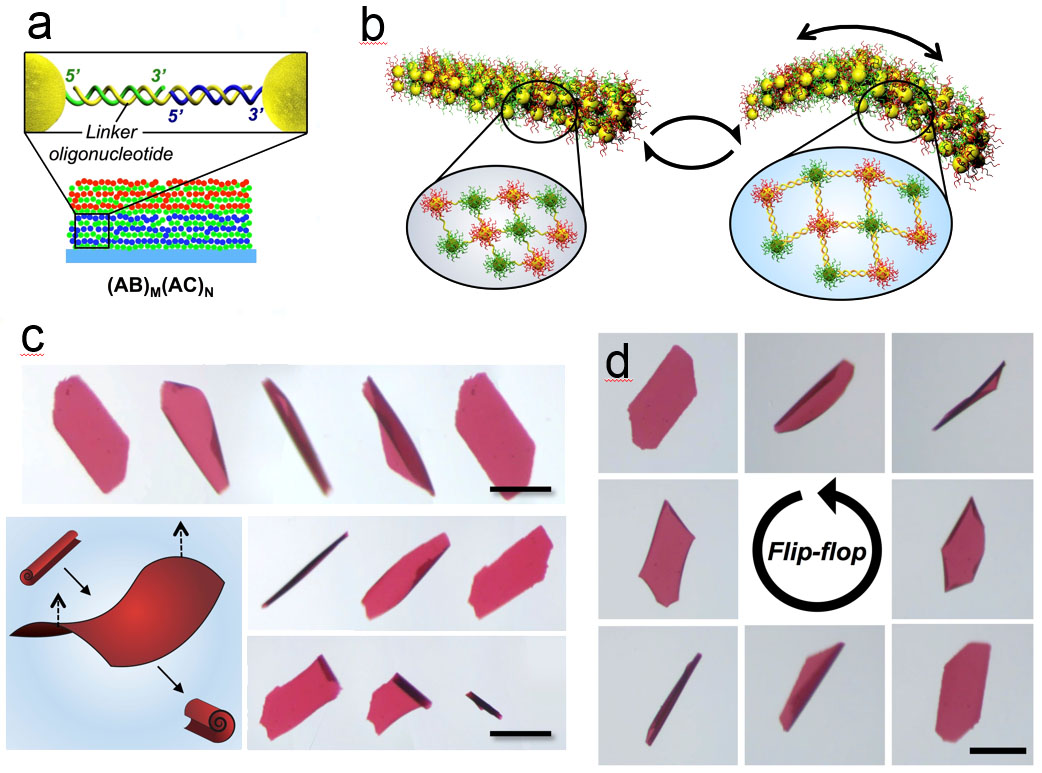
The ‘micro-origami’ approach to making microrobotic devices is to form thin films that can fold themselves into desired, dynamically transformable shapes. By combining photolithography, synthetic DNA and gold nanoparticles, NSF MRSEC engineers created thousands of identical micromachines in water that can change their shape in seconds when commanded by the addition of other DNA strands to solution.1 These machines, by curling and uncurling themselves, could roll over synchronously in a controlled manner; such that they all faced ‘up’ or ‘down’ on command. This operation required two independently controllable types of nanoscale DNA ‘muscles’, and would have been difficult or impossible with earlier micro-origami materials. In the future, these researchers hope to build more complex and capable microrobots to interface with biological systems.
Broader Impact
SEED Team Builds Simple Microrobots from DNA
D. Chenoweth, D. Lee, S.J. Park, T. Sinno, J.C. Crocker
Overall, this SEED project has supported the training of three postdoctoral scholars and three Ph.D. students in the engineering of state of the art nanomaterials formed by a combination of directed self-assembly and novel photolithography methods.
Dr. Tae Soup Shim led the experimental effort to produce simple DNA-powered microrobots, requiring interdisciplinary training in nanoparticle chemistry, DNA nanotechnology and advanced photolithography methods. He is now an Assistant Professor of Chemical Engineering, Ajou University, Korea.
Dr. Mehdi Zanjani led theoretical efforts to understand directed self-assembly in general, and the operation of the DNA-powered microrobots in particular, relying on training in multi-scale modeling, DNA nanotechnology, solid mechanics and statistical mechanics. He is now Assistant Professor of Mechanical and Manufacturing Engineering, Miami University, Ohio.
 Download

UPENN Materials Research Science and Engineering Centers
The LRSM at UPENN is a center of excellence for materials research and education. It facilitates collaboration between researchers from different disciplines including physics, chemistry, engineering, and biology to advance transformative scientific projects and solve societal challenges.