Highlights

Jun 12, 2017
Northwestern Materials Research Science and Engineering Center

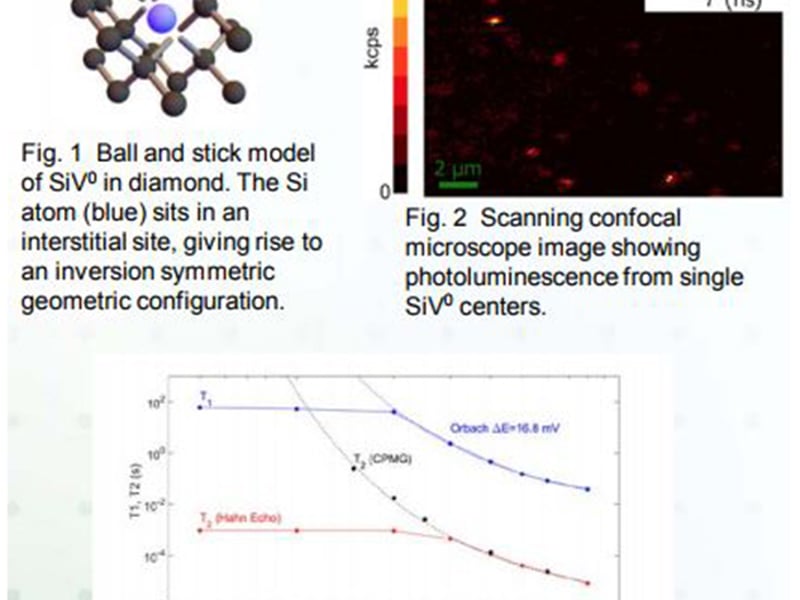
Anisotropic Polarized Emission from ReS2

Nathaniel P. Stern, Northwestern University MRSEC

Optical properties of layered materials can be controlled manipulating the discrete number of atomically-thin two-dimensional crystal layers. Unique amongst the layered transition metal dichalcogenides, ReS2 has optical emission that is linearly polarized and proportional to layer number.
Jun 12, 2017
Northwestern Materials Research Science and Engineering Center

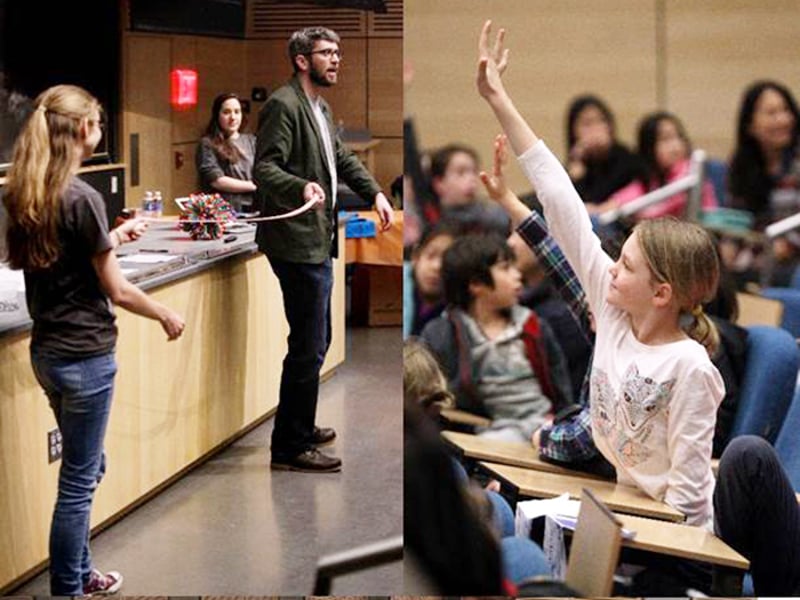
Tinkering Lab at Chicago Children's Museum

Northwestern University with the Chicago Children’s Museum in prototyping and formative evaluation of the new permanent exhibit, Tinkering Lab, which focuses on the self-guided exploration of materials for K-8 students.
Jun 12, 2017
Northwestern Materials Research Science and Engineering Center

NSF-MRSEC Booth at International Materials Research Congress

To increase awareness, promote international collaboration, and broaden participation from traditionally underrepresented groups in the NSF-MRSEC program, an NSF-MRSEC booth was featured at the XXV International Materials Research Congress in Cancun, Mexico. 
Figure: (A) Amorphous polymer networks inevitably possess topological “loop” defects whose impact on elasticity (stress vs. strain behavior of the bulk material) was unknown.
Jun 7, 2017
MIT Center for Materials Science and Engineering (2014)

Understanding Loops in Polymer Networks Results in an Improved Theory for Rubbery Materials

Jeremiah Johnson

MRSEC researchers have used newly developed loop counting methods to precisely measure the storage moduli and loop fractions of a range of rubbery gels. A new theory, called Real Elastic Network Theory (RENT) was derived that describes how loop defects affect bulk elasticity.
Top: Photograph of a cylindrical polymer fiber undergoing cold-drawing under axial stress at a speed of approximately 5 mm/s. Multiple shots taken over 1 min are overlaid to highlight the extent of fiber elongation. Bottom: Transmission optical micrograph of a multimaterial cylindrical fiber after undergoing cold-drawing, as shown in the top panel. The fiber consists of a brittle glass core (diameter ~ 10 – 20 microns) embedded in a larger diameter ductile polymer cladding ( diameter ~ 1 mm).
Jun 7, 2017
MIT Center for Materials Science and Engineering (2014)

Controlled Fragmentation of Multimaterial Fibers Via Polymer Cold-Drawing

Ayman Abouraddy and Yoel Fink

MIT MRSEC researchers have demonstrated for the first time a selective cold drawing process in multi-material fibers in which one material undergoes cold-drawing while the others do not.
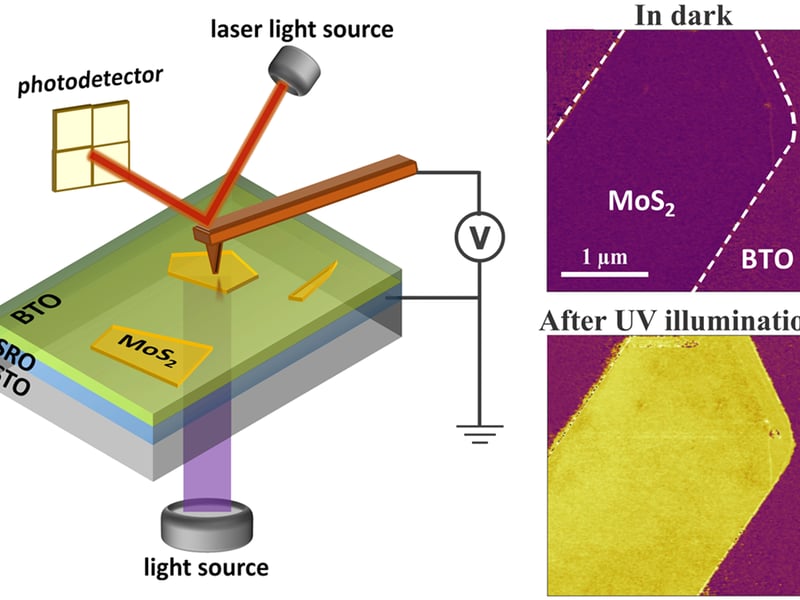
A hybrid MoS2/BaTiO3 ferroelectric tunnel junction showing (a) its nanoscale topography and (b) local polarization switching for different amplitude and duration of the applied voltage pulse.
Jun 7, 2017
UNL Materials Research Science and Engineering Center (2014)

Hybrid 2D-Ferroelectric Structures for Information Technology

Alexei Gruverman, Alexander Sinitskii, and Evgeny Tsymbal (University of Nebraska-Lincoln) and Chang-Beom Eom (University of Wisconsin-Madison)
Nebraska MRSEC researchers have implemented hybrid electronic devices comprising two-dimensional (2D) materials and ferroelectric thin films of barium titanate (BaTiO3) that exhibit polarization-controlled non-volatile modulation of the electronic properties.
Attendees converse with scientists from the University of Nebraska and across the country during a “scientist speed-dating” activity at Science Night Live! in the Lincoln Railyard.
Jun 7, 2017
UNL Materials Research Science and Engineering Center (2014)

Science Night Live! : Bringing Science to the Public

Rebecca Lai and Jocelyn Bosley (Nebraska MRSEC)

Nebraska MRSEC sponsored and organized Science Night Live!, a unique event that created opportunities for Nebraska scientists to engage the general public with science in ways that challenged stereotypes about who scientists are, how science is done, and why basic research is valuable. 
Local density of states on the surface of bismuth at magnetic field B = 12.9 T and energy E = 780 µeV. Dark concentric ellipses reflect the shape of individual electronic states. The anisotropy points in different directions for states at other energies.
Jun 5, 2017
Princeton Center for Complex Materials (2014)

Real-Space Imaging of a Nematic Quantum Liquid

B. E. Feldman1, M. T. Randeria1, A. Gyenis1, F. Wu2, H. Ji1, R. J. Cava1, A. H. MacDonald2, A. Yazdani1 1Princeton University 2University of Texas at Austin

Interactions among electrons can give rise to a variety of exotic quantum phases in solids. An intriguing example is the formation of “nematic” electronic states, whose wave functions break the rotational symmetry of the host material.
Jun 5, 2017
Princeton Center for Complex Materials (2014)

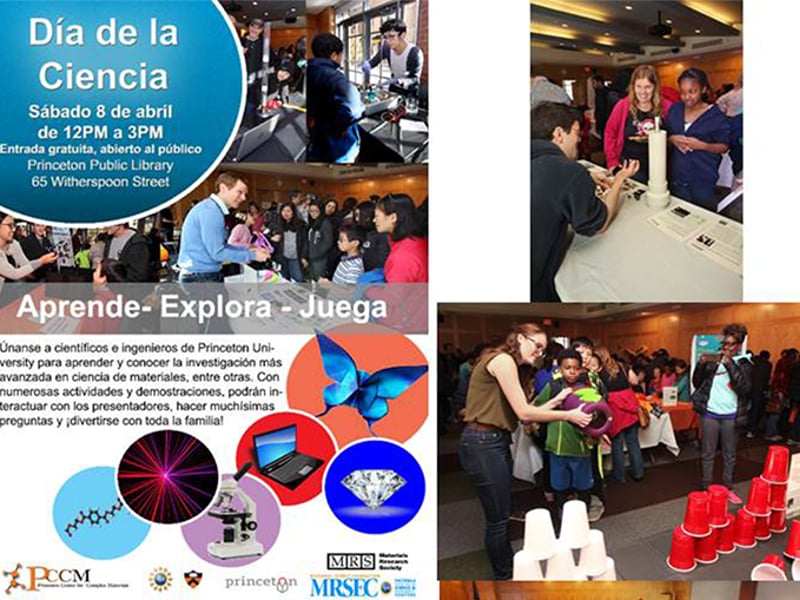
Princeton MRSEC: Dia De la Ciencia/Science Day

On April 8, 2017, PCCM held its first Día de la Ciencia at the Princeton Public Library. Forty scientists, mostly PCCM members, at 20 tables, met with over 500 members of the community.
Students from Zahra Fakhraai's group demonstrate Harry Potter science.
May 24, 2017
UPENN Materials Research Science and Engineering Centers

Philadelphia Science Festival

Zahra Fakhraai (Chemistry), Andrew R. McGhie (LRSM EDU) & Mark Licurse (LRSM EDU)

The Philadelphia Science Festival is an annual nine day celebration of science aimed to engage and excite kids of all ages. Each day there are multiple events building up to the Science Carnival, which was held on April 30th, 2016, and attracted approximately 55,000 attendees.