Highlights

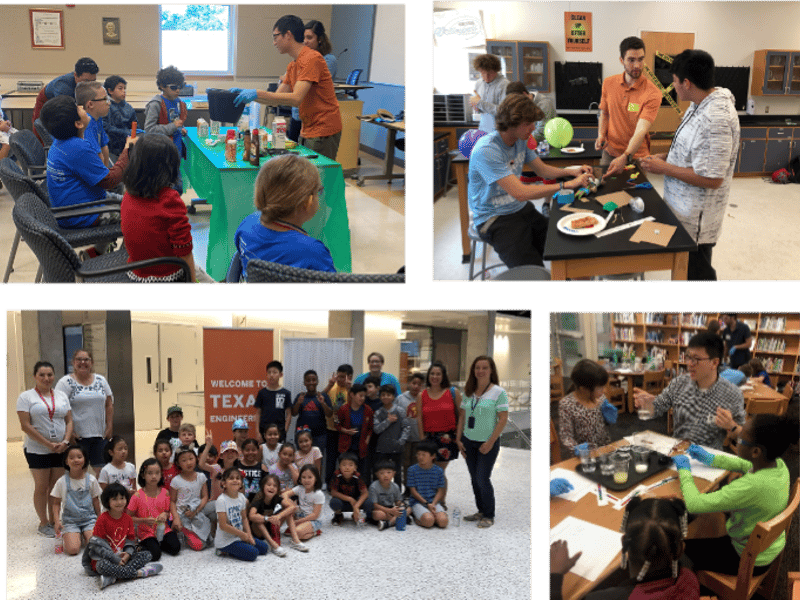
Fig. 1: a) I-MRSEC Director Mason introduces the MRSEC on the first day of the program; b) MRSEC grad student participates in “Destroy a Toy” lesson alongside several 8th graders; c) MRSEC faculty Huang leads the class in demos to teach about materials science; d) Two 8th graders record a song they wrote; e) MRSEC grad student Kang leads a VR activity during the field trip to MRL; f) a group of students and their teachers at the end of a cleanroom tour during the field trip to MRL. Image source: Photos c) – f) by B. Innes.
Apr 30, 2019
Illinois Materials Research Science and Engineering Center

Musical Magnetism: Engaging Middle School Students in Materials Science

The Illinois MRSEC developed and implemented an 8-week program called “Musical Magnetism” that engages middle school students in materials science using the popular platform of music. The program combines engaging lessons and demos, researching a topic, turning that research into lyrics, and recording a song. 35 8th graders at Franklin STEAM Academy participated.
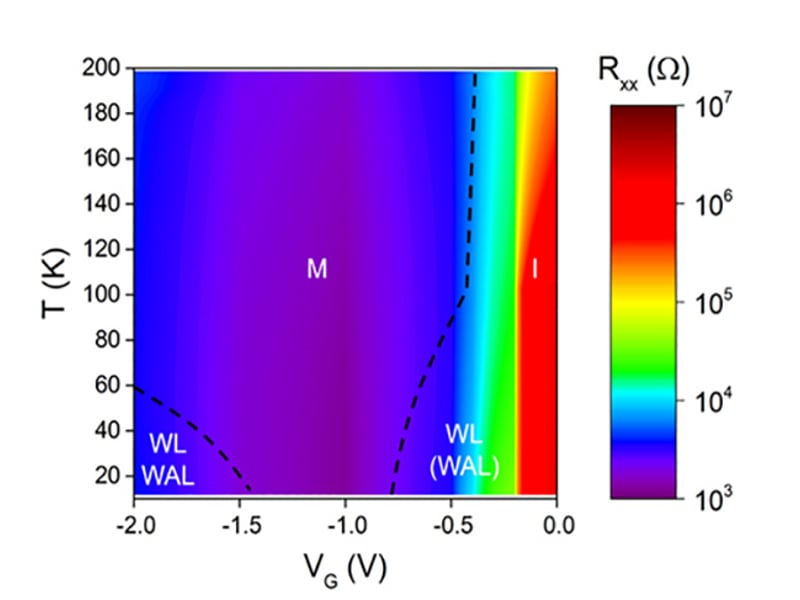
Conductance vs carrier density for different graphene devices. Black curve is flat graphene; colored curves are all on nanospheres. The nanosphere devices all show kink at expected density for strain superlattice created by nanospheres
Apr 30, 2019
Illinois Materials Research Science and Engineering Center

Strain Superlattice of Graphene on Nanospheres

N. Mason, N. Aluru, P. Huang, and M. Gilbert University of Illinois at Urbana-Champaign

Strain engineering two-dimensional (2D) materials provides a new way to tailor electronic bandstructures and access novel electronic devices. A key route to strain 2D materials, such as graphene, is via underlying nanostructured substrates.
Apr 30, 2019
Center for Dynamics and Control of Materials (2017)

CDCM K-5 Research Experience for Teachers is Forging Direct Links between Elementary Classrooms & University Labs, Mentors, & Facilities

The CDCM RET program is unique in that it is designed specifically for K-5 teachers, with the intended purpose of engaging and sustaining student interest in STEM at a young age. In summer 2018, CDCM launched its inaugural program with 4 teachers participating, spanning grades 1st – 5th.
Switching of the Dirac nodal line state from degenerate to gapped (bottom panels) of by reorientation of the antiferromagnetic order parameter (indicated by arrows on the top panels).
Apr 23, 2019
UNL Materials Research Science and Engineering Center (2014)

A Viable Material for Topological Antiferromagnetic Spintronics

Ding-Fu Shao, Gautam Gurung, and Evgeny Tsymbal (University of Nebraska-Lincoln)

Topological antiferromagnetic spintronics is an emerging field of research where topological properties of a material are coupled to the antiferromagnetic ordering. Topological properties involve non-trivial electronic states, such as Dirac nodal lines, which are protected by the structural and magnetic symmetry of the material.
Top panel: Cross-section image of the designed new hybrid heterostructure nanophotonic material. Bottom panel: The computed electric field distribution, indicating a substantial field enhancement along its metallic nanoscale regions.
Apr 23, 2019
UNL Materials Research Science and Engineering Center (2014)

New Hybrid Heterostructure Nanophotonic Materials

Christos Argyropoulos, Mathias Schubert, and Eva Schubert (University of Nebraska-Lincoln)

The inherently weak light-matter interaction at the nanoscale can be enhanced by new metal-dielectric hybrid nanomaterials. This enhancement can enrich some of the quantum and nonlinear features of light, leading to new nanophotonic applications. Nebraska MRSEC researchers have designed new hybrid heterostructure nanophotonic materials composed of plasmonic metals and dielectrics to manipulate photons at optical frequencies. They demonstrated tunable plasmonic resonant responses with narrowband spectra that can be used for nanosensing applications.
Changes in the diffraction pattern of gold 10 picoseconds after photoexcitation (1 picosecond = 1 trillionth of a second). The intensity of the diffraction peaks decrease (dark blue regions) due to the heating induced disorder, and the intensity around the peaks increases (yellow regions).
Apr 23, 2019
UNL Materials Research Science and Engineering Center (2014)

Capturing Structural Dynamics of Materials with Ultrafast Electron Diffraction

Martin Centurion (University of Nebraska-Lincoln)

“Phase transition” is a term which is commonly used to describe transformations between solid, liquid, and gaseous states of matter. However, even in solids, phase transitions may occur between different structural phases, resulting in a discontinuous change of certain material properties, such as electrical conductivity and heat capacity, which can be used in technological applications. Many phase transitions in solids involve ultrafast motion in the atomic positions towards a new equilibrium configuration.
University of Puerto Rico, Rio Piedras undergraduate Shyline Santana gives an invited talk at the 2018 WoPhyS conference.
Apr 23, 2019
UNL Materials Research Science and Engineering Center (2014)

Tenth Annual Conference for Undergraduate Women in Physical Sciences (WoPhyS)

Rebecca Lai and Jocelyn Bosley (University of Nebraska-Lincoln)

At Nebraska MRSEC’s Conference for Undergraduate Women in Physical Sciences (WoPhyS), participants present research accomplishments, attend keynote talks, participate in graduate school preparation workshops, and tour UNL facilities and labs.
Figure 1. The conductance (top) of a device containing trilayer CrI3 overlaying monolayer WTe2 encapsulated in hBN, shows steps and hysteresis as a function of perpendicular magnetic field. The steps occur when the magnetization of the CrI3 rearranges, as detected by circular dichroism (bottom) which measures the total magnetization.
We are developing Yb3+-doped CsPbX3 nanocrystals that can convert the energy from absorption of single blue photons into the energy of emission of pairs of near-infrared photons – quantum cutting. We are also developing a new and unique technology that partners such quantum-cutting materials with conventional luminescent solar concentrators (LSCs) to massively reduce thermalization losses in LSCs. Our so-called monolithic bilayer LSC is a unique technology that does not require complex wiring or current matching. Using a combination of experimental data and models, we predict that monolithic bilayer LSCs will improve the performance of best-in-class NC LSCs by at least 19%.
Apr 8, 2019
Genetically Engineered Materials Science and Engineering Center (2005)

MEM-C IRG-1: Quantum-Cutting Nanocrystals in High-Efficiency Monolithic Bilayer Luminescent Solar Concentrators

Milstein, T. J.; Kroupa, D. M.; Gamelin, D. R., Nano Lett. 2018, 18, 3792. Cohen, T. A.; Milstein, T. J.; Kroupa, D. M.; MacKenzie, J. D.; Luscombe, C.; Gamelin, D. R., J. Mater. Chem. A 2019 DOI: 10.1039/C9TA01261C.

Nanocrystal (NC) luminescent solar concentrators (LSCs) represent a promising clean-energy technology capable of concentrating direct and diffuse light to reduce the area of photovoltaic (PV) cells – which are energetically costly to manufacture – required to meet energy demands.
Visitors of all ages enjoy polymer activities led by UCSB MRSEC graduate students and faculty at the MOXI, Santa Barbara.
Apr 4, 2019
Materials Research Science and Engineering Center at UCSB

UCSB MRSEC Partners with the Wolf Museum of Exploration and Innovation

The UCSB MRSEC is excited to announce a new partnership with Santa Barbara’s Wolf Museum of Exploration and Innovation (MOXI). Open in 2017, the MOXI provides a space for hands-on exploration in science and creativity for children and families. In August 2018 the UCSB MRSEC provided a week of polymer activities in MOXI’s Innovation Workshop that attracted approximately 700 visitors.