Highlights

May 20, 2019
Center for Precision Assembled Quantum Materials (PAQM)

2D Superconductivity

Cory Dean, Center for Precision Assembly of Superstratic and Superatomic Solids

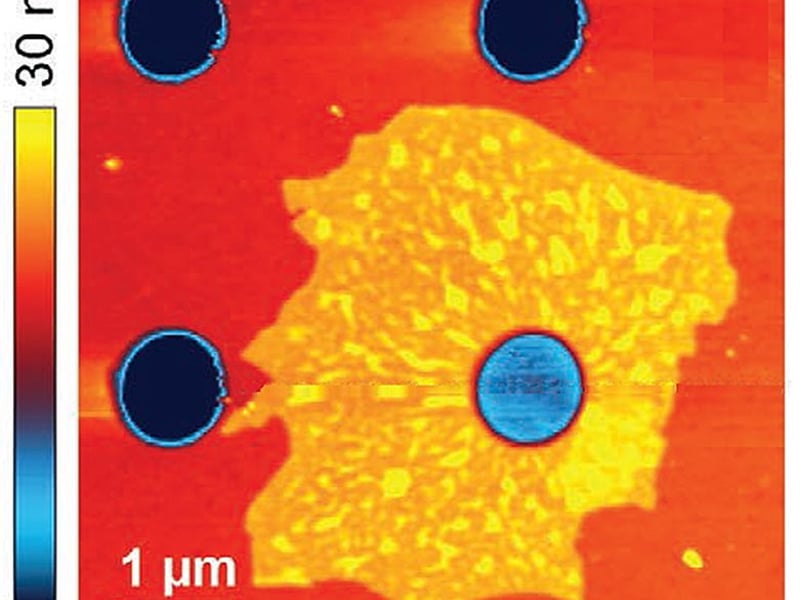
Two-dimensional materials offer a unique opportunity to explore superconductivity in the two-dimensional (2D) limit with low disorder.  IRG1 creates heterostructures of high-quality monolayers of superconductors encapsulated within insulating boron nitride, which provides protection from external disorder and oxidation.
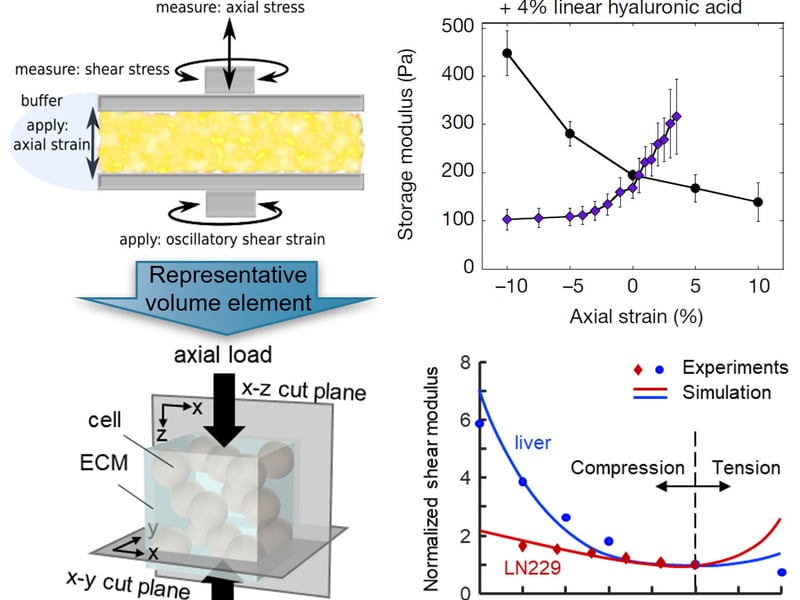
A base hydrogel, combined with collagen, allows for a mechanical response similar to natural cartilage. A small addition of collagen significantly enhances the mechanical properties.
May 17, 2019
Cornell Center for Materials Research (2017)

Biomimetic design of 3D-printed cartilege

Cornell researchers employ advanced 3D printing technologies, along with bio-inspired design principles and multiscale predictive modeling to optimize the chemo-mechanical properties of bioprinted artificial cartilage.
The degree of tilt of the RuO6 octahedra in the SrRuO3 film, as determined by ultra-high resolution electron microscopy, determines the magnitude of the spin Hall effect in the material.
May 17, 2019
Cornell Center for Materials Research (2017)

Maximizing the spin Hall effect by tuning crystal structure

Y. Ou, Z. Wang, C. S. Chang, H. Nair, H. Paik, N. Reynolds, D. C. Ralph, D. A. Muller, D. G. Schlom, and R. A. Buhrman (Cornell University)

Cornell scientists have found that thin films of SrRuO3, when optimally produced, have an exceptionally high spin Hall ratio. This is directly correlated with the degree that octahedral RuO6 subunits in the crystal are tilted away from a flat in-plane orientation.
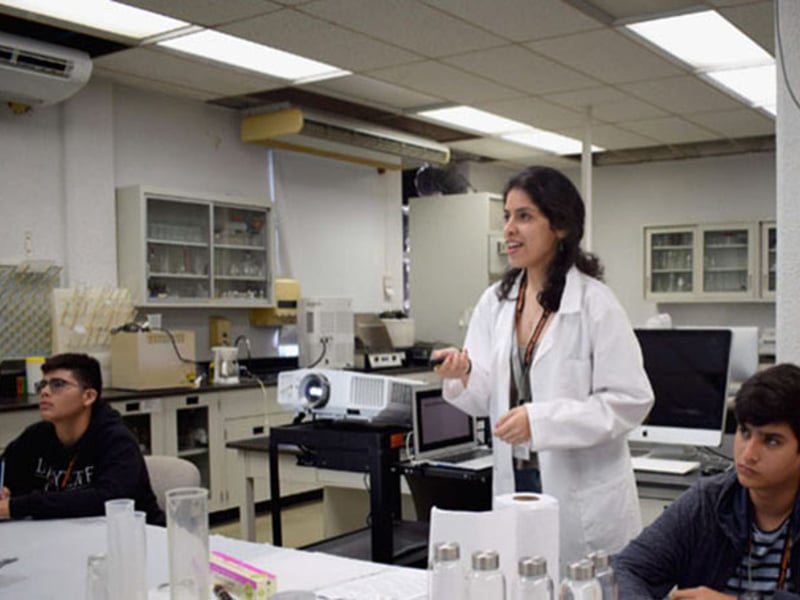
Graduate students (top) Omar Padilla Velez teaching high school students at Escuela Cedin about batteries with electrochemistry lab  and (bottom) Berit Goodge presenting how to build a microscope using pvc pipes and lenses at Sebastian Bilingual High School in Puerto Rico.
Graduate students (top) Omar Padilla Velez teaching high school students at Escuela Cedin about batteries with electrochemistry lab and (bottom) Berit Goodge presenting how to build a microscope using pvc pipes and lenses at Sebastian Bilingual High School in Puerto Rico.
May 17, 2019
Cornell Center for Materials Research (2017)

Teaching and Inspiring Students in Puerto Rico

Graduate student Omar Padilla Velez, an NSF Graduate Research Fellow, gathered a team of Cornell scientists working in fields from Chemistry to Physics, to bring science to students from middle to undergraduate schools in Puerto Rico.
(a) Schematic of layered structure, where a gate voltage Vg splits water and injects protons (H+) toward the magnetic cobalt (Co) layer.  The magnetization (M) switches between in-plane and out-of-plane depending on the presence or absence of protons, as seen in the hysteresis loops of (b).  The magnetization orientation can be switched reversibly as the voltage is toggled (c), for thousands of cycles with no device degradation.  X-ray absorption spectroscopy was used to verify the presence of hydrogen in a Pd sensing layer (d).
(a) Schematic of layered structure, where a gate voltage Vg splits water and injects protons (H+) toward the magnetic cobalt (Co) layer. The magnetization (M) switches between in-plane and out-of-plane depending on the presence or absence of protons, as seen in the hysteresis loops of (b). The magnetization orientation can be switched reversibly as the voltage is toggled (c), for thousands of cycles with no device degradation. X-ray absorption spectroscopy was used to verify the presence of hydrogen in a Pd sensing layer (d).
(a) Schematic of the light-emitting fiber. Wires (orange) are connected to the LEDs (purple). Photograph of light-emitting fibers containing (b) InGaN blue-colour LEDs, (c) InGaN green LEDs, (d) AlGaAsP red LEDs.  (e) Schematic of the photodetecting fiber structure, where an individual photodiode (orange) detects external light (red arrow). (f) Current–voltage curve of photodetecting fiber, showing clear rectifying behaviour. Black curve: in darkness. Red curve: under illumination. (g) Bandwidth of the photodetecting fibre. The 3 dB bandwidth achieved is around 3 MHz. a.u., arbitrary units.
Selection of 3D printed artifacts clockwise from top: flasks & pottery; 3D printer lab; ivory plaque; Buddha heads Image source: Justin Jureller, Jeff Gustafson
May 10, 2019
UChicago Materials Research Center (2014)

Oriental Institute Mobile Museum Project

At the University of Chicago MRSEC, we pursued new outreach directions with campus museums including the Smart Museum of Art and the Oriental Institute.
Image sequence of actin droplets (2.6 M, red) severing from a motor cluster (12.3 nM myosin, active, white).
from J. S. Jeong, H. Song, J. T. Held, K. A. Mkhoyan, Phys. Rev. Lett. 122 (2019).
May 8, 2019
UMN Materials Research Science and Engineering Center (2014)

Subatomic Channeling and Spiraling Electron Beams in Crystals

K. Andre Mkhoyan, University of Minnesota

Using analytical aberration-corrected scanning transmission electron microscopy (STEM), we studied the behavior of the electron probe propagating in SrTiO3 at sub-atomic length scales.